
Nittaku
Latika.
Five all-wood plies grown out of the Kasumi Basic: honest control, a communicative feel and value for money that is hard to match. Speed enough, without any claim to being the fastest.
Gallery.
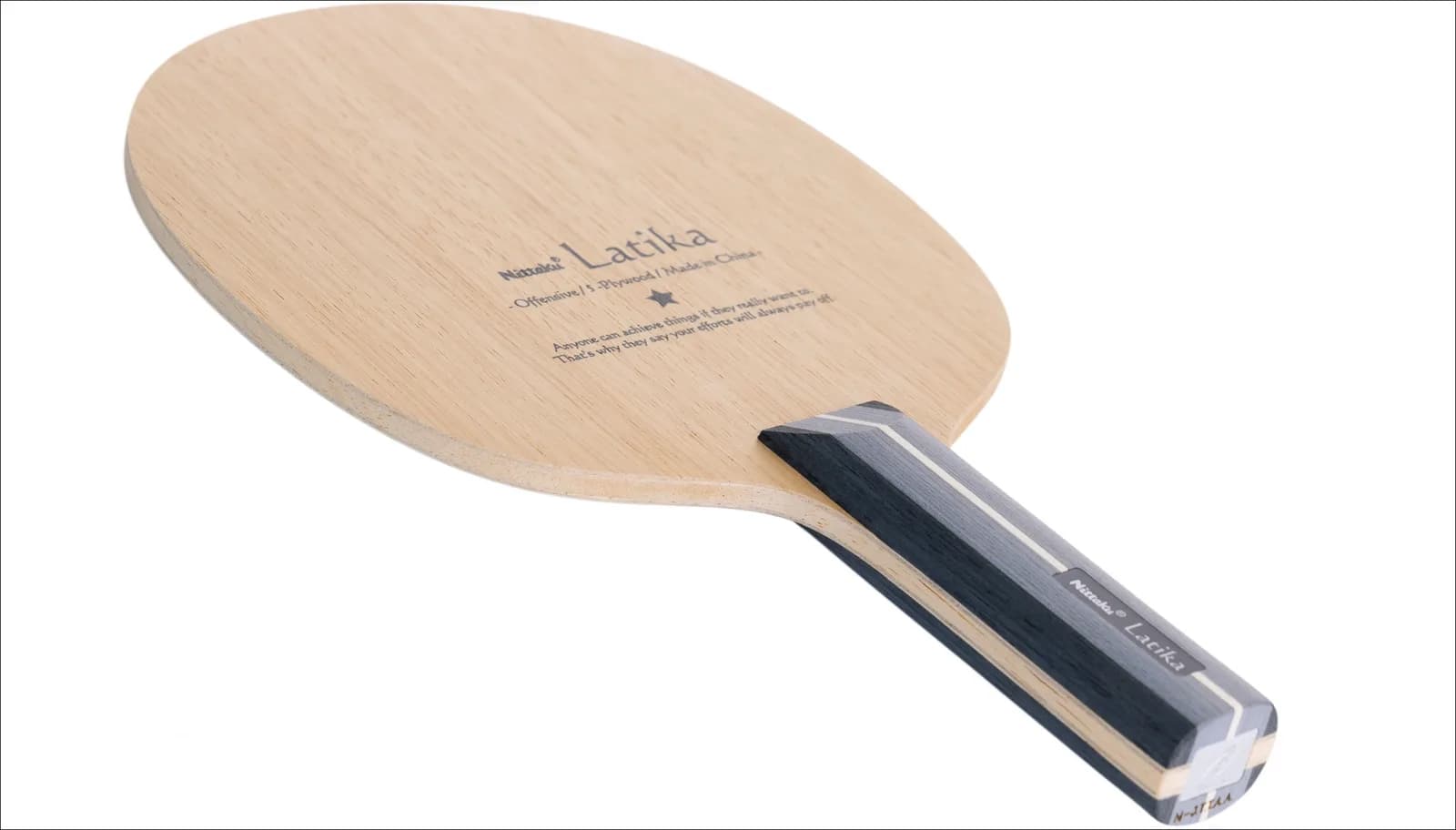
2 imagesNittaku's blade catalogue holds some very well-known names — Acoustic, Violin, Septear — and others that go largely unnoticed despite performing remarkably well. The Latika belongs to that second group: a five-ply offensive blade, no fibres, developed out of the Kasumi Basic that Japan's Kasumi Ishikawa made popular. It is neither a flashy blade nor a heavily advertised one, yet it has built a solid reputation among players looking for control, feel and a modest price.
This review looks at what it actually offers on the table, which player it is meant for and how it stands against its direct alternatives.
Where the blade comes from
The Latika began as an evolution of the Kasumi Basic, the blade Kasumi Ishikawa took to the quarter-finals of the 2009 World Championship in Yokohama. Nittaku presents it as a versatile blade, aimed at the player who wants a reliable base of control on which to build an offensive game without alarms. The marketing story insists on elegance and balance; what can be verified, as always, is what is felt on the table.
Structurally this is an offensive blade of five all-wood plies, with no synthetic layers and limba on the outer faces. It is a classic, thoroughly tested formula: limba gives a soft, communicative feel on contact and a surface that grips the ball well on spin strokes, while the five-ply construction aims at a balanced compromise between speed and control. Nothing here tries to break the mould; it is a well-resolved reading of a very familiar concept.
The all-wood Latika is worth separating from its variants. Nittaku also offers the Latika Carbon — fibre added for speed and stiffness — and the Latika 7, of seven plies, alongside the Latika Light already mentioned, a smaller and lighter version of around 78 grams aimed at junior players and at those who prefer a manageable bat with less inertia. They are blades of a different philosophy; this review is about the five-ply Latika, the one that defines the character of the range.
The specifications that matter in play
Beyond the data sheet, the numbers are worth translating into what counts once play begins.
A thickness close to 5.8 millimetres puts it in the usual range for five-ply offensive blades. It is neither thin nor excessively thick, which contributes to its balanced behaviour and to a wide, predictable contact zone.
The weight sits around 88 grams in the standard version. That is a medium-high figure, and it brings stability and a sense of solidity at impact, although, being natural wood, each unit varies a little. Anyone after a more agile bat with less inertia has the Latika Light as an alternative built expressly for that.
As for stiffness, the Latika is a flexible blade, with one important qualification: it is somewhat harder and more direct than other pure-control blades from the same brand. That slightly higher hardness suits the current plastic ball particularly well — the ball tends to need a touch more firmness to avoid losing speed — without giving up the flex that makes control and the start of the spin easier.
Behaviour in play
This is where the Latika earns its reputation. Its greatest virtue is not a specific figure but the combination of high control and stability.
For an offensive player, speed is rarely the problem; the hard part is mastering it. The Latika solves that equation well: it is a fast blade for an all-wood five-ply, yet it never feels out of hand. The ball stays an instant longer on the blade — the dwell so prized in the spin game — and that turns into a very pleasant sense of grip and predictability.
The topspin at short and mid distance is where it expresses itself best. The blade goes with the stroke, opens comfortably against backspin and offers a generous margin for error. Spin is built gradually and under control, which makes it especially suitable for the player who is refining their topspin technique and needs a base that gives clear feedback.
Blocking and countering close to the table benefit from that same forgiving nature and from the stability its weight provides. The ball goes where it is aimed, and the constant feedback helps in adjusting the angle with confidence. It is a tolerant blade, one that forgives imperfect strokes and, for exactly that reason, helps a player improve.
Its limits deserve an honest word, though. The Latika is not a blade of explosive punch: getting terminal speed out of it takes good technique and the player's own acceleration, because the blade does not hand that power over. In the same way, play away from the table is not its natural ground. It feels secure and fast at short and mid distance, but it loses some drive as the player steps back and asks more of the arm. Very physical players who base their game on powerful topspins from distance will find more brutal blades elsewhere.
Pros
- Very high control without giving up speed enough for most players
- Soft, communicative feel, with good transmission of the ball at impact
- Great stability in the block and in play close to the table
- A touch of extra hardness that suits the plastic ball while keeping the flex
- Outstanding value for money: high-end behaviour at a modest cost
- Very tolerant of different types of rubber, which makes the covering easy to choose
Cons
- Terminal punch is not its strong point; maximum speed demands good technique
- It loses effectiveness in play away from the table
- The advanced, very physical player may miss more speed and more reach
- Less "personality" and prestige than other blades from the brand, intangible but a factor at the point of purchase
Who it is for
The Nittaku Latika fits particularly well with the improving offensive player who values control and stability over raw power, and who develops their game at short and mid distance. It is a sound choice for anyone who wants a fast but forgiving blade on which to consolidate the topspin and the placement game without feeling overwhelmed.
It is also a very sensible option for the player looking for high-end behaviour on a tight budget: the Latika delivers much of what more expensive blades give, at a noticeably lower price. The pure hitter, on the other hand — very physical, playing from distance — will probably find more brutal blades with more reach.
Pairing it with rubbers
On rubbers, the Latika gets on well with medium-hardness tensor coverings, which make use of its control without taking away its speed. Its tolerance of different types of rubber is one of its strengths: it accepts anything from control coverings to faster rubbers without becoming awkward. Paired with very hard rubbers it gains punch, but at the cost of some of the honesty that characterises it.
Two set-ups that work
- A medium-hardness tensor on both faces — the configuration that makes the most of its nature: control and feel, while keeping speed enough to attack with confidence.Offensive control
- A hard, fast tensor on the forehand — for anyone after more punch, even at the cost of some of the honesty and forgiveness that define the blade.More punch
How it compares with the alternatives
The most natural comparison is with Nittaku's own Acoustic, the brand's flagship in the control segment. The two share a philosophy — five all-wood plies, outer limba, priority on feel and control — but there are differences. The Acoustic is somewhat faster and offers a feel that is perhaps more refined and more communicative, with the "acoustic response" that gives it its name. The Latika, for its part, is a touch firmer and more direct, which makes it rather more comfortable with the plastic ball, and above all it costs considerably less. Anyone chasing maximum feel with no regard for price may lean towards the Acoustic; anyone who puts value for money first will find in the Latika a companion almost as capable for less money.
Outside the brand, its classic rival is the Butterfly Petr Korbel, another benchmark among offensive five-ply blades. The Korbel is usually perceived as somewhat stiffer and more direct, with a drier response and a more immediate punch. The Latika offers a softer feel and a more gradual build-up of spin. The choice depends, again, on whether immediate punch or feel and control comes first.
Within the range itself, the Latika Carbon adds fibre to raise speed and stiffness: it gains punch and play away from the table, but sacrifices much of the feel and forgiveness that define the all-wood Latika. They are not substitutes but answers to different needs. If what is wanted is precisely that classic sensation of control, the carbon version is not the way there.
Frequently asked questions
Is the Nittaku Latika a suitable blade for beginners?
It is an excellent option for the improving player with some technical grounding, and even for the beginner who already strikes the ball cleanly, thanks to its high control and its tolerance. An absolute newcomer still settling their stroke may benefit first from a slower, pure-control blade, but the Latika is one of the most accessible offensive blades for making that step.
What is the difference between the Latika and the Latika Light?
The Light is a smaller, lighter version (around 78 grams against the 88 of the standard), meant for junior players or for those who prefer a manageable bat with less inertia. The standard version brings more stability and solidity at impact.
Which rubbers go best with the Latika?
Medium-hardness tensor coverings make good use of its balance between control and speed. Its tolerance of different types of rubber makes the choice easier: it accepts anything from control rubbers to faster coverings. Very hard rubbers increase the punch but reduce some of the feel that sets it apart.
Is it worth it against the Nittaku Acoustic?
That depends on budget and priorities. The Acoustic is somewhat faster and offers a feel that is perhaps more refined, but it costs more. The Latika offers very similar control and stability, with a touch of extra firmness for the plastic ball, at a considerably lower price. As value for money, the Latika is hard to beat.
Rating by dimension
It performs above its quiet reputation.
The Nittaku Latika is one of those blades that deliver more than their quiet reputation suggests. What it offers — very high control, a pleasant feel, good stability and a touch of firmness that suits the current ball — answers a timeless kind of game: the offensive player who builds the point with spin and placement rather than force. It is not the fastest or the most brutal blade, and it makes no such claim. What really sets it apart is its value for money: it delivers much of what more expensive and more prestigious blades give, at a noticeably lower cost. For the improving player looking for a reliable base to grow on, or for anyone who wants high-end behaviour without emptying their wallet, the Latika is a choice that is hard to regret.