
Nittaku
Acoustic.
Five all-wood plies inspired by instrument-making. No carbon and no grand promises: speed enough, outstanding control and a feel that still wins over players who play for the sensation of the ball.
Gallery.
2 imagesThe Nittaku Acoustic is one of those blades that needs no marketing campaign to stay in players' conversations year after year. No carbon fibre, no grand promises, just a classic five-ply all-wood construction — and with it something rare: it has become a reference point among players who value the sensation of the ball in the hand above raw power.
This review looks at what it actually delivers on the table, which player it is built for, and where it stands against its direct alternatives.
Where the product comes from
Nittaku sells the Acoustic on an unusual argument: inspiration drawn from the making of stringed instruments. The brand claims to use a wood-lamination technique related to lutherie, hence the name "Acoustic" and the idea of a blade that "sounds" and transmits. That story deserves the appropriate distance. It is, above all, an evocative piece of marketing; what can be verified is what the blade does on the table, and there the Acoustic really does offer a feel and an acoustic response that are unusually communicative.
Structurally this is an offensive five-ply all-wood blade, with no synthetic layers. The combination of limba on the outer plies and a light kiri (paulownia) core is a classic all-wood formula: reasonable speed, good vibration, and a wide, predictable contact area. The construction is not revolutionary, then, but a particularly careful reading of a very well-proven concept.
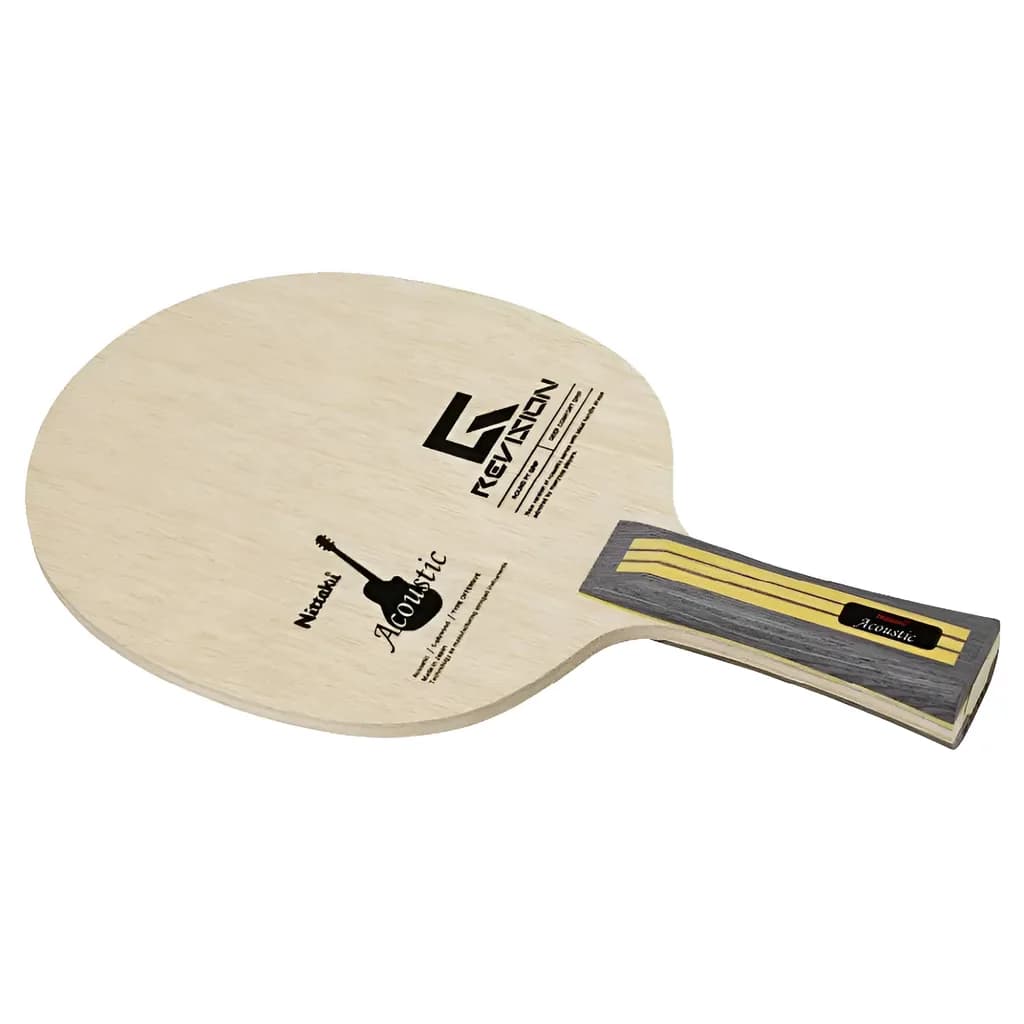
The versions need a word of clarification. Nittaku currently lists the Acoustic as the Acoustic G-Revision, which keeps exactly the same all-wood construction — five plies, ≈ 5.7 mm, ≈ 88 g — and changes only the handle shape, now slightly more oval and firmer than on the "classic" Acoustic. Apart from that grip detail, everything said in this review applies to both: it is the same blade. The photographs illustrating it are of the G-Revision.
The specifications that matter in play
Beyond the spec sheet, the numbers are worth translating into what counts once the game starts.
A thickness of close to 5.7 millimetres puts it in the usual range for five-ply offensive blades. It is neither especially thin nor thick, which is part of why it behaves so evenly.
The weight deserves particular attention. Units usually fall between 85 and 88 grams, though notably lighter examples around 82 grams are not rare. That variability, natural in all-wood blades, has real consequences: a light Acoustic is very manoeuvrable and comfortable in blocking and fast play close to the table, while a heavier unit adds a little more stability and punch. Where the shop allows a choice of weight, it is worth picking one to suit the player's own style rather than leaving it to chance.
As for the outer limba plies, they account for much of the blade's character: a soft, communicative feel on touch, with a surface that "grips" the ball well on spin strokes. It is one of the reasons the Acoustic transmits what happens at impact so clearly.
Behaviour in play
This is where the Acoustic earns its reputation. Its greatest virtue is not any single figure but the relationship between control and speed.
For an attacking player, speed is rarely the problem; mastering it is. The Acoustic solves that equation well: it is clearly fast for a five-ply blade — faster than most expect on first picking it up — yet it never feels out of hand. The ball stays a moment longer on the blade, the dwell so prized in spin play, and that translates into a very agreeable sense of grip and predictability.
In the topspin, especially at close and mid distance, is where it shines. The blade goes with the stroke, makes opening against backspin comfortable, and leaves a generous margin for error. Anyone coming from a stiff or carbon blade will notice the difference straight away: more feel here, more contact time, and a more gradual, more controllable build-up of spin.
Blocking and countering close to the table benefit from that same docility. The ball goes where it is aimed, and the constant feedback helps the player adjust the angle with confidence. It is a forgiving blade and, for exactly that reason, one that helps a player improve.
Its limits deserve equal honesty, though. The smash is probably its weakest department: this is not a blade of explosive punch, and getting maximum power out of it takes good technique and the player's own acceleration, because the blade does not hand over that terminal speed. In the same way, play away from the table is not its natural territory. The Acoustic feels secure and fast at short and mid distance, but step back and it loses some drive and asks more of the arm. Very physical players whose game is built on powerful topspins from distance will find better-suited blades.
Pros
- Excellent control without giving up speed that is more than enough for most players
- Outstanding feel and feedback: it transmits the ball at impact very clearly
- Great capacity to generate and control spin, especially in the topspin
- Predictable, forgiving behaviour, ideal for consolidating technique
- High build quality, with careful finishing and comfortable handles
Cons
- The smash is not its strong point; maximum punch takes good technique
- It loses effectiveness in play away from the table
- The weight variation between units means buying with care
- For the top-level player after pure speed, it may fall a little short
Who it is for
The Nittaku Acoustic suits the modern attacking player who puts spin and placement ahead of raw power and who builds the game at short and mid distance particularly well. It is a very sound choice for the improving player who wants a fast but controllable blade on which to refine the topspin without feeling overwhelmed.
It is also a natural option for the experienced player who, after a spell with carbon blades, misses the feel and the vibration of all-wood and wants to "sense" the ball again. The pure hitter, by contrast — very physical, playing at distance — will probably find blades with more bite and more range.
Pairing it with rubbers
On rubbers, the Acoustic goes well with medium-hardness tensor sheets, which make use of its control without taking away its speed. Paired with very hard, fast rubbers it can gain punch, but at the cost of part of the poise that defines it.
Two set-ups that work
- Medium-hardness tensor on both sides — the set-up that best suits its nature: control and feel, with speed enough to attack safely.Offensive control
- A hard, fast tensor on the forehand — for anyone after more punch, even at the cost of some of the poise and docility that define the blade.More punch
Compared with the alternatives
Its most frequently cited rival is the Butterfly Petr Korbel, another classic among offensive five-ply blades. The Korbel is slightly thicker (around 5.9 mm) and tends to feel a touch stiffer and more direct, with a somewhat drier response. The Acoustic, on the other hand, offers a softer, more communicative feel and a more gradual build-up of spin. Whoever wants more immediate punch may lean towards the Korbel; whoever puts sensation and control first will find the Acoustic the more rewarding companion.
Within its own range, Nittaku offers the Acoustic Carbon, which adds fibre to raise speed and stiffness. It is a different blade in philosophy: it gains punch and range away from the table but sacrifices much of the feel and docility that define the all-wood Acoustic. They are not substitutes for one another but answers to different needs. For anyone who is after precisely the classic Acoustic sensation, the carbon version is not the way.
Frequently asked questions
Is the Nittaku Acoustic a suitable blade for beginners?
It suits improving players with some technical grounding better than outright newcomers. Its control helps a great deal, but this is an offensive blade; a beginner still settling the stroke may get more out of a slower, pure-control blade first.
Which rubbers pair best with the Acoustic?
In general, medium-hardness tensor sheets make good use of its balance between control and speed. Very hard rubbers increase the punch but reduce part of the poise and feel that set it apart.
Is the carbon version worth it?
It depends on what is wanted. The Acoustic Carbon is faster and stiffer and works better away from the table, but it loses the feel and docility of the all-wood version. If the appeal is precisely the classic Acoustic sensation, the five-ply blade is the one to keep.
Why does the weight vary so much between units?
Being an all-wood blade with no synthetic layers, every example differs slightly. That is why it is advisable, where possible, to choose the weight at the point of purchase according to playing style: lighter for handling and blocking, a little heavier for stability and punch.
Rating by dimension
A blade that ages well because it chases no fashions.
The Nittaku Acoustic is neither the fastest nor the most punishing blade around, and it does not try to be. What it offers — speed enough, outstanding control and an exceptional feel — answers a timeless kind of game: the attacker who builds the point with spin and placement rather than force. It is one of the most balanced and rewarding blades in its class, and a hard choice to regret for anyone who values the sensation of the ball above raw power. For a game that lives close to the table, built on heavy spin, and for a player who wants a blade that goes along with them instead of making demands, the Acoustic has more than earned a place on the shortlist.