
Butterfly
Korbel.
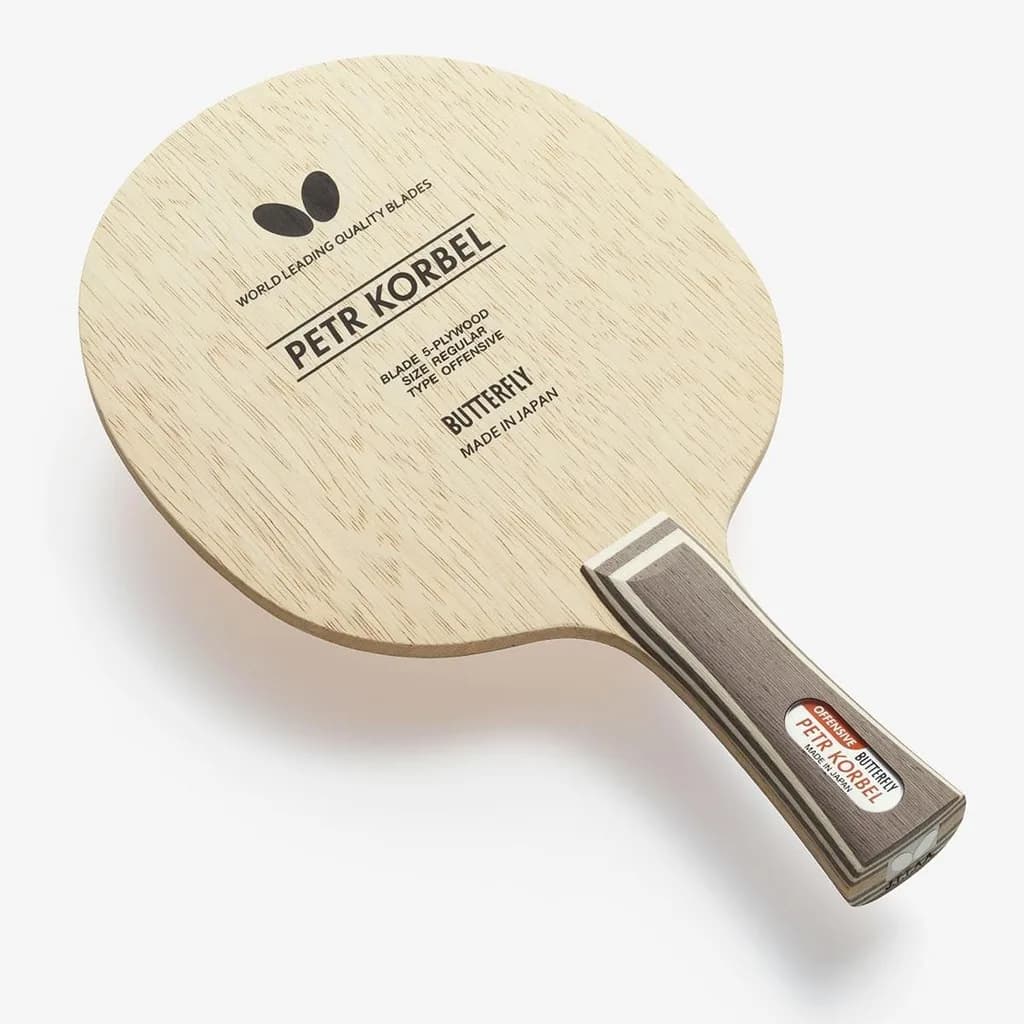
The five-ply limba plywood that still sells in quantity in the middle of the carbon era. A touch more direct than the Primorac, without giving up the feel of an all-wood build.
Gallery.
3 imagesFew blades can claim decades in the catalogue with barely a change and no need to reinvent themselves. The Butterfly Korbel is one of them. Named after the Czech Petr Korbel — a leading European attacker of the nineties — it is a five-ply plywood, entirely wood and without a single carbon fibre, that still sells in large numbers in the middle of the ALC and ZLC era. In a market pushing constantly towards carbon, that staying power is no accident: the Korbel does exceptionally well what many modern blades have left behind.
This review looks at what the Korbel actually offers on the table, which player it makes sense for, and how it stands against its closest alternatives, starting with its own sister in the range, the Primorac.
Placing the product
The Korbel belongs to the classic school of European topspin plywood. Its recipe is the canonical one: a double limba ply on each side over an ayous core. It is exactly the composition used by many benchmark offensive all-wood blades — the Tibhar Stratus Power Wood, to take the obvious case, shares the structure — which places it squarely within a well-tested constructive tradition.
It is worth understanding what each material contributes. Limba is the outer wood of European topspin par excellence: relatively soft, sensitive to spin and with a very legible feel, one that "talks" to the player at every contact. Appearing twice on each side, it reinforces that sensitivity and adds an elastic response. The ayous core, light and soft-grained, keeps the weight contained and contributes a progressive flex. The result is a blade that carries the ball along — what is technically called dwell, the contact time between ball and rubber — and that gives the energy back gradually instead of firing it out all at once.
Butterfly officially classifies it as OFF (offensive), a rung above the Primorac, which the same manufacturer labels OFF−. That difference on the label matches the character: the Korbel is a touch faster and more direct than the Primorac, somewhat more emphatic through the stroke, although both share a philosophy and a family. It is a blade meant for the attacker who wants punch without giving up the feel of an all-wood build.
Specs that matter to the player
Beyond the spec sheet, it is worth translating the numbers into what is felt with the bat in hand.
The thickness, around 5.9 millimetres, is a little greater than that of a five-ply blade built purely for control, and it helps explain the more offensive character. That extra body brings a somewhat firmer, more direct response without reaching the stiffness of a carbon structure.
The weight is probably the figure that deserves most attention at the point of purchase. The average is around 91 grams, but the variation between units is considerable — Butterfly acknowledges swings of several grams, and in practice examples turn up from 85 to close to 100 grams. This is not a defect but the natural consequence of working with fibre-free woods; it does, however, call for care. A light unit is nimbler and easier to handle in the fast exchange and in touch play; a heavier one gains stability and punch in the power stroke, at the cost of manoeuvrability. Combined with two modern rubbers, often heavy ones, a Korbel from the top of the range can end up as a fairly loaded bat. Where the shop allows a choice of weight, it is worth picking one to suit the player's own style.
The head, slightly oversized relative to the average, widens the usable surface and contributes to the sense of a broad sweet spot discussed below. It is a discreet detail, but a welcome one in real play.
The absence of fibre, although it appears as no number on the sheet, is the fact that defines the blade's character: maximum sensitivity, rich feel and a linear, predictable response curve, without the jump in energy that carbon layers introduce. In exchange, it gives up the terminal speed and the extra stability that fibre brings away from the table.
On-table behaviour
This is where the Korbel earns its longevity. Its virtue is not one isolated quality but the balance between control and punch within an all-wood feel.
The first thing anyone who tries it notices is the clarity of the feedback. The outer limba faithfully transmits what happens at contact: how much spin the ball carries, how firmly it was struck, where on the rubber it landed. That legible vibration is what makes the blade so pleasant for the player who values feeling the ball, and so instructive for anyone refining their technique.
In the topspin its ability to combine spin and speed stands out. The generous dwell makes it comfortable to load the ball and impart substantial rotation, while its slightly more direct character compared with the Primorac gives it something extra for closing the point from mid-distance. It is a blade that loads the opening loop against backspin well and that, at the same time, allows a powerful stroke without feeling soft.
The short game and touch play is another of its natural territories. The sensitivity of the limba makes the push, the flick and the passive block come out naturally; the ball goes where it is sent, and the blade forgives small adjustments of angle better than a fibre structure does. The sweet spot, broad for a five-ply blade, reinforces that tolerance: it forgives imprecision at the point of impact without punishing either direction or depth too heavily.
Where the Korbel shows its limits is in pure power play away from the table. With no fibre to stabilise the response and no great reserve of terminal speed, the player who sets out to trade heavy topspins from the back will find it short of punch and firmness against a carbon blade. In the flat smash from long range, the stiffness that "fires" on its own in the finishing stroke is missed. The Korbel holds its own with dignity at mid-distance, but the power rally away from the table is not its ground.
Pros
- Direct, communicative feel, typical of a good all-wood limba plywood
- Excellent balance between control and punch: more offensive than a pure control blade, more sensitive than one with fibre
- Generous dwell that favours the spin game and loading the topspin
- Very solid in the short game: push, flick and block come out with great ease
- Broad sweet spot, reinforced by the slightly oversized head
- Enormous versatility depending on the rubber mounted on it
- Proven build quality and decades of backing in the market
Cons
- Short on terminal speed and firmness compared with fibre blades
- Less stable in power play away from the table and in the flat smash
- Marked weight variation between units: it calls for care at the point of purchase
- With two heavy modern rubbers, an example from the top of the range can make for a fairly loaded bat
- The outer limba ply is soft: sealing the blade before gluing is advisable to protect it from fibre tear-out
Who it is for
The Butterfly Korbel fits naturally with the attacking or all-round player who wants punch without giving up the feel of an all-wood build. It is a sound choice for anyone who builds the point with placement and rotation on the topspin, alternates power with the short game, and values feeling the ball in the bat above raw speed.
It is also a very suitable blade as a platform for improvement for the intermediate player with offensive leanings who wants to step up from an allround or control blade to a first clearly offensive one, without the wildness of a carbon structure. Its linear response and broad sweet spot make it an honest instrument: it does not disguise technique, but nor does it punish it.
The modern hitter looking for terminal speed and stability in the game away from the table, on the other hand, will find the Korbel limited and would do better to look towards a fibre blade — the Viscaria, the Timo Boll ALC or any equivalent ALC.
Pairing with rubbers
On the rubber front the Korbel is a very obliging base. With European or Japanese tensor rubbers of medium or medium-high hardness on the forehand it uses its dwell to load spin and adds the speed that the all-wood structure holds back; this is probably the most balanced combination for the modern attacker. On the backhand a slightly softer rubber can be comfortable, making the block and the fast game near the table easier. It also takes tacky Chinese rubbers for anyone after a heavily spun topspin of placement, although with very hard, untreated Chinese rubbers it demands more acceleration from the player, since part of the assisted speed is lost.
Three set-ups that work
- A medium-hard European or Japanese tensor on the forehand and something softer on the backhand — the most balanced configuration: it uses the dwell to load spin and adds the speed the blade holds back. The default option for the modern attacker.Modern offensive
- A soft tensor or a control rubber on both sides — for the player who puts touch play, the push and the block first, squeezing out the sensitivity of the limba and the broad sweet spot.Control / touch play
- Tacky Chinese on the forehand and a tensor on the backhand — for the heavily spun topspin of placement; it is worth reckoning with the hard Chinese rubber asking for more acceleration from the player.Asian style
Comparison with the alternatives
The most relevant comparison is within the same brand, and it is the one that settles the most common buying question.
Against the Butterfly Primorac, its sister in the family, the resemblance is obvious: both are five-ply limba blades, without fibre, with a rich feel and high control. The difference lies in the shade of character: the Korbel is a touch faster, firmer and more direct, somewhat more oriented towards punch; the Primorac is a step softer and more communicative, somewhat more given to fine control. They do not compete on different concepts but on shades of speed and feel. Anyone who puts weight of shot first will lean towards the Korbel; anyone who puts maximum sensitivity first, towards the Primorac.
Against the Tibhar Stratus Power Wood, which shares exactly the same limba-limba-ayous-limba-limba composition, the comparison is especially revealing. The Stratus tends to offer even more pronounced flex and dwell, with a somewhat springier character given over to spin; the Korbel comes out a touch firmer and more direct. It is also a comparison that tends to be settled on price: the Stratus performs at a very close level for a usually smaller outlay, an argument worth taking seriously between two blades of such similar concept.
Against the Butterfly Viscaria — the brand's ALC benchmark — the contrast is the one that separates every all-wood blade from a fibre one. The Viscaria is faster, more stable away from the table and more emphatic in the power stroke; the Korbel offers in exchange a richer feel, a more linear response and superior control in the short game. The Viscaria is the choice of the modern attacker who wants speed with control; the Korbel, that of the player who puts feel and variation first.
Outside Butterfly, practically every brand offers offensive five-ply limba blades at often lower prices, and many perform at a very close level. The Korbel nonetheless keeps two advantages that are hard to replicate: high manufacturing consistency and the backing of decades of use, which brings the reassurance of a thoroughly proven pattern.
Frequently asked questions
Is the Butterfly Korbel suitable for an intermediate player?
Yes. Although it is an offensive blade, its high control, linear response and broad sweet spot make it especially friendly. It is an excellent option for the intermediate player with attacking ambitions who wants to make the jump to a first clearly offensive blade without the wildness of a carbon structure.
What is the difference between the Korbel and the Primorac?
Both are five-ply limba blades, without fibre, with plenty of feel and control. The Korbel (OFF) is a touch faster, firmer and more direct, somewhat more oriented towards punch; the Primorac (OFF−) is a little softer and more communicative, more given to fine control. The choice comes down to shades of speed and feel, not to concept.
Is the Korbel any use away from the table?
It holds its own at mid-distance, but that is not its natural ground. With no fibre to stabilise the response and with contained speed, the heavy topspin rally from the back and the flat smash from long range ask more of it than it offers. For that style, fibre blades such as the Viscaria or the Timo Boll ALC are preferable.
Which rubbers go best with the Korbel?
It is a highly adaptable blade. With European or Japanese tensor rubbers of medium or medium-high hardness on the forehand it gains speed and a more automatic topspin while keeping its feel, and that is the most balanced combination for the modern attacker. On the backhand a slightly softer rubber can be comfortable for the block. It also takes tacky Chinese rubbers for a heavily spun topspin of placement.
Does the blade need sealing before use?
It is advisable. The outer limba ply is soft, and sealing the blade protects it from fibre tear-out when the rubber is peeled off, extending its working life.
How does it differ from the Tibhar Stratus Power Wood?
They share the same composition (limba-limba-ayous-limba-limba). The Stratus tends to be somewhat more flexible and springy, with even greater dwell; the Korbel comes out a touch firmer and more direct. The Stratus also tends to offer keener value for money.
Rating by dimension
Proof that the feel of an all-wood blade never goes out of fashion.
The Butterfly Korbel is not the fastest blade, nor the most stable away from the table, nor the one that has moved furthest with the technology. And yet it remains one of the best five-ply all-wood blades an attacking player can buy, because it gets the hardest part right: it transmits the ball faithfully and offers a very fine balance between control and punch across the whole repertoire of strokes, from topspin to push. Its limitation is clear and honest: it lacks the terminal speed and the firmness that modern power play often demands, above all away from the table. But for the attacker who builds the point through placement and variation, or for anyone who wants a candid blade on which to consolidate technique before making the jump to carbon, the Korbel remains a hard choice to regret. That a blade this simple has sold in quantity for decades, in the middle of the carbon era, is no accident.