
Butterfly
Primorac.
The classic five-ply all-wood blade that taught half a generation to attack. Deep into the carbon era, good feel never goes out of fashion.
Gallery.
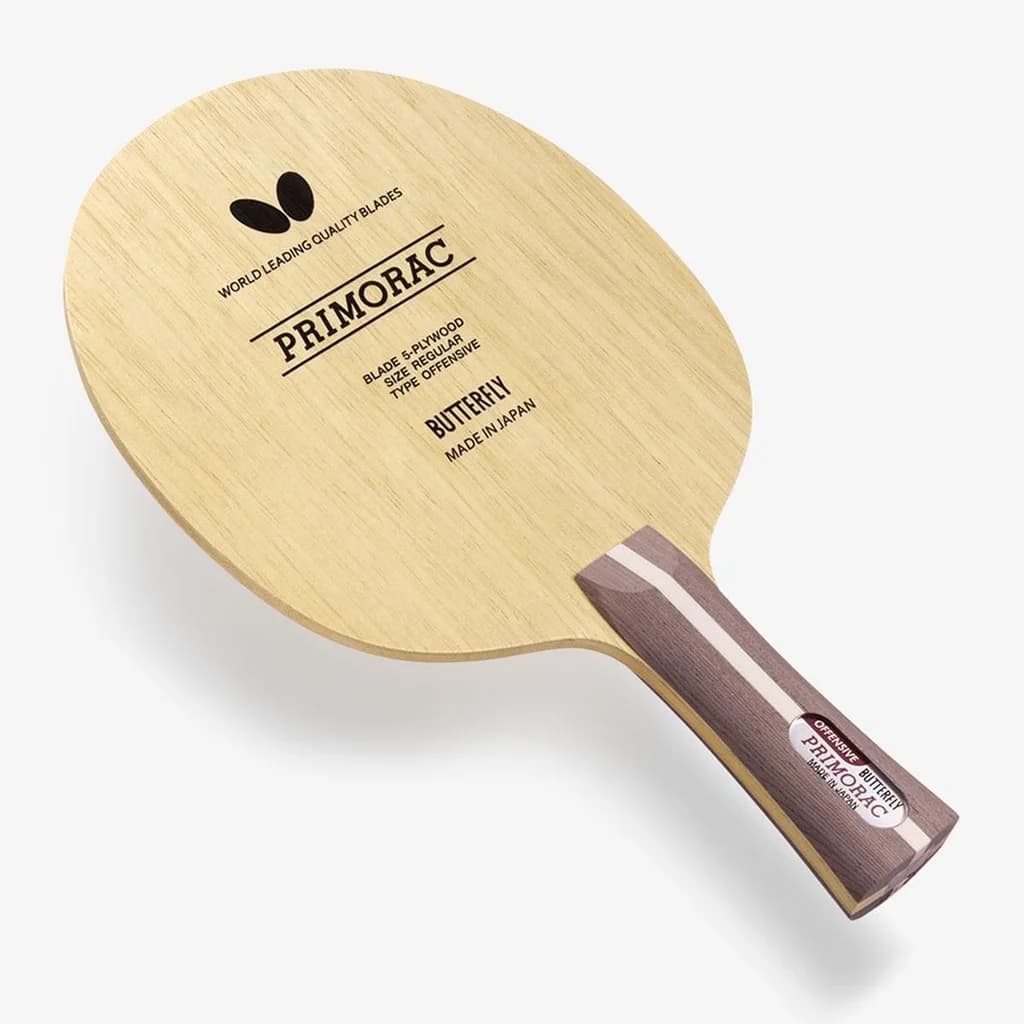
2 imagesSome blades earn their standing through technology, and others earn it through sheer years on the table. The Butterfly Primorac belongs to the second group. Named after the Croatian Zoran Primorac — one of the great European attackers of the eighties and nineties — it is an all-wood blade, with no fibre of any kind, that has been in the catalogue for decades and that Butterfly still sells in large numbers. In a market obsessed with carbon, it is surprising that a build this simple should stay so relevant.
This review looks at why the Primorac is still a sensible buy, which player it is meant for, and how it stands against its closest alternatives.
One thing is worth clearing up from the start, because it is behind more than one mistaken purchase: several blades carry the name "Primorac" in the Butterfly catalogue. This review refers to the classic five-ply all-wood Primorac, the original one. It should not be confused with the Primorac Carbon, which adds carbon fibre and behaves in a far faster, stiffer way, nor with later special editions. That difference comes up again below, because it decides the purchase.
Placing the product
The Primorac was born in an era when the benchmark attacking blades were, almost all of them, all-wood builds. Fibre existed, but it did not dominate the market as it does now. In that context Butterfly designed a five-ply blade aimed at the modern attacker of its day: fast without being uncontrollable, and with a feel rich enough to allow a varied game of topspin, block and short touch.
Its chief virtue lies precisely in that absence of fibre. An all-wood blade vibrates and "talks" to the player in a way that layers of carbon or arylate tend to quieten. The ball stays an instant longer on the surface — what is technically called dwell, the contact time between ball and rubber — and that extra instant is gold for building spin, metering out force and placing the ball precisely.
Butterfly officially classes it as OFF− (offensive, at the lower end of that category), though a sizeable share of players feel it closer to ALL+: a blade clearly playable at mid distance, but without the punch of a pure offensive blade. That gap between the label and the sensation is telling: the Primorac is fast on paper, but its character is that of a controlled, communicative blade rather than a speed weapon.
Specs that matter to the player
Beyond the spec sheet, it is worth translating the numbers into what is felt with the bat in hand.
The thickness, around 5.5–5.7 millimetres, is the usual figure for a five-ply offensive blade. It does not chase raw speed through sheer depth of wood, but an elastic, progressive response. As it flexes, the blade returns energy gradually, and that translates into the sensation of "pushing" the ball through rather than hitting it flatly.
The weight sits, on most units, between 85 and 90 grams, with the variation that is unavoidable in any product made from natural woods. As with every blade, it is worth keeping in mind at the point of purchase: a light unit is nimbler and easier to handle in the fast exchanges and the touch game; a heavier one gains stability and punch in the power stroke, at the cost of some manoeuvrability. Where the shop allows a choice of weight, it is worth picking one to suit the player's own style.
The absence of fibre is the most relevant fact of all, even though it appears as no figure at all. It defines the character of the blade completely: maximum sensitivity, a rich feel and a very linear, predictable response curve, with none of the energy "jump" that carbon layers introduce. In exchange, it gives up the terminal speed and the extra stability that fibre brings in play away from the table.
Behaviour in play
This is where the Primorac justifies its longevity. Its great virtue is not a number but its control and sensitivity, and on that ground it remains a benchmark that is hard to beat within the Butterfly catalogue.
The first thing any player who tries it notices is the clarity of the feedback. The blade relays with enormous fidelity what is happening at contact: how much spin the ball is carrying, how firmly it was struck, which part of the rubber it hit. That constant communication is what makes it so instructive and, at the same time, so pleasant for the experienced player who values feel over power.
In the topspin its ability to build spin stands out. The generous contact time makes it comfortable to "load" the ball, impart a considerable amount of rotation and place it precisely. The launch angle is medium, comfortable for clearing the net against backspin without abrupt corrections. It is not the blade that accelerates the ball the most, but it is one of those that allow the topspin to be played with the most margin and variety, especially at short and mid distance.
The block and the short touch are probably where it is most enjoyable. The sensitivity of the blade makes the push, the short flick and the passive block come out with remarkable naturalness; the ball goes where it is sent and forgives angle adjustments better than a fibre blade does. It is a blade that invites a fine, varied game, not just force.
Where the Primorac shows its limits is in power play and away from the table. With no fibre to steady the response and no great reserve of speed, the player who sets out to trade heavy topspins from the back will find it short of punch and firmness against a carbon blade. The Primorac holds its own with dignity at mid distance, but the power rally away from the table is not its natural ground. Its philosophy is control, not terminal speed, and anyone after the latter will look towards other blades — starting with the Primorac Carbon itself.
Pros
- Outstanding control and sensitivity, among the best in its class
- A rich, communicative feel, typical of a five-ply blade with no fibre
- A linear, predictable response that is very easy to meter out
- Excellent for the fine game: push, block and short touch
- Enormous versatility depending on the rubbers mounted on it
- Proven build quality and decades of backing in the market
Cons
- Short on terminal speed and punch next to fibre blades
- Less stable and less firm in power play away from the table
- Weight variation between units makes it worth looking closely at the purchase
- The name confusion within the Primorac range makes it easy to buy the wrong blade
Which player it is for
The Butterfly Primorac fits naturally with the attacking or all-round player who puts control, feel and variety of play ahead of raw speed. It is an especially sound choice for anyone who builds the point with placed topspin, alternates force with the short game and values feeling the ball on the bat.
It is also a very suitable blade as a platform for learning and refinement for the intermediate player with attacking ambitions. Unlike a firm fibre blade, the Primorac does not paper over technique, but neither does it punish: its linear response and its tolerance make it an honest instrument on which to improve the stroke without the loss of control of a faster blade. Many players recommend it for exactly that, to consolidate technique before the jump to carbon.
The modern hitter after terminal speed and stability in play away from the table, on the other hand, will find the classic Primorac limiting and would do better to look towards a fibre blade — the Viscaria, the Primorac Carbon itself or any equivalent ALC.
Pairing with rubbers
On rubbers, the Primorac is a very obliging and adaptable blade. With European or Japanese tensors of medium hardness it gains speed and a more automatic topspin without losing its characteristic feel, and that is probably the most balanced combination for the modern attacker. It takes slower or control rubbers just as well for anyone who puts the fine game first, and even tacky Chinese rubbers for anyone after a heavily spun, placed topspin. Its neutral, communicative character means it adapts to the rubber rather than imposing itself on it.
Three set-ups that work
- European or Japanese tensor of medium hardness on both sides — the most balanced configuration: speed and a more automatic topspin without losing the feel. The default option for the modern attacker.Modern offensive
- Control rubbers or a soft tensor on both faces — for anyone who puts the fine game, the push and the block first, squeezing out the sensitivity of the blade.Control / touch play
- Tacky Chinese on the forehand and tensor on the backhand — for the heavily spun, placed topspin; the communicative blade makes good use of the spin the tacky rubber generates.Asian style
Comparison with alternatives
The most important comparison is, once again, in-house, and it is the one that settles the main confusion at the point of purchase.
The Primorac Carbon shares the name and the original philosophy, but it is a radically different blade. By adding carbon fibre it gains speed, stiffness and stability, and loses a good part of the feel and sensitivity that define the classic. It is not an "improved" version but an answer to a different need: that of the player who wants punch and firmness for power play. Anyone after the control and the sensation of the five-ply Primorac must make sure not to buy the carbon version by mistake, and the other way round.
Against the Butterfly Viscaria — the house ALC benchmark — the contrast is the one that separates every all-wood blade from a fibre blade. The Viscaria is faster, more stable away from the table and carries more punch in the power stroke; the Primorac offers in exchange a richer feel, a more linear response and better control in the short game. They are not competing for the same thing: the Viscaria is the choice of the modern attacker who wants speed with control; the Primorac, that of the player who puts sensation and variety first.
Within Butterfly's own all-wood range, the Primorac sits alongside classics such as the Korbel — very similar in character, perhaps a touch faster and more direct — or slower, more controlled all-wood builds. Among them the choice comes down to shades of speed and feel rather than differences of concept.
Outside Butterfly, practically every brand offers five-ply all-wood offensive blades at often lower prices, and many of them perform very close to this level. The Primorac keeps, however, two advantages that are hard to replicate: very high manufacturing consistency and the backing of decades of use, which brings the reassurance of a thoroughly proven pattern.
Frequently asked questions
Is the Butterfly Primorac suitable for an intermediate player?
Yes, and that is one of its strongest cards. Carrying no fibre, it offers a linear, forgiving response with very high control, which makes it an excellent platform for consolidating attacking technique without the loss of control of a carbon blade. It works as well for the intermediate with attacking ambitions as for the advanced player who puts feel first.
What is the difference between the Primorac and the Primorac Carbon?
The classic Primorac is a five-ply all-wood blade, with no fibre: very sensitive, controlled and communicative, but with less terminal speed. The Primorac Carbon adds carbon fibre, which makes it far faster, stiffer and more stable in power play, at the cost of losing feel and sensitivity. They are different blades for different needs, and it is worth not confusing them when buying.
Is the Primorac any good for playing away from the table?
It holds its own at mid distance, but that is not its natural ground. With no fibre to steady the response and with contained speed, the heavy topspin rally from the back asks more of it than it has to give. For that style, fibre blades such as the Viscaria or the Primorac Carbon itself are preferable.
Which rubbers go best with the Primorac?
It is a very adaptable blade. With European or Japanese tensors of medium hardness it gains speed and a more automatic topspin while keeping its feel, and that is the most balanced combination for the modern attacker. It takes control rubbers for the fine game just as well, or tacky Chinese rubbers for a heavily spun, placed topspin.
How does it differ from the Viscaria?
The Viscaria carries Arylate-Carbon fibre: it is faster, more stable away from the table and hits with more punch. The Primorac, with no fibre, offers more feel, a more linear response and better control in the short game. The Viscaria is for anyone who wants speed with control; the Primorac, for anyone who puts sensation and variety first.
Rating by dimension
Good feel never goes out of fashion.
The Butterfly Primorac is not the fastest blade, nor the most stable away from the table, nor the one technology has moved along the furthest. And yet it remains one of the best all-wood blades an attacking player who values feel can buy, because it does exceptionally well the thing that is hardest to find today: relaying the ball faithfully and offering fine control across the whole repertoire of strokes, from the topspin to the push. Its limitation is clear and honest: it lacks the terminal speed and the firmness that modern power play often demands, above all away from the table. But for the player who builds the point with placement and variety, or for anyone after a candid platform on which to refine their technique, the classic Primorac is still a choice that is hard to regret. That a blade this simple has sold in quantity for decades, deep into the carbon era, is no accident.