
Butterfly
Viscaria.
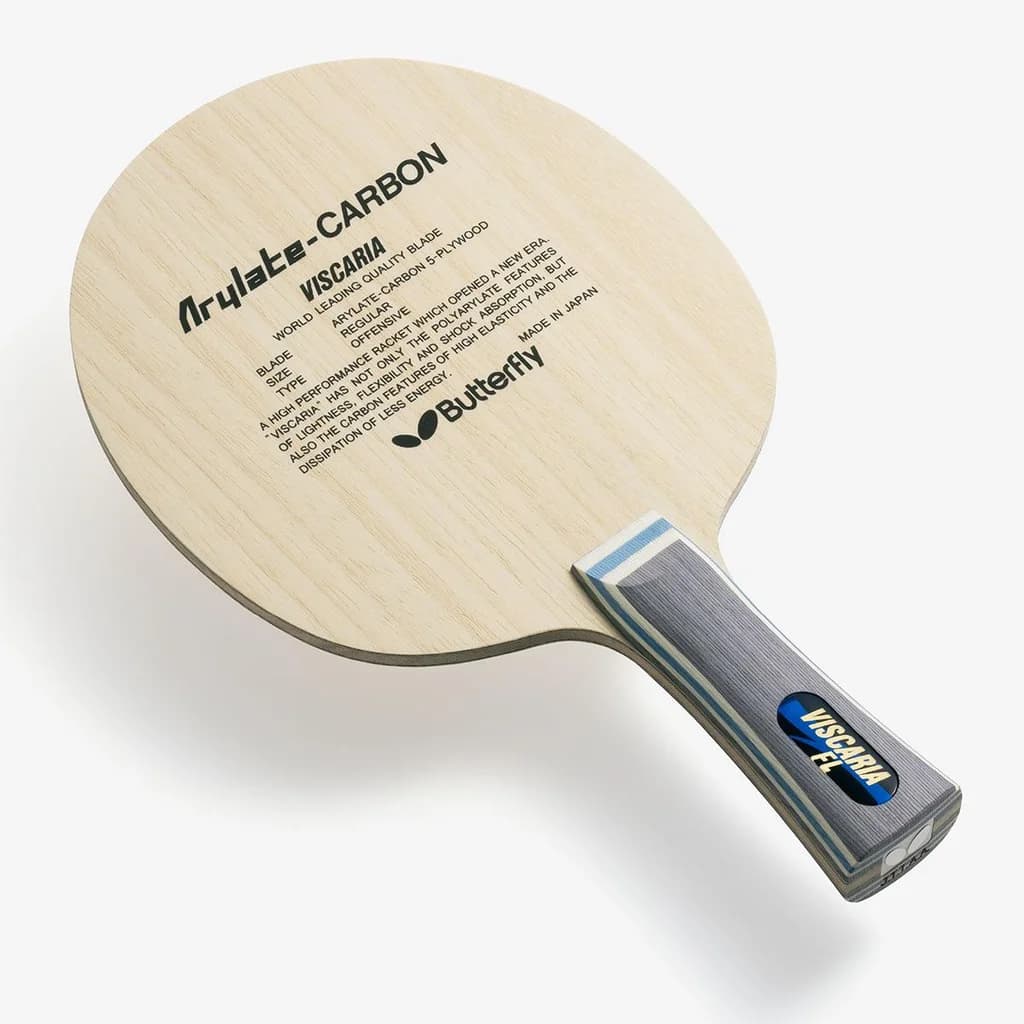
The ALC legend that still sets the standard for modern attacking play. Koto, limba and two layers of Arylate-Carbon: carbon speed without giving up control or feel.
Gallery.
3 imagesFew blades carry a reputation as large as the Butterfly Viscaria's. Born in the early nineties and tied to legendary names — from Jan-Ove Waldner in its day to Tomokazu Harimoto now — it became the benchmark that defined what we understand today as a fibre attacking blade: fast but controllable, firm but sensitive. Its combination of koto and limba plies with two layers of Arylate-Carbon (ALC) set a pattern the industry itself has copied for decades.
This review looks at what it actually offers on the table, which player it is meant for, and how it stands against its closest alternatives, including its own siblings in the range.
Placing the product
The Viscaria belongs to Butterfly's ALC family, which takes its name from the Arylate-Carbon fibre. It is worth understanding what this means, because it is the key to its character. Arylate brings lightness, flexibility and vibration absorption; carbon brings stiffness, elasticity and a very efficient energy return. By weaving both materials into a single layer, Butterfly aimed for a middle ground: the speed and stability that carbon gives, but without the dry, slightly deadened response that characterises pure carbon fibres. The result is a fibre blade that nonetheless keeps a surprisingly communicative feel.
Structurally, the Viscaria is a seven-layer build: two outer koto plies, two ALC layers beneath them, two intermediate limba plies and a kiri (paulownia) core. The outer koto is a relatively hard wood, and much of that firm, defined sensation at impact comes from it; the light kiri core helps keep the weight contained and the response lively.
It is important to be clear about the variant. This review refers to the original Viscaria with ALC fibre, the one Butterfly keeps in its catalogue as a reissue of the classic model. It should not be confused with the Viscaria Super ALC, which uses a stiffer fibre and offers a faster, drier behaviour. They are related but distinct blades, and this difference will come up again later.
Specs that matter to the player
Beyond the spec sheet, it is worth translating the numbers into what is felt with the bat in hand.
The thickness close to 5.7 millimetres is modest for a blade with a double fibre layer. This is deliberate: rather than chasing raw speed through thickness, the Viscaria goes for an elastic, progressive response. The fibre does the job of accelerating the ball; the wood takes care of keeping the feel.
The weight deserves attention. Units usually sit between 85 and 90 grams, though the factory range is wide and it is not unusual to find examples from 82 up to 94 grams. This variability, unavoidable when starting from natural woods, has real consequences on the table. A light Viscaria is more manoeuvrable and nimble in fast play and blocking; a heavier unit gains stability and punch on the power stroke, at the cost of some manoeuvrability. Where the shop allows a choice of weight, it is worth picking one to suit the player's own style rather than leaving it to chance, especially given that this blade is usually fitted with tensor rubbers that are far from light.
The outer koto plies define much of its personality. Against the softer feel of a blade with limba on the outside, koto offers a firmer surface and a more direct return. It is not a stiff or metallic response, but it is more defined and "crisp" than that of a classic all-wood blade.
Behaviour in play
This is where the Viscaria earns its status. Its virtue is not any single figure but the balance between speed and control, a meeting point very few fibre blades reach so naturally.
The first thing that surprises a player coming from an all-wood blade is that the Viscaria is fast without feeling out of control. It sits in the medium-high part of the offensive range, and yet it is hard to overshoot on the stroke. That sense that the ball does not overrun the table is one of the reasons it has earned its reputation: it offers the power of a carbon blade with a margin for error more typical of a slower one.
It is in the topspin that its character is best explained. The ball lingers an instant on the blade — that dwell that lets the player build the spin — and leaves at a medium or medium-high angle, comfortable for clearing the net over a chopped ball. It is not the spinniest blade on the market, nor does it aim to be: its charm is that it combines respectable spin with a safe, predictable trajectory. It works well at short and medium range and, unlike many all-wood blades, holds up well in play away from the table, thanks to the stability the fibre provides.
Blocking and counter-hitting benefit from that firm koto feel. The response is fast and defined, which allows flat, aggressive blocks with the wrist, and comfortable counters thanks to the blade's stability. The ball goes where it is aimed, and the feedback is clear enough to adjust the angle with confidence even at high pace.
In the short game and the serve, the Viscaria behaves better than one might expect of a fibre blade. It keeps enough sensitivity to meter a drop shot and a touch under the net, though, as is only logical, it demands a little more precision than a pure control blade: the fibre always takes a point of forgiveness off the delicate touch.
It is worth being honest about its limits. The Viscaria is not the most explosive blade in its category. Its philosophy is balance, not maximum punch, and a player after terminal speed above all else will find more forceful options — including its own Super ALC sibling. Nor is it the most forgiving: its firmness demands a reasonably formed technique. Whoever is still settling their stroke will notice that the blade does not hide gesture errors as much as a soft all-wood blade does.
Pros
- Exceptional balance between speed and control, hard to match in its category
- Firm, defined, communicative feel, without the dry response of pure carbon
- Notable stability at all distances, including away from the table
- Real versatility: it performs in topspin, block, counter and short game
- Consistent manufacturing and a huge track record of high-level use
Cons
- Not the fastest or most explosive in the ALC range itself
- Less forgiving than an all-wood blade: it demands a formed technique
- Weight variability between units means paying attention when buying
- Its popularity has driven up the price and the spread of counterfeits
Who it is for
The Butterfly Viscaria fits naturally with the modern attacking player, intermediate-advanced or above, who wants to make the jump to a fibre blade without giving up control. It is an especially sound choice for whoever already commands the topspin at medium range and is after more speed and stability than an all-wood blade offers, but fears the loss of control of faster carbon blades. The Viscaria is, precisely, the bridge between those two worlds.
It is also a very suitable blade for the all-rounder who switches distances and needs a reliable response both close to the table and in the topspin exchange from the back. Its versatility makes it hard to catch off guard.
On the other hand, the player still building their base technique will find more forgiving and cheaper blades for that stage; and the hitter chasing pure terminal speed may prefer a stiffer, more explosive blade.
Pairing with rubbers
On rubbers, the Viscaria is famous for its compatibility with tacky Chinese rubbers on the forehand, a combination very common in Asian-style play, where its medium-high launch angle offsets the lower speed of those rubbers well. With European or Japanese tensors of medium-high hardness it works just as beautifully, gaining speed and a more automatic topspin. It is a blade that takes demanding rubbers without overflowing, which hugely widens its range of set-ups.
Three set-ups that work
- Tacky Chinese on the forehand and tensor on the backhand — the Asian-style set-up: the blade's medium-high angle offsets the lower speed of the tacky rubber and squeezes out the spin.Asian style
- European or Japanese tensor of medium-high hardness on both sides — speed and a more automatic topspin while keeping control; the most direct attacking configuration.Modern offensive
- Medium-hardness tensor on both sides — for the all-rounder who switches distances and puts reliability ahead of maximum punch.All-rounder
Compared with the alternatives
The most useful comparison for this blade is within the same house, because Butterfly has built a whole family around this concept.
The Timo Boll ALC shares exactly the same composition and philosophy as the Viscaria. The differences are subtle but real: the Viscaria tends to weigh a few grams more and to be a tenth thicker, and is usually felt as slightly firmer and more direct, while the Timo Boll ALC conveys a feel a touch softer and more flexible. In practice, many players consider them almost interchangeable; the choice is often decided by nuances of feel and by the particular unit that reaches the player. Whoever prioritises a slightly softer, spinnier contact may lean towards the Timo Boll ALC; whoever wants a more defined response, towards the Viscaria.
The Zhang Jike ALC is, for all practical purposes, a Viscaria with a different graphic design and, on occasion, slight variations in finish. If the price is more favourable, it can be a perfectly valid way to access the same concept.
The most significant step up is the Viscaria Super ALC. Here Butterfly swaps the ALC fibre for Super Arylate-Carbon, which is stiffer, and this translates into a blade that is faster, drier and with a more demanding contact zone. It gains punch and penetration, but loses part of the feel and forgiveness that make the original Viscaria so pleasant. It is not a "better" version, but a response to a different need: that of the player who prioritises speed and firmness over feel. Whoever is after precisely the classic Viscaria balance should make sure not to buy the Super by mistake.
Outside the Butterfly catalogue, the ALC concept has been imitated by practically every brand, with blades of outer koto and arylate-carbon fibre at much lower prices. Many offer a notably close experience. The Viscaria keeps, however, two advantages that are hard to replicate: very high manufacturing consistency and the backing of decades of use at the highest level, which brings the reassurance of a thoroughly proven pattern.
Frequently asked questions
Is the Butterfly Viscaria suitable for an intermediate player?
Yes, provided they have a reasonably formed technique and a clearly attacking game. It is a firm, fast fibre blade; the player still settling the basic stroke will benefit sooner from a slower, more forgiving all-wood blade, and can make the jump to the Viscaria when their technique calls for it.
What is the difference between the Viscaria and the Viscaria Super ALC?
The Viscaria uses ALC fibre (Arylate-Carbon) and offers a balance between speed and control with good feel. The Super ALC uses a stiffer fibre (Super Arylate-Carbon) that makes it faster, drier and more demanding. The Super is more powerful, but loses part of the feel and forgiveness of the original. They are different blades for different needs.
Is the Viscaria the same as the Timo Boll ALC?
They share composition and philosophy, and many players consider them almost interchangeable. The Viscaria tends to be somewhat heavier, thicker and firmer; the Timo Boll ALC a touch softer and more flexible. The real difference is subtle and depends a lot on the particular unit.
Which rubbers pair best with the Viscaria?
It is very versatile. It works notably well with tacky Chinese rubbers on the forehand, taking advantage of its medium-high launch angle, and also with European or Japanese tensors of medium-high hardness, which give it more speed and a more automatic topspin. It takes demanding rubbers without overflowing.
Why are there so many Viscaria counterfeits?
Its enormous popularity and high price have made it one of the usual targets of the imitation market. It is best always bought from trusted shops, treating abnormally low prices with suspicion.
Rating by dimension
The balance that time has not managed to improve.
The Butterfly Viscaria is not the fastest blade, nor the spinniest, nor the most forgiving. And yet it remains one of the best possible buys for the modern attacking player, because it does something very hard: it brings speed, control, feel and stability together in a package with no obvious weak points. It stands out not for any one extreme but for the absence of flaws, and that is precisely the kind of virtue that grows on the player the more it is used. Its main drawback today is not technical but commercial: its fame has pushed the price up and multiplied the imitations. But bought with guarantees and paired with rubbers to match, it delivers exactly what it promised almost three decades ago: a reliable, versatile attacking platform that is hard to regret. That the world elite keep choosing it when they could use anything says a great deal about a balance that has never needed a revision.