Tibhar
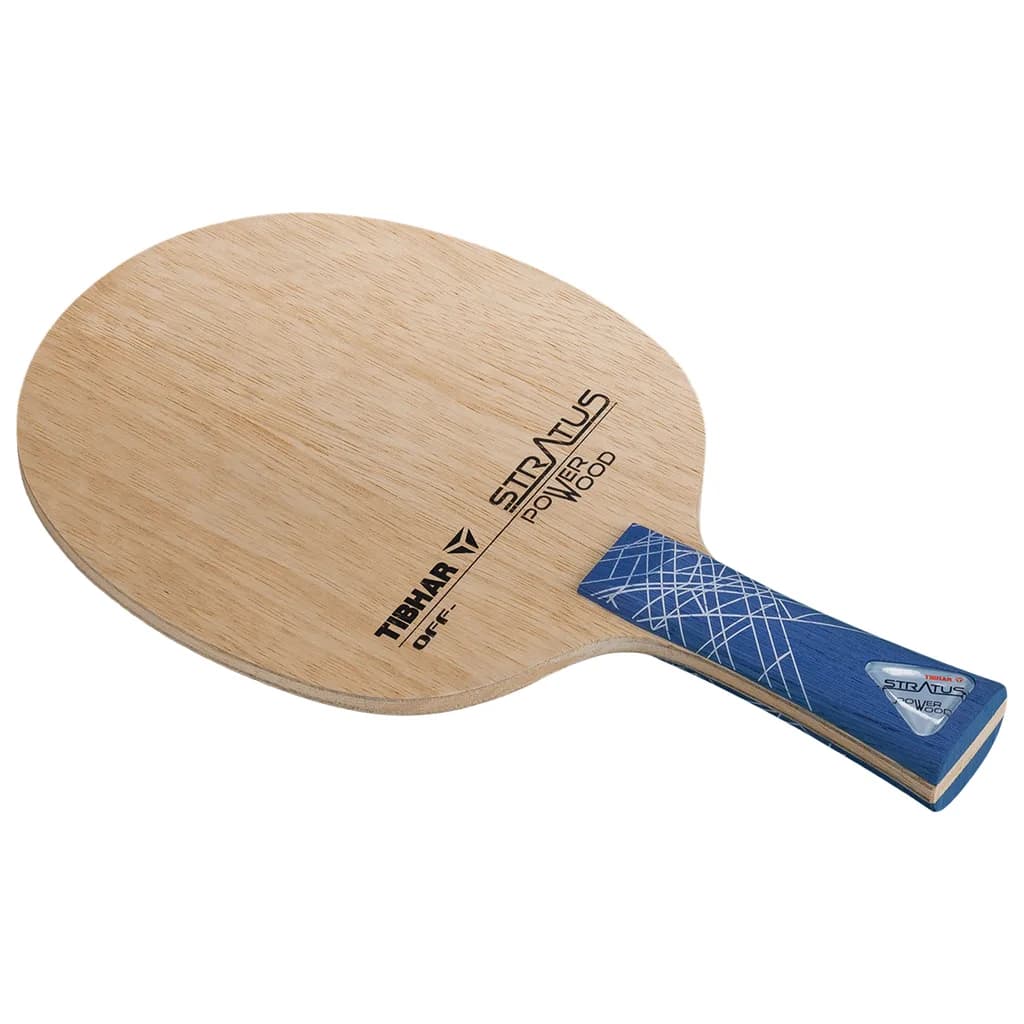
Stratus Power Wood.
The blade that earned its reputation slowly, review by review. Five plies of limba, not a single carbon fibre, and a flexibility that stretches the dwell and grips the spin: speed earned, not given away.
Gallery.
0 imagesSome blades succeed on the back of a marketing campaign and some earn their reputation slowly, review by review and player by player. The Tibhar Stratus Power Wood belongs squarely to the second group. It is a classic five-ply construction, entirely wood, without a single carbon fibre, and yet it has spent years appearing on recommendation lists for anyone after a first clearly offensive blade that does not give up control. That is no accident.
This review looks at what the Stratus Power Wood actually offers on the table, which player profile it makes sense for, and how it stands against its direct alternatives, inside and outside the Tibhar catalogue.
What it is and where it comes from
The Stratus family is one of Tibhar's veteran all-wood lines, and the Power Wood is its most popular member. Its approach is deliberately classic: a five-ply construction with a double layer of limba on each side and an ayous core. That is the canonical recipe of the European topspin blade, the same school so many offensive control constructions draw on, and the Stratus executes it with one distinguishing trait: a very pronounced flexibility.
That construction is worth understanding. Limba is the classic outer wood of European topspin: relatively soft, sensitive to spin and with a very readable feel. Here it appears twice over on each side, which reinforces the elastic character of the whole. The ayous core, light and soft-grained, keeps the weight in check and contributes to that sense of generous flex. The result is not a fast, direct blade but one that bends, stores and returns energy, with a long contact time (dwell).
One practical detail not to overlook: the head is slightly larger than that of most blades from general manufacturers. It is not a drastic difference, but it widens the usable surface and, in practice, feeds the wide sweet spot discussed further on.
On-table behaviour
The Stratus Power Wood is an offensive blade, but the kind of offence matters. It is neither explosive nor direct. It sits in OFF- / OFF territory: there is speed enough to attack from mid-distance and to finish points with a good topspin, but the blade asks the player to supply the acceleration and the technique. Its speed is earned, not given away. Its considerable flex also colours that speed. On impact the blade bends, and that bending introduces an instant of "loading" that transfers energy to the ball progressively instead of returning it all at once. The effect cuts both ways: some raw speed and immediacy are lost against a stiffer or fibre-reinforced blade, but a great deal of control is gained, along with a wider margin for error on the table. Where it shows its limits is the flat smash and pure power from long range: there the stiffness of a carbon construction is missed.
Control and feel are the ground on which the Stratus Power Wood justifies its reputation. High flexibility combined with the double limba ply produces an especially long dwell: the ball stays an instant longer on the rubber, which translates into a very clear sensation of the spin biting. For the topspin player who works with rotation, that is gold. The practical result is outstanding control in the spin game, in the opening against backspin and, above all, in the short and touch game. Pushes, flicks and blocks come off with notable precision, largely because the blade transmits a clear, readable vibration to the hand. The sweet spot, moreover, is wide for a five-ply blade without fibre, helped by the slightly oversized head: it forgives small inaccuracies in the contact point without punishing either the direction or the depth of the stroke too heavily.
As for weight, it usually falls in a band of 85 to 90 grams, with the unit-to-unit variation normal in any natural wood blade. It is not a particularly light blade, nor a heavy one, and its balance is comfortable. That is worth bearing in mind when pairing it with modern rubbers, which are often heavy: a unit at the top of that band, with two contemporary rubbers, can end up as a somewhat loaded bat for anyone after very fast play close to the table. Not a problem, but a figure to weigh against the intended style.
Pros
- Outstanding control and feel, among the best in its price bracket
- Very long dwell thanks to its high flexibility: ideal for the spin and topspin game
- Wide sweet spot, reinforced by the slightly oversized head
- Excellent in the short game, the touch play, the opening and the block
- Clear, readable vibration that makes learning and adjusting the stroke easier
- Exceptional value for money against high-end blades and carbon constructions
Cons
- It lacks punch in the flat smash and in pure power from long range
- The considerable flex, which is its virtue, can feel less than direct for anyone after immediate response
- Soft limba outer ply: sealing the blade before gluing is strongly recommended
- On units at the top of the weight band, the bat can end up somewhat loaded depending on the rubbers
- Reasonable consistency, but with the variability inherent to a natural wood blade without fibre
Pairing with rubbers
The Stratus Power Wood is a blade that supplies control and feel, and it welcomes rubbers able to add the speed and the punch it holds back. On the forehand it works very well with medium to medium-hard tensors, which exploit the blade's long dwell to load spin and add the power the all-wood construction does not give away: options along the lines of the Tibhar Evolution in its various versions, or the reference European and Japanese tensors, fit naturally. On the backhand, a slightly softer rubber or one with a medium sponge makes blocking and fast play close to the table easier.
It is also a very rewarding base for the player learning to load topspin, because the blade flexes and "helps" in feeling the ball. With very hard, untreated Chinese rubbers, on the other hand, the combination can prove demanding for anyone who does not generate much acceleration of their own, since part of that assisted speed is lost.
Three set-ups that work
- Medium-hard tensor on the forehand (the Tibhar Evolution family or similar) — the blade supplies the control and the dwell, the rubber the power. The Stratus's natural balance.Offensive
- A slightly softer backhand — a medium-sponge tensor makes blocking and fast play close to the table easier without losing the feel of the base.Block
- A base for learning to load topspin — the flex "helps" in feeling the ball; avoid very hard untreated Chinese rubbers where the player does not generate much acceleration.Progression
Who it is for
The Stratus Power Wood suits the technically grounded offensive topspin player particularly well — the one who builds the point through rotation and values feeling the ball above raw speed; the intermediate player ready to move up from an allround or slow five-ply blade to a first clearly offensive one, without giving up control or making an abrupt leap to carbon; and the classic European-style player, for whom limba and all-wood plywood are natural ground.
It is not, on the other hand, the logical choice for the pure power-and-smash player, nor for anyone after the immediate speed and direct response of a fibre blade from the first stroke.
How it compares
Within Tibhar's own catalogue, the Stratus Power Wood sits as the flexible, high-feel all-wood option. Anyone after more speed and a more direct response looks towards the brand's fibre constructions — the carbon or aramid families — clearly faster and more forgiving on the finishing stroke, but also less sensitive and with a duller sensation. The Stratus prioritises exactly the opposite: dwell, control and feedback.
Outside Tibhar, it competes head to head with the classic offensive control blades of other European brands. Against a Stiga Infinity VPS V or five-ply limba-and-spruce blades of a similar profile, the Stratus tends to offer even more pronounced flexibility and dwell, in exchange for slightly less stiffness and direct speed. Against classics such as the Yasaka Sweden Extra or the reference allround-plus blades, it sits a rung higher in offensive character. Its real differentiator, in any case, lies less in superior performance than in a very fine balance of control, feel and, above all, price.
Frequently asked questions
Is the Tibhar Stratus Power Wood suitable for beginners?
It is an offensive blade, so it is not the first choice for an absolute beginner. Its high control and its flexibility make it unusually kind, though, so it is an excellent option for a player who already has the fundamentals and wants a first clearly offensive blade.
Does the blade need sealing before use?
It is strongly recommended. The outer limba ply is soft, and sealing protects it from fibres tearing out when the rubber is peeled off, extending its working life.
Why is it described as so flexible?
Because of its construction: a double limba ply on each side and an ayous core, with no fibre to stiffen it. That structure bends noticeably on impact, which lengthens the contact time and favours the spin game, at the cost of some direct speed.
Which rubbers go well with this blade?
It works especially well with medium or medium-hard tensors that add the speed the blade holds back. On the backhand a slightly softer rubber can feel comfortable, making blocking and fast play easier.
Does it work at mid and long distance?
It performs very well at mid-distance in linked topspin rallies. At long range and in pure power it shows its limits, for want of fibre.
Rating by dimension
Honest, coherent and kind to spin.
The Tibhar Stratus Power Wood is not a spectacular blade on paper, and that is precisely where its merit lies: it is honest and coherent. It delivers exactly what a good five-ply offensive control construction promises — feel, long dwell, precision and a very readable vibration — with a flexibility that makes it especially kind to the spin game, and all of it at a price that is hard to match. It is a strongly recommended buy for the offensive topspin player who values control and feel above raw speed, and one of the most sensible options on the market for anyone who wants a first clearly offensive blade without jumping to carbon. Whoever is after immediate power and a devastating smash should look towards stiffer or fibre-reinforced constructions; whoever wants a precise, elastic, durable tool for building the point will find in the Stratus Power Wood a companion that still makes complete sense, two decades after its launch.