
Xiom
Novus Allround S.
Xiom’s reading of the European allround archetype: five all-wood plies, soft feel and high control. A blade for learning to feel the ball, not for tearing through it.
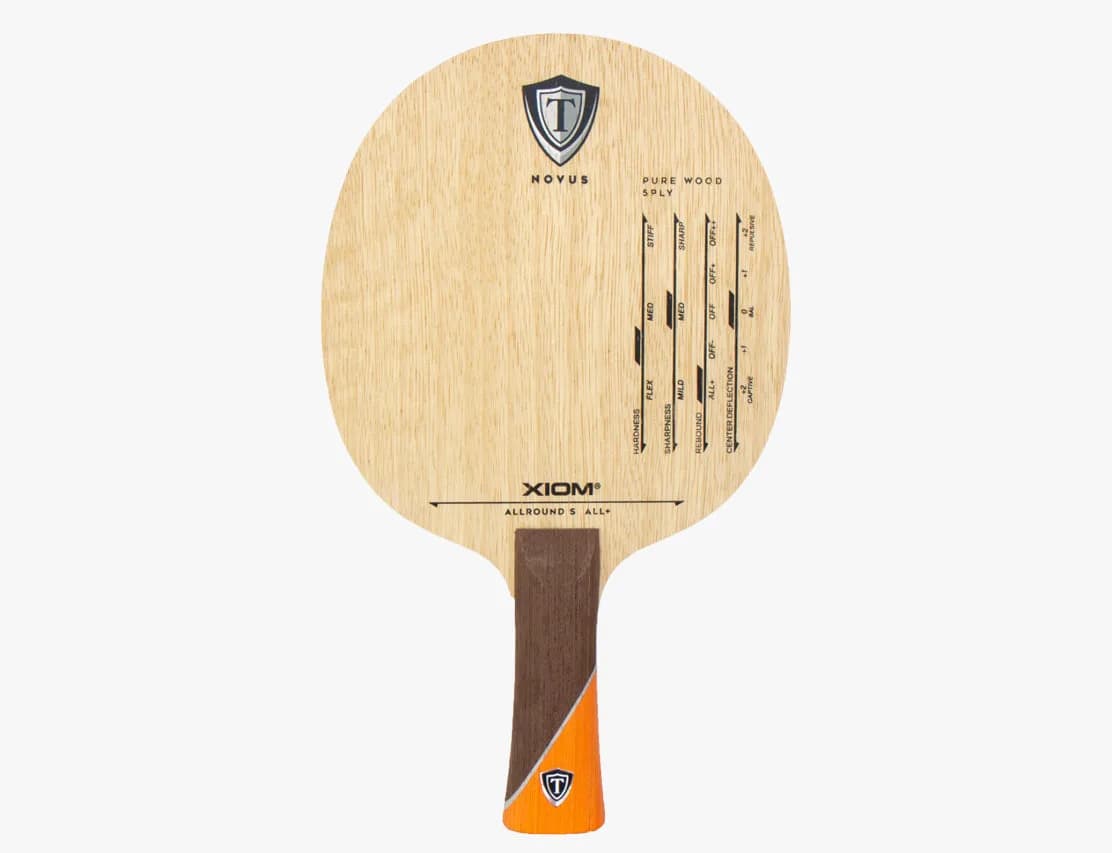
Gallery.
3 imagesIn a market ruled by carbon, high-speed blades and the constant promise of “more power”, a five-ply all-wood allround base can look like a product swimming against the tide. The Xiom Novus Allround S belongs to exactly that category many catalogues push to the back pages, and which nevertheless remains the most sensible starting point for a huge share of players: the control blade, European in conception, meant for learning, for feeling the ball and for building the point rather than blowing it apart.
This review looks at what the Novus Allround S actually offers on the table, which player profile it makes sense for, how it stands against the classic references of the same segment — beginning with the inevitable Stiga Allround Classic — and where its limits are. The aim is not to repeat Xiom’s sales pitch, but to help decide whether this base fits a given game or whether the player’s level is already asking for something else.
What the Novus series is
The Novus series is one of Xiom’s longest-running families. It was born with the brand as a range designed to cover the whole spectrum of styles — from defence and allround through to pure attack — with classically conceived constructions. Within that logic, each model’s surname states its character: Allround, Offensive, Extreme, and so on, while the trailing letter (S, among others) qualifies the feel or the hardness of the build.
The Novus Allround S occupies the control rung of the family. It is a blade of five all-wood plies, with no synthetic fibre at all (no carbon, no aramid, no glass), true to the European school of allround blades: soft, flexible, with a contained trajectory and a long contact time that favours spin and precision over speed. It is, in essence, Xiom’s reading of an archetype that Stiga, Butterfly, Donic and Yasaka have been building for decades.
Construction and design philosophy
The Novus Allround S is a simple, honest construction: five all-wood veneers, no reinforcement, a thickness of around 5.4 mm and a balanced weight in the region of 82–85 grams. Xiom does not publish the exact ply layout in detail, but the behaviour is that of a traditional European allround base: a relatively soft outer ply with good grip, a light core and an elastic response that works through the flex of the whole blade rather than through the rebound of a stiff fibre.
That absence of fibre is the key to its entire character. In a carbon blade, energy comes back fast and direct, with an artificially widened sweet spot and a drier ball launch. Here the opposite happens: the ball sinks slightly into the blade, stays an instant longer on the surface (the dwell time, the span during which the ball remains “hooked” before it is thrown off) and leaves on a medium, very controllable trajectory. The intended consequence is a blade that forgives in the touch game, that reports clearly what happens at impact, and that does not fire the ball off while the player is still refining their technique.
The manufacturer itself frames the blade in a register of control and versatility (“classic European allround”), with a slightly large and somewhat thin head surface, meant to pair well with soft sponges or medium-to-thick rubbers. It is a coherent statement of intent: this is not a base for wringing out hard, fast rubbers, but one to accompany a game built on placement and spin.
On-table behaviour
It is worth being honest about the starting point: what follows rests on the manufacturer’s specifications, on the published laboratory tests of the Novus series and on the converging assessments of players and reviewers, not on weeks of personal use with this particular blade. That said, the portrait the sources draw is very consistent and matches squarely what a five-ply all-wood allround blade is expected to do.
Speed. The Novus Allround S is, deliberately, a slow blade by current standards. It sits clearly in ALL / ALL+ territory, a step — sometimes two — below any modern offensive carbon base. This is not a flaw but its reason for being: contained speed is precisely what allows such a wide margin of control. In close and mid-distance rallies it responds soundly, but once the player backs away from the table or tries to close points with raw power, the blade falls short. It needs the player to supply the acceleration; it does not hand it over.
Feel and contact time. This is its strongest argument. All-wood plies plus a flexible build give a soft, woody, highly informative feel: ball contact registers with clarity, and that feedback is exactly what a developing player needs to calibrate the stroke. The long contact time makes it easy to load spin on the topspin and gives a great deal of security in the touch game. Anyone coming from a stiff, springy blade will notice straight away that here the ball “stays” an instant longer on the bat.
Trajectory and spin. The arc is medium, neither especially high nor flat, which makes it comfortable and predictable. Flexing across the whole blade and offering good grip, it follows the topspin gesture well and makes spin easy to apply, above all in openings against backspin and in mid-distance rotation play. It is not a base that generates spin by itself — that comes from the rubber and the technique — but it does not get in the way: it lets the stroke work.
Sweet spot and stability. Here comes the caveat most often repeated by those who have played it. With no fibre, the sweet spot is not widened, and several users describe it as fairly small: off-centre hits lose feel and speed more noticeably than on a carbon blade. It is a trait inherent to all-wood blades of this type, not a defect peculiar to the Novus, but it is worth keeping in mind. It demands a reasonably centred strike to give its best, which in turn makes it a good learning tool: it forces the player to sharpen the contact point.
Short game and control. This is its natural ground. Pushes, touches, blocks and control flicks come out simple and safe thanks to the contained speed and the good feel. The blade inspires a lot of confidence in close play and in active defence, which is exactly what an allround base is asked for. For the player who builds the point and looks for placement before power, that reliability is its great value.
Pros
- Very high control: a generous margin for error in touch play, blocking and close-to-the-table work
- Soft, informative feel, ideal for developing technique
- Long contact time: makes spin easy to load and gives security in rotation play
- Balanced, manoeuvrable weight (≈ 82–85 g), comfortable close to the table
- Modest price, very reasonable for its target audience
Cons
- Limited speed: falls short at mid to long range and for closing points with power
- Tight sweet spot: penalises off-centre hits more; demands a centred strike
- Gets outgrown by the player who progresses and starts asking for more speed
- Little personality against the very well-established classics of the segment
Who it is for
The Novus Allround S fits two profiles particularly well. The developing player (advanced beginner, or someone who has just left the pre-assembled supermarket bat behind) who wants an honest base for learning to strike the ball, feeling it and building technique without the blade sending shots out of control. And the control allrounder who plays close or at mid distance, builds the point with placement and spin, and values consistency and feel above speed.
A game defined by mid-to-long-range attack, powerful topspins and a fast ball launch, on the other hand, will find this blade holding it back. In that case it makes more sense to move up to an offensive base — with or without carbon — matched to the player’s level.
Pairing with rubbers
Being a slow blade with a soft feel, it asks for rubbers that bring some dynamism without demanding speed from the blade. The manufacturer itself points towards soft sponges or medium-to-thick rubbers. Control rubbers or medium-hardness tensors are a logical pairing; mounting very hard, fast rubbers distorts its character and makes poor use of the base.
Three set-ups that work
- A medium-hardness tensor on both sides — brings the dynamism the blade holds back without betraying its control. The natural balance of a pure allround set-up.Allround
- A control / beginner rubber (Xiom Vega Europe, Donic Liga and the like) — for the developing player who puts learning the stroke first, with the widest possible safety net.Beginner
- A soft sponge in a medium-to-thick gauge — the combination the manufacturer itself suggests; it maximises dwell and close-to-the-table spin play.Control
How it compares with the direct alternatives
Against the Stiga Allround Classic. This is the obligatory comparison, because the Allround Classic is the historical reference of the five-ply allround segment. The Stiga offers an equally woody feel, a sweet spot many players perceive as somewhat more generous, and a more recognisable identity backed by decades of use. The Novus Allround S plays on the same ground with a very similar character; the choice between them may come down to availability, price and brand preference. For anyone after “the” benchmark allround blade, the Stiga is still the yardstick; the Xiom is a perfectly valid and often cheaper alternative.
Against the Donic Appelgren Allplay. Another classic of European control. The Appelgren Allplay moves in the same register of contained speed and soft feel, with a settled reputation as a beginner and allround blade. The differences between the two are matters of nuance rather than of concept: both are after the same thing and both achieve it.
Against an entry-level offensive base (the Butterfly Korbel and its kind). For anyone hesitating between staying in pure allround and going one step up, it pays to be clear: the Korbel and similar bases are five-ply blades, but of offensive cut (OFF−), faster and with more travel. Where a player already senses that their game is asking for speed, the Novus Allround S may be outgrown sooner than expected, and starting a rung higher may well be worth it. Where the absolute priority is learning with control, the Novus does that job better.
Frequently asked questions
Does the Novus Allround S contain carbon?
No. It is a five-ply all-wood blade, with no synthetic fibre at all. Its whole behaviour — soft feel, high control, contained speed — comes precisely from that traditional construction.
Is it a good blade to start with?
Yes, that is one of its main uses. Its high control and informative feel make it suitable for learning to strike the ball and developing technique. It is, however, a blade that can fall short as the player progresses.
Why does it sometimes appear as “Novus 19 Allround S”?
The “19” is part of the internal nomenclature of Xiom’s Novus series. It refers to the same product; it is not a different model.
Which rubbers does it pair well with?
Being a slow blade with a soft feel, it asks for rubbers that bring some dynamism without demanding speed from the blade. The manufacturer points towards soft sponges or medium-to-thick rubbers. Control rubbers or medium-hardness tensors are a logical pairing; mounting very hard, fast rubbers distorts its character.
Does it suit a defensive player?
Its register of control and contained speed fits active defence close to the table and allround play, but it is not a specific defensive blade (those tend to be larger, slower and more flexible). For classic defence at distance there are more specialised constructions.
Rating by dimension
The allround archetype, well executed and without surprises.
The Xiom Novus Allround S is exactly what it claims to be: a classic allround blade, five all-wood plies, built for control and for learning. It does not try to surprise anyone or to offer anything the great references of the segment have not offered already, and that modesty is both its virtue and its limit. As a tool for feeling the ball, developing technique and playing safely close to the table, it is a sound option at a reasonable price. Its two more serious drawbacks — limited speed and a tight sweet spot — are inherent to this kind of construction; its big warning is a short shelf life, because many players outgrow it as soon as their stroke matures. For anyone after a control base to start well, or for a pure allround style, it will not disappoint. For a player who already senses that their game is asking for speed, it is probably better to look one step up from the outset.