
Andro
Rasanter R53.
The hard end of the Rasanter range: top-tier speed and spin on the full stroke, for the advanced hitter who knows what he is doing.
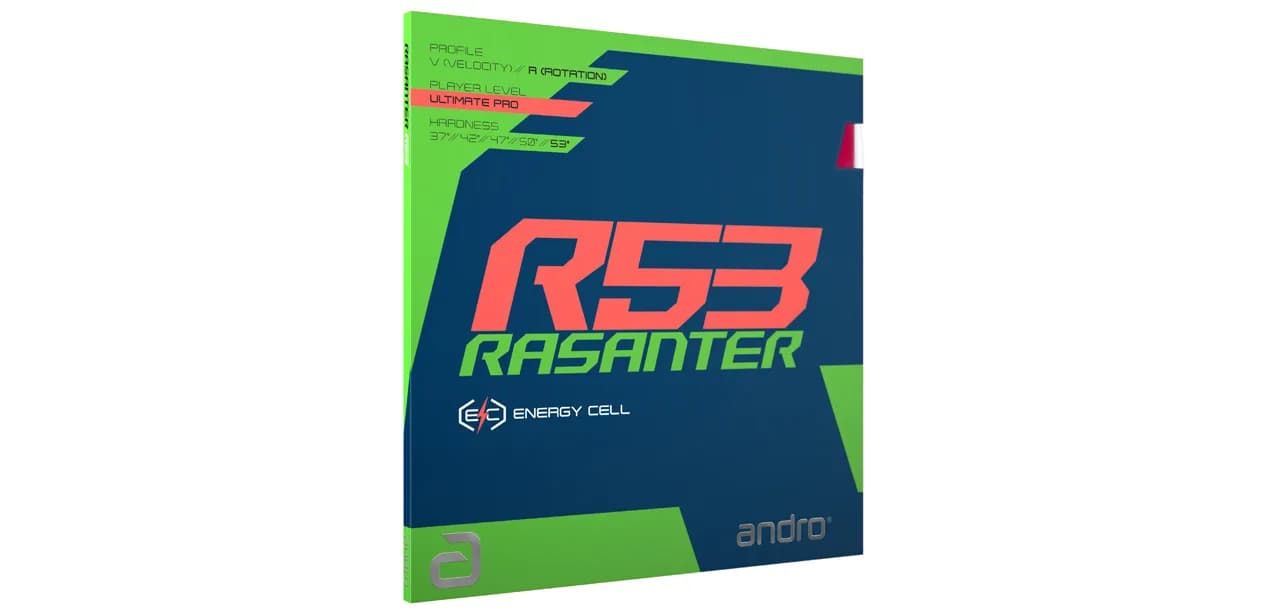
Gallery.
2 imagesWithin Andro's Rasanter series, the R53 occupies the hard end of the catalogue, the one the brand reserves for the most aggressive, most powerful game. If the R47 is the central, safe-recommendation option, the R53 raises the stakes: more hardness, more speed on the full stroke and, in exchange, a markedly higher technical demand. What follows is what it actually offers on the table, where it shines, where it punishes the player who is not up to it, and the profile for which it genuinely makes sense.
What it is and what it sets out to be
The R53 is an inverted rubber —inverted: a smooth contact surface with the small pimples turned inwards, glued to the sponge— of the kind known as a tensor rubber. A tensor rubber has a topsheet and a sponge built so that the assembly sits under pre-tension, like a loaded trampoline. When the ball strikes, the rubber sends it back with extra speed and launch —the so-called catapult effect— without the player having to supply all the energy with the arm.
Within the Rasanter series, Andro orders its rubbers by sponge hardness, and the number attached to each model states exactly that: the R37 carries a soft sponge, the R47 a medium-hard one and the R53 the hardest in the family. The number sets the character: the higher it is, the firmer the sponge, the more power on the full stroke and the more it demands. The R53 is therefore the most offensive and least forgiving proposition in the range.
One design trait shared by the whole series explains much of its behaviour: Andro maximises sponge thickness to 2.3 mm —what it calls Ultramax— and thins the topsheet in exchange, since ITTF rules cap total thickness at 4 mm. In the R53 that sponge is also of the Energy Cell type: a high-elasticity cellular structure conceived to return energy in a particularly dynamic way on fast, powerful strokes. The result is a rubber that rewards a full, committed impact, and one that turns out to be less generous when the stroke is tentative.
The specifications that matter
Sponge hardness. Around 53° on the ESN scale, squarely in hard-sponge territory. This is its defining trait: the firmness brings speed and sustains maximum-power strokes, but it demands real acceleration to sink the ball into the sponge and wake the catapult up. With one nuance many players underline: despite that high number, the feel comes out rather more benign than the figure would suggest, thanks to a thin, elastic topsheet. It does not mislead about its nature, though: it is still a hard rubber that asks for technique.
Thickness. It comes in 1.7, 2.0 and 2.3 mm (Ultramax). For the attacking game it aims at, maximum thickness is the coherent choice. The thinner options trim speed and weight in exchange for a little more control, and can make sense on the backhand of a player who prioritises placement, but they waste much of the R53's reason for existing.
Weight. It is a heavy rubber, in the region of 51 to 53 grams in 2.3 mm before cutting, above its sibling the R47. Mounted in Ultramax on a blade that is already heavy in itself, it can produce an emphatic but tiring bat, short on agility in the close game and over long matches. Anyone who values handling should factor that in when choosing blade and thickness.
Tack. Very light, barely perceptible. This is not a tacky rubber in the Chinese style: its spin does not come from the sticky grip of the surface but from friction and deformation on impact. That said, the grip of its topsheet is notable, with a contact that bites the ball well on a stroke with travel, which lets it generate very high spin when the stroke is full.
Behaviour in play
The trait that best defines the R53 is that it rewards the full, committed stroke. When the player really accelerates and hits with travel, the response is emphatic: plenty of speed, abundant spin and a penetrating ball that arrives early on the other side. It gives its best version to the power topspin, both over the table and at mid-distance, and repays the player who strikes decisively many times over.
The flip side is just as clear: it punishes the tentative stroke. Because of its hardness, the R53 needs the player to open the sponge up with a full impact; on soft or barely accelerated touches, the ball does not penetrate enough and the rubber shows itself to be less generous. That is not a flaw but the logical consequence of a hard sponge: whoever does not hit hard gets nothing out of it.
The trajectory is tight and fairly direct, with a medium arc. That translates into fast, flat-flying, very penetrating balls, but also into less margin over the net: it demands good control of the contact point, because a ball opened up with little cover tends to go long. In exchange, that direct character brings consistency in the fast exchange, provided the technique is there.
In the close game and the counter-attack, the R53 is reliable when it is played actively: block with intent, counter-topspin over the table and hitting at the top of the bounce. It is not as comfortable as the R47 for the player who wants to redirect without committing to the stroke, but in firm hands it offers a fast, stable response. Spin at low speed —short touches, drop shots— is the trickiest ground: not being tacky and carrying a hard sponge, the R53 does not spin by itself on soft strokes and requires correct contact technique. Like the rest of the series, it also stands out for its durability: it holds its performance for a long time, with slow wear that makes it good value over the long run.
Pros
- Very high speed and spin on the full stroke, among the best in its segment.
- An emphatic response to power topspin, close in and at mid-distance.
- Feel more benign than its hardness suggests, thanks to the thin, elastic topsheet.
- A tight, penetrating trajectory, very effective in the fast exchange.
- Excellent durability, with the slow wear typical of the whole Rasanter series.
Cons
- Very demanding technically: it punishes the tentative stroke and does not forgive imprecise contact.
- High weight, which can drag on handling if combined with a heavy blade.
- Less control and margin than the R47, above all in the passive game and at low speed.
- A direct arc that leaves little margin over the net if the ball is not covered well.
- Not suitable for beginners or for a technique still being formed.
Which player is it designed for?
The Andro Rasanter R53 has a narrow, well-defined audience: the advanced attacking player, with a fully settled topspin technique, who bases their game on hitting hard and with travel and is looking for a hard rubber that repays the full impact with high-level speed and spin. It is a natural choice for the hitter who plays close in and at mid-distance and knows how to really accelerate on every stroke.
The forehand is where it expresses itself best, in the service of an attacker who imposes their hitting. The backhand demands a firm technique: whoever uses it mainly to block and place will find more comfort in softer rubbers or in the R47 itself; whoever attacks with the backhand too can get something out of it, ideally in a slightly smaller thickness to keep the weight down. It is not the rubber for the beginner, nor for the intermediate still refining a topspin: that profile will progress far better with a softer, more tolerant rubber, starting with the lower-hardness versions of the series itself.
Recommended set-ups
- A balanced OFF carbon-fibre blade on the forehand: it squeezes out the R53's speed and spin on the power topspin, with the firmness the hard sponge asks for.Forehand · power
- To keep the weight down on the backhand, the R53 in 2.0 mm on an OFF– or ALL+ blade with good control: a little more margin without giving up its character entirely.Backhand · contained weight
- For balance rather than the extreme, the natural alternative is the Rasanter R47: the same language, more tolerance and less weight.Balanced alternative
Comparison with the alternatives
The inevitable comparison is with its sibling, the Andro Rasanter R47. Both share a language —thick sponge and thin topsheet, very light tack, direct trajectory and good durability— but they differ in character. The R47 is the balanced option: a little slower on the full stroke, but more controllable, more tolerant and easier to handle thanks to its lower weight. The R53 raises the power and the top speed in exchange for more demand, less margin and more weight. The rule is simple: whoever wants high performance without giving up control should stay with the R47; only the player who really hits hard will feel the difference fall in favour of the R53.
Against the Butterfly Tenergy 05 Hard, the benchmark of the Japanese hard segment, the Tenergy tends to describe a slightly higher arc and a livelier sensation in the spin, while the R53 answers with a more direct, firmer trajectory, and plays the card of superior durability and a somewhat more contained price. Against the Tibhar Evolution MX-P, a European tensor rubber with a medium-hard sponge, the difference is one of hardness and purpose: the MX-P is explosive but more accessible on the medium stroke; the R53 is harder and more demanding, and asks for a fuller hit to perform. Within the Rasanter series itself, the R53 is the offensive summit, the natural step for the player who has taken the R47 to its limit and wants more power and hardness.
Rating by dimension
The hard end of the range, for those who know how to hit.
The Rasanter R53 deliberately gives up the tolerance and margin of its sibling the R47 and offers, in exchange, a hard extreme with top-tier speed and spin on the full stroke, a penetrating trajectory and the excellent durability of the whole series. In the hands of the advanced attacker who hits hard and has a settled technique, it is one of the most emphatic options in its segment. For everyone else, the R47 remains the more sensible way into the range.