
Xiom
Vega Pro.
The tensor rubber that earned its reputation the hard way: hard, direct and linear. It does not forgive hesitation, but it rewards the player who strikes with intent —and at a price that has made sense for more than fifteen years.
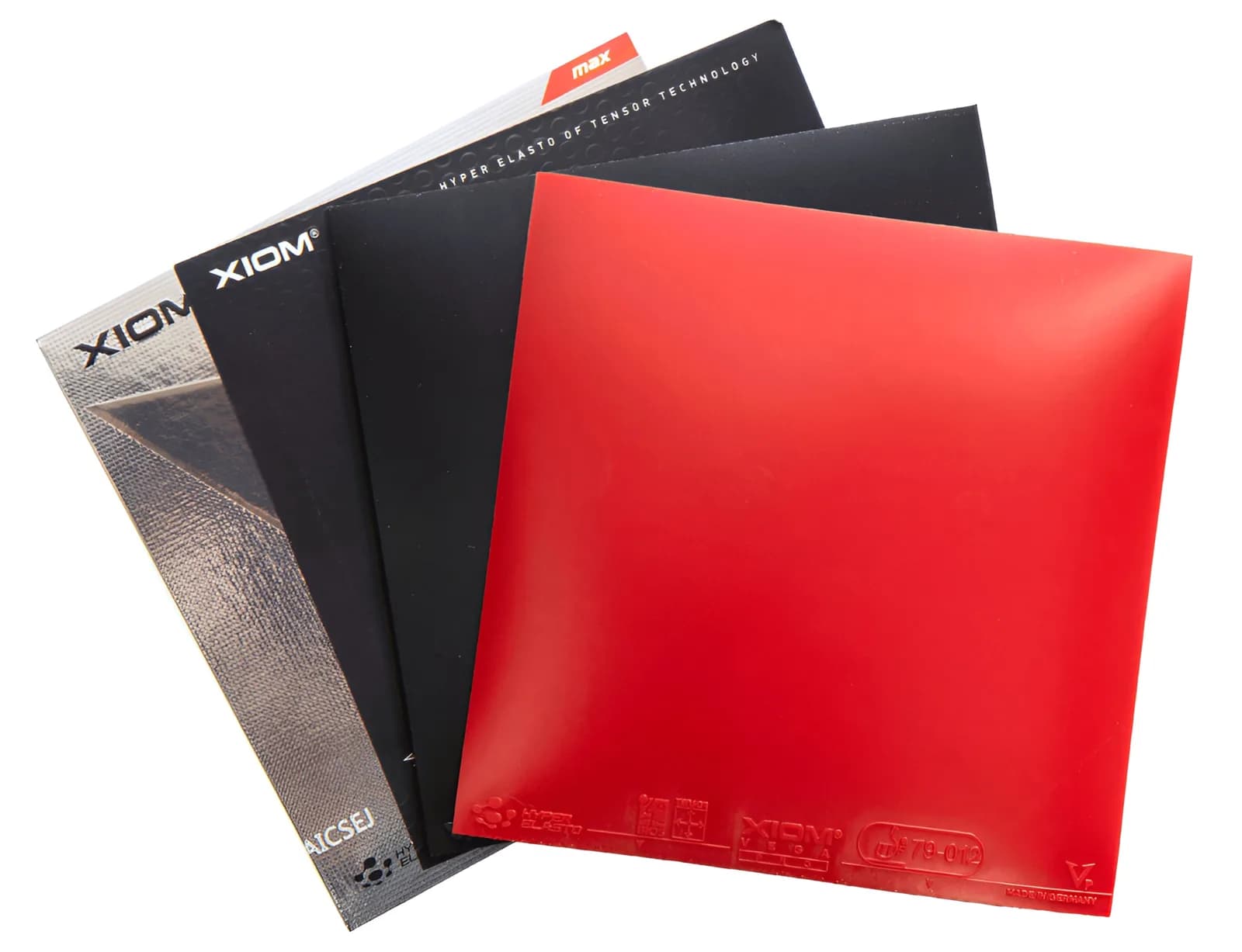
Gallery.
2 imagesFew rubbers have had a career as long and as respected as the Xiom Vega Pro. Launched in 2009, when the European tensor revolution was beginning to dispute Butterfly's throne, it quickly became a reference for the offensive player after high performance without paying elite prices. More than fifteen years later it is still in the catalogue, still selling and still turning up on the bats of plenty of club players. That longevity, in a market that renews its models almost every season, already says a good deal.
This review goes over what the Vega Pro actually offers on the table, which kind of player it makes sense for today and how it stands against its direct alternatives. It is worth saying from the outset that this is a rubber with a defined character: it does not set out to be comfortable or to forgive mistakes, but to reward the player who puts speed into the stroke.
Context: what it is and where it comes from
The Vega Pro belongs to Xiom's Vega family, the range that made the Korean brand popular in Europe. Within that family it occupies the most demanding step: above the Vega Europe, Vega Intro or Vega Asia, and with a different premise from more recent versions such as the Vega X.
Technically it combines two elements Xiom presented at the time as its hallmarks: a topsheet named Hyper Elasto, with the pimples densely arranged —which contributes to its firm touch— and a fine-pore black sponge known as Carbo Sponge. The brand insists on the efficiency of that sponge in converting swing speed into ball speed, and on the superior durability of its tensioned structure. The latter deserves a caveat: the Vega Pro has a reputation for standing up well to the passage of time, although several users point out that the sponge loses some performance after prolonged use, something common to almost every tensor rubber anyway.
It is worth explaining what "tensor" means for the less technical reader: it is a rubber that carries an internal tension built in at the factory, which increases the spring effect without needing to be treated with oils. That effect —the catapult— is what supplies the extra speed to the stroke. In the Vega Pro that spring effect exists, but it is measured: the rubber responds in proportion to the force applied to it, not explosively.
On-table behaviour
A hard touch and a linear response
The first thing noticed with the Vega Pro is its firmness. The 47.5° of sponge, added to a topsheet with densely packed pimples, produce a rubber with a solid, far from soft touch, one that transmits the sensation of the ball on impact well. It is not a "comfortable" rubber in the sense of the soft, elastic sheets that do half the work for the player.
Its most characteristic trait —and the one that explains much of its reputation— is linearity. The speed it returns is very proportional to the speed put into it. This means it answers a soft stroke with moderation and a full stroke with power, with no abrupt jumps between the two extremes. For the player with a sound technical stroke this translates into predictability: they know what will happen when they strike, and that reliability is gold in fast exchanges.
Attack: its natural ground
The Vega Pro is designed to attack. On topspin close to the table it offers a taut, direct trajectory, with a flatter arc than rubbers with a great deal of grip. That makes it especially effective on finishing strokes, spin smashes and counter-attacks at mid distance. The ball leaves fast, penetrating and on a curve that looks for the corner rather than the safety of the net.
On spin an honest clarification is in order. Aggregated user ratings score it very highly for rotation, but the more detailed technical reviews agree that it generates good spin, though below the ultra-offensive rubbers with extreme grip that dominate the market today. Its strength is not pure spin but the combination of speed and control with enough spin for an aggressive game. It is an important distinction: whoever is after maximum grip for heavily loaded serves, or for opening from below the table with little margin, will find more specific options.
Block and passive play
Its hardness and direct behaviour make it a solid rubber on the block. The ball comes off with depth and speed, which puts the pressure back on the opponent. Passive play and the defensive chop, by contrast, are not its speciality: the firmness of the sponge and the taut trajectory mean the soft game demands more precision and more wrist sensitivity.
Distance matters
One point that comes up repeatedly: the Vega Pro performs best close to and at mid distance from the table. Further back, its measured spring effect forces the player to supply more of their own power to keep the ball deep. It is not a rubber that "pushes" on its own from a distance, as some tensors with a more reactive sponge do. The active blocker and close-range attacker will make more of it than the defender playing far back.
Who it is for
The Vega Pro has a fairly clear addressee: the intermediate or advanced offensive player with a technical stroke already formed, who strikes decisively and builds their game close to or at mid distance from the table. It is on the forehand side that it shines most, although advanced players with a powerful backhand can also make it work.
It is not a rubber to recommend to the beginner still building a technique: its lack of forgiveness and its hard touch will slow the learning down. Nor to the player whose strategy rests on maximum spin or on the far game. For those profiles there are more suitable options. It is, on the other hand, a very sensible choice for whoever is after high performance on a tight budget and values reliability above spectacle.
Comparison with the alternatives
Placing the Vega Pro against its competitors helps in deciding. The Butterfly Tenergy 05, the historical reference among grippy tensor rubbers, generates more spin and a more pronounced arc with less effort, thanks to its very reactive sponge; the Vega Pro is harder, more direct and more linear, with less "help" from the spring effect, but at a far lower price. The Andro / Donic Rasanter R47 (or R48) are modern tensors of similar hardness and a more "explosive" character, with a more marked catapult; the Vega Pro responds in a more measured, proportional way. The Yasaka Rakza 7, a direct competitor in the price-to-performance bracket, tends to offer a little more spin and a slightly grippier touch, while the Vega Pro stands out for its direct trajectory and linear response. And within the family itself, the Xiom Vega X looks for more spin and control with a more modern character: it is the logical evolution for whoever wants an updated Vega, while the Pro keeps the more direct, classic premise.
Conclusion
The Xiom Vega Pro is one of those rubbers that age well because they never promised more than they deliver. It is not the fastest, it is not the one that generates the most spin and it is not the most comfortable on the market. What it offers is something harder to find: a linear, predictable and reliable response, with enough speed to attack with authority and a price that keeps it within reach. It remains a solid recommendation for the intermediate or advanced attacker who values reliability and value for money above the latest fashions in extreme spin.
Pros
- Linear, predictable behaviour, which translates into reliability in the exchanges
- Medium-high speed with a direct trajectory that is very effective in finishing
- Good control for its hardness category, unusual in fast rubbers
- Excellent performance for the price: high-end play at a cost appreciably below the Butterfly benchmarks
- Recognised durability, above the average for tensors
- Contained weight (~49 g) for a hard rubber
Cons
- Direct, demanding trajectory: being taut and deep, it forgives little; an imprecise stroke goes long easily
- Spin below the current extreme-grip rubbers; not the best choice for whoever builds their game on pure rotation
- Requires a good physical engine: the player with a passive arm will struggle to get anything out of it
- Declining performance away from the table, owing to its measured spring effect
- Little comfort in the soft and defensive game, a consequence of its firmness
Which blade to pair it with
Being a hard, fast rubber with a linear response, the Vega Pro asks for a base that gives feel back without taking away its direct character. With offensive control blades (Off / Off−) the whole gains predictability and makes good use of its linearity; with carbon blades terminal speed is reinforced, at the cost of demanding even more precision. It is on the forehand that it looks best, so many players reserve it for that side and mount something more forgiving on the backhand.
Set-ups that work
- Allround-offensive 5-ply blade + Vega Pro max. on the forehand — control and a direct trajectory for building and finishing.Allround
- Carbon blade (Off) + Vega Pro max. — high terminal speed for the hitter with a good physical engine.Offensive
- Vega Pro on the forehand + a softer, grippier rubber on the backhand — it spreads demand and comfort across the two sides.Forehand
Rating by dimension
It ages well because it never promised more than it delivers.
The Xiom Vega Pro is not the fastest, it is not the one that generates the most spin and it is not the most comfortable rubber on the market. What it offers is something harder to find: a linear, predictable and reliable response, with enough speed to attack with authority and a price that keeps it within reach. It is a rubber for the player who wants to control their game rather than be controlled by it: it rewards whoever strikes with intent and penalises whoever hesitates. That it has stayed in the catalogue for more than fifteen years is no accident —it does well what it promises, and it still does.