
Andro
Rasanter R47.
The German tensor rubber that gives up being the fastest to offer something harder: an uncommon balance of speed, spin and control. Linear behaviour, reliability on the counter, and durability that makes it pay off over time.
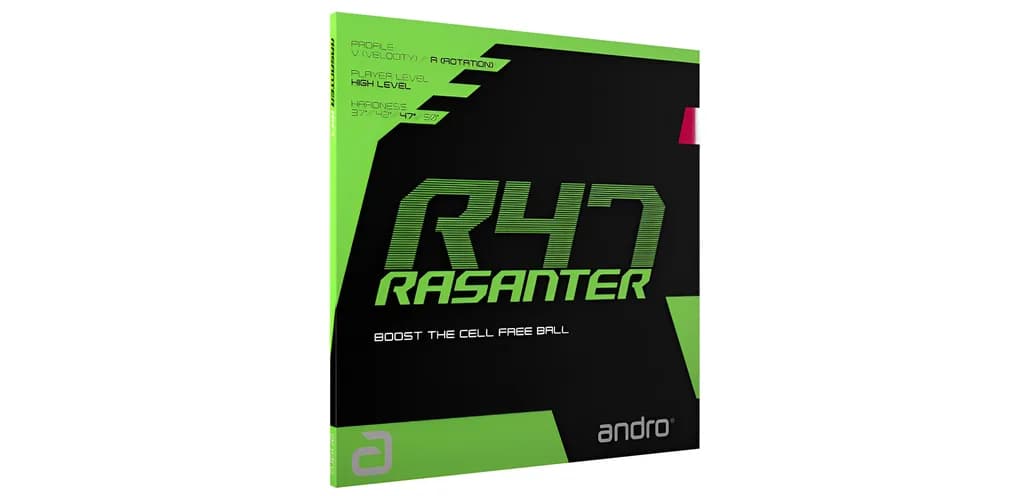
Gallery.
2 imagesWhen Andro rebuilt its offensive catalogue around the Rasanter series, it had a specific target in mind: a modern European tensor rubber able to go toe to toe with the high-end Japanese sheets, but with an identity of its own. Of the whole family, the Rasanter R47 has become the central reference, the one most players recommend when someone asks for a tensor that is fast but civilised. This review looks at what it actually delivers on the table, where it stands out, where it shows its limits and which kind of player it makes sense for.
Context: what it is and what it sets out to be
It is worth placing the product before going into detail. The R47 is an inverted rubber — a smooth contact surface with the small pimples facing inwards, glued to the sponge — of the type known as a tensor rubber. That expression is the key to everything else.
A tensor rubber pairs a topsheet and a sponge built so that the assembly sits under permanent pre-tension, like a loaded trampoline. When the ball lands, the rubber sends it back with extra speed and launch — the so-called catapult effect — without the player having to supply all the energy with the arm. Compared with classic untensioned rubbers, this kind of surface offers more speed and more potential spin, at the price of demanding better technique to control it.
Within the Rasanter series, Andro sorts its rubbers by sponge hardness, and the number attached to each model states exactly that: the R37 carries a soft sponge, the R53 a very hard one, and the rest sit on the steps in between. The R47 occupies the medium-hard point of the range, the one usually considered most versatile and the safest recommendation. Its intent is clear: a modern offensive tensor, fast and very spinny, but designed to be governable by a wide spread of players, not only by the most extreme hitter.
One design trait deserves a mention, because it explains much of the behaviour. Andro builds the R47 around maximising sponge thickness up to 2.3 mm — what the brand calls Ultramax — thinning the topsheet in exchange, since ITTF rules cap total rubber thickness at 4 mm. The practical consequence is that the ball sinks further into the sponge on impact, which favours very high spin without giving up speed.
Specifications that matter to the player
Only a few numbers on the data sheet matter, but they are decisive.
Sponge hardness. It sits around 47° on the ESN scale (the usual reference for European rubbers of this type), which places it in medium-hard territory. That is an important hardness point: firm enough to transmit speed and hold up powerful strokes, but short of the stiffness of the hardest sheets on the market. One nuance many players underline: despite that number, the R47 feels somewhat more forgiving than the figure would suggest, with a touch that is firm without being harsh.
Sponge thickness. It comes in 1.7 mm, 2.0 mm and 2.3 mm (Ultramax). For the offensive game the rubber aims at, maximum thickness is the natural choice: it makes the most of the thick-sponge, thin-topsheet concept that defines the product. The thinner options trade speed and weight for a little more control, and can make sense on the backhand of a player who prioritises placement, but they leave part of the R47's reason for existing on the table.
Weight. This is a moderately heavy rubber, in the order of 49 to 50 grams in 2.3 mm before it is cut to the shape of the bat. That is one of its quiet arguments: for the performance on offer, it is not a particularly heavy sheet, which makes it easier to assemble a balanced, manageable bat. Against other high-end tensors that weigh considerably more, the R47 proves less tiring in the close game and in long matches.
Tack. The surface has very light tack, barely perceptible. It is not a sticky rubber in the Chinese mould: its spin does not come from a tacky grab at the surface, but from friction and deformation on impact. That said, the grip of the topsheet is notable, with a contact that bites the ball well and hardly slips, which lets it generate plenty of spin on strokes with a long swing.
On-table behaviour
This is where an offensive rubber really defines itself, beyond the manufacturer's figures.
The trait that best defines the R47 is its balance. It is neither the fastest rubber in its category nor the one that generates the most spin, but it combines both qualities at a very high level with a degree of control unusual in such an offensive tensor. On topspin with a full swing it answers with a fast launch and a medium arc, more direct than curved, and with abundant spin thanks to a grip that hardly slips. It is a rubber that rewards an active, committed stroke: when the player really accelerates, the reply is emphatic; when the stroke is reduced to blocking or pushing without intent, the rubber asks for more involvement before it gives its best.
The trajectory is a distinguishing figure. The R47 traces a medium arc, quite taut and direct, which translates into fast, penetrating balls. That direct character demands control over the contact point — an open ball with little margin tends to fly long — but in exchange it offers great consistency: many players single out its linear behaviour, meaning the sense that the rubber's response is proportional and predictable to the stroke, with no surprises. That linearity is one of its strongest cards and explains why it inspires so much confidence.
Where the R47 shines in particular is in the counter close to the table. Its combination of measured speed, grip and control makes it very reliable in topspin exchanges at mid distance and on counter-topspin over the table, situations where predictability and stability are worth more than raw power. It is a rubber that makes active blocking, redirecting and hitting at the top of the bounce feel comfortable.
On spin at low speed — short touches, the push, the game over the table — it acquits itself well for a fast tensor. It is not tacky, so it does not spin the ball on its own in soft strokes and needs correct contact technique, but its good grip and reasonable control make it easier to handle in the short game than other, more explosive tensors with a lower arc.
The point where it shows its limits is the far game at maximum power. The R47 is fast, but it does not belong to the category of the most explosive tensors: away from the table and without a full, accelerated stroke, winners are hard to extract from it. A player whose game is built on powerful topspin from mid-to-long distance will notice that it lacks the last degree of speed the harder, more catapult-heavy rubbers offer. That is not a fault but a logical consequence of its balanced premise: the R47 trades a share of top-end power for control and consistency.
One aspect that deserves explicit praise is its durability. Unlike many tensors with pronounced catapult, which give their best version for a few weeks and then fall away, the R47 stands out for holding its performance over a long period, with very slow wear. That is a real cost factor over time, and it works clearly in its favour, setting it apart from much of the European competition.
Who it is for
The Andro Rasanter R47 has a broad but well-defined addressee: the intermediate or advanced offensive player whose topspin technique is already in place, looking for a fast, spinny tensor but unwilling to give up control or consistency. It is an especially sound choice for whoever plays close to and at mid distance from the table and values reliability on the counter above raw power.
It works very well on both the forehand and the backhand. On the forehand it gives a balanced attacker the mix of speed and control many players are after. On the backhand, its linear character and good contact make it a solid option for active blocking and counter-topspin over the table.
By contrast, it is not the right rubber for the beginner still forming a topspin technique, who will progress better with a softer, more forgiving sheet — within the Rasanter series itself, the softer-sponge versions fill that role. Nor is it the best choice for the pure hitter whose game is built on maximum-power topspin from distance: that profile will find more room in harder, more explosive tensors.
How it compares
The unavoidable comparison is with the Butterfly Tenergy 05, the historical reference in this segment. The R47 has earned a reputation as a more affordable European alternative on its own ground, and the comparison is revealing: both offer plenty of spin and high speed, but the Tenergy 05 tends to trace a higher, more curved arc and feels somewhat livelier, while the R47 replies with a more direct trajectory and a firmer, more linear touch. Many players consider the R47 slightly less magical in pure spin but more predictable and consistent, as well as clearly longer-lasting. The choice is largely one of style and budget.
Against the Tibhar Evolution MX-P, another European tensor with a medium-hard sponge, the difference is one of character. The MX-P is faster and more explosive, with a lower arc and a more extreme offensive slant, but it is also more demanding and its performance falls away sooner with use. The R47 concedes some top speed in exchange for more control, more arc and, above all, far better durability. Whoever prioritises hitting hard from distance may prefer the MX-P; whoever is after balance, consistency and longevity will find the R47 the rounder proposition.
Within the Rasanter series itself, the R47 is the central option and the safest recommendation. Anyone who finds it too firm can look towards the softer-sponge versions of the range, which add tolerance at the cost of speed; anyone after more power and hardness has the harder models of the series available. That is one of the family's virtues: it allows a player to move up in hardness without changing language, and the R47 is the natural starting point for most.
Final assessment
The Andro Rasanter R47 has earned its benchmark status on a solid argument: it is an offensive tensor that gives up being the fastest or the most explosive in order to offer, in exchange, an uncommon balance of speed, spin and control. Its linear behaviour, its reliability on the counter, its contained weight and its remarkable durability make it one of the soundest choices in its segment, above all for the player who wants high performance without sacrificing consistency.
Its limits are the coherent flip side of its virtues: whoever is after maximum power from mid-to-long distance will find more emphatic rubbers, and whoever does not take an active part in the stroke will not get everything out of it. But for the intermediate-to-advanced offensive player who values control as much as speed, the R47 is a hard choice to improve on within its category, and one of the best ways into the world of high-end European tensors.
Pros
- Outstanding balance of speed, spin and control, unusual in such an offensive tensor
- Linear, predictable behaviour that inspires confidence and helps consistency
- Great reliability on the counter and in the game close to the table
- Very high spin thanks to its grip and the thick-sponge, thin-topsheet concept
- Moderate weight, which makes a balanced, manageable bat easier to assemble
- Excellent durability, with slow wear that makes it pay off over time
Cons
- Less top-end power than the most explosive tensors, above all in the far game
- Demands an active game: it gives little without stroke and acceleration
- Direct arc that leaves little margin unless the contact point is controlled
- Mid-to-high price, in keeping with the range it competes in
- Not suited to a technique still in the making that needs a rubber to forgive and place the ball on its own
Which blade to pair it with
Being a balanced rubber, contained in weight and with a medium-direct arc, the R47 adapts well to a wide range of blades. On offensive control bases (Off / Off−) it forms a linear, reliable whole, ideal for the player close to the table who is after consistency; on carbon blades it gains terminal speed for the mid-distance game without sending the total weight up, thanks to how modest it is on the scales. Its docile character makes it equally valid on the forehand and the backhand.
Set-ups that work
- Offensive control blade (Off−) + R47 Ultramax — a linear, consistent whole for the player close to the table who prioritises reliability.Allround-Off
- Carbon blade (Off) + R47 Ultramax — adds terminal speed without loading up the weight, taking advantage of how light the rubber is.Offensive
- R47 on both sides — its docility and linear character make it equally dependable on forehand and backhand for a balanced game.Balance
Rating by dimension
Balance made rubber — fast, spinny and, above all, reliable.
The Andro Rasanter R47 has earned its benchmark status on a solid argument: it gives up being the fastest or the most explosive rubber in order to offer, in exchange, an uncommon balance of speed, spin and control. Its linear behaviour, its reliability on the counter, its contained weight and its remarkable durability make it one of the soundest choices in its segment. Its limits — less top-end power from distance, and the demand for an active stroke — are the coherent flip side of its virtues. For the intermediate-to-advanced offensive player who values control as much as speed, it is a hard choice to improve on.