
Tibhar
Evolution EL-P.
The sensible sister of the Evolution series: medium sponge, medium-high arc and an even balance of speed, spin and control, with no rough edges. For the attacking player who finds the MX-P too hard but does not want to give up the spinny character of the range.
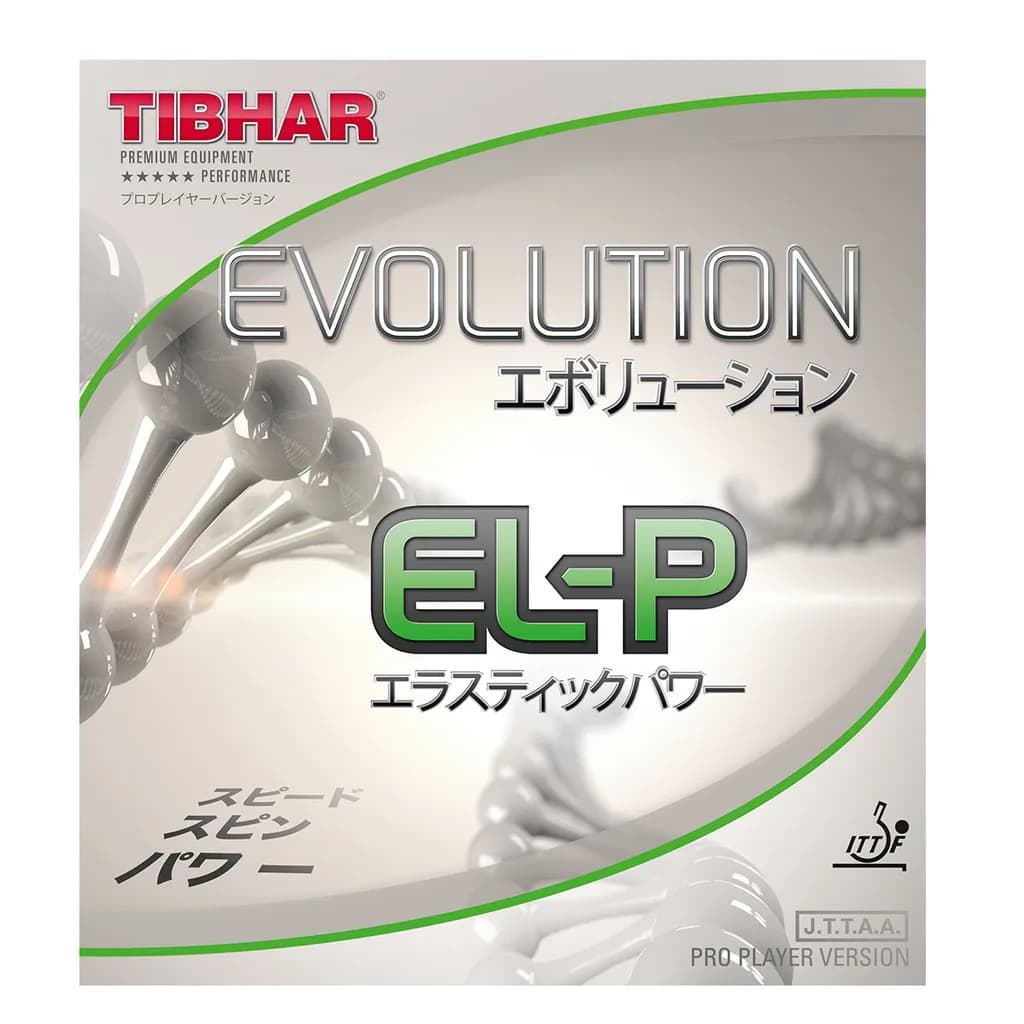
Gallery.
0 imagesWithin Tibhar's well-known Evolution series, the MX-P has taken the spotlight for years as the fast, explosive rubber of the range. But the family is a wide one, and not every player needs — or is well served by — the most aggressive sister. The Evolution EL-P sits in between and, for many, in a more sensible place: an offensive tensor rubber with a medium sponge, made for anyone who wants the spin game of the series without the demanding character of the harder versions. This review looks at what it actually offers on the table, where it shines, where its limits show and which kind of player it makes sense for.
Context: what it is and what it sets out to be
It helps to place the product before going into detail. The EL-P is an inverted rubber — a smooth contact surface with the little pimples turned inwards, against the sponge — of the kind known as a tensor rubber.
A tensor rubber pairs a topsheet and a sponge built so that the assembly sits under permanent tension, like a loaded trampoline. When the ball lands, the rubber sends it back with extra speed and launch — the so-called catapult effect — without the player having to put all the energy in with the arm. Compared with classic non-tensioned rubbers, this kind of surface gives more speed and more potential spin, in exchange for demanding better technique to keep it under control.
The Evolution series is organised by sponge hardness and orientation. Tibhar arranges it in three levels of firmness — MX (medium-hard), EL (medium) and FX (soft) — each available in two topsheet variants, P and S, with different shades of spin and feel. On that map the EL-P sits in the middle: the medium-sponge rubber aimed at the offensive topspin game. It is, in essence, Tibhar's answer for the player who finds the MX-P too hard and too demanding, but who does not want to give up the spinny, powerful character of the range. It is not a beginner's rubber, but it is a markedly more accessible one than its harder sisters.
The specifications that matter to the player
Only a few numbers on the spec sheet really count, but those few are decisive.
Sponge hardness. It sits around 43° on the ESN scale — the usual reference for European rubbers of this type — which places it squarely in medium-sponge territory. That figure explains its character better than any other: firm enough to sustain an offensive game with speed and spin, but elastic enough to give a soft feel and a margin of control that the harder versions of the series do not have. That middle hardness is the key to everything else.
Sponge thickness. It is usually offered in 1.9 mm, 2.1 mm and max. For the offensive game the rubber is built for, the thicker options (2.1 and max) are the natural choice: they get the most out of the catapult effect and the spin potential. A thinner sponge trims speed and weight in exchange for a little more control, and can make sense on the backhand of a player who puts placement first.
Weight. It is a moderately light rubber for what it delivers, in the region of 48 grams once cut to the shape of the bat. That is a favourable and slightly surprising figure: despite its softer sponge, it weighs practically the same as the MX-P, so choosing the more controllable version costs nothing in extra grams. That moderate weight makes it easy to build a balanced, nimble bat, and makes it less tiring close to the table and over long matches.
Tack. The surface has a very slight tack, barely noticeable. This is not a sticky Chinese-style rubber: its spin does not come from the surface gripping the ball, but from friction and deformation at impact. That has practical consequences for the kind of strokes it performs best on.
How it plays
This is where an offensive rubber really defines itself, beyond the manufacturer's numbers.
The trait that defines the EL-P best is its balance between speed, spin and control. It is neither the fastest rubber in the series nor the spinniest — those places belong to the MX versions and to the EL-S — but it brings the three attributes together in a particularly harmonious proportion. On the opening topspin it produces considerable spin, with a quick launch that never quite becomes explosive, and it does so with a safety margin its harder sisters do not offer. It is a rubber that rewards an offensive stroke without punishing every small inaccuracy.
The trajectory is one of its most useful features. The EL-P describes a medium-high arc, more generous and more curved than the tense, direct arc of the MX-P. That arc adds height to the topspin naturally and gives a good margin over the net, which translates into consistency: the ball is easier to bring down inside the table, and topspins can be strung together safely. For the player still settling their technique, that more forgiving curve makes a real difference against the faster versions of the range.
Where the medium sponge shows most clearly is in the block and in active defence. Its middling firmness works as a natural damper: it absorbs part of the spin and speed of incoming loops, which makes blocking notably simple and stable, without the tendency to jump found in livelier rubbers. The player who blocks and counter-hits at mid-distance will find a very reliable rubber here, and an easy one to direct.
In the short game and touch play it also benefits from its softer, more controllable character. It is still a non-tacky tensor rubber, with the demands that come with the type — an imprecise contact on a short ball can come off longer than expected — but its medium sponge and soft feel make it considerably more manageable on the push, the serve and the short return than the hard tensors of the segment.
That said, two points deserve an honest mention. The first is that its top-end speed and spin fall short of the more aggressive versions of the series. For the player after maximum power in the attack from mid and long distance, the EL-P may feel like too little: it has neither the explosiveness of the MX-P nor the extra bite of the EL-S on a full stroke. It is a rubber of balance, not of extreme performance, and anyone who puts sheer punch above everything else will notice that ceiling. The second is how the topsheet connects against very heavy backspin: looping against strongly chopped balls, the combination of a medium sponge and a non-tacky surface can demand an especially clean contact to bite into the ball properly, and a half-committed stroke risks slipping. It is not a serious flaw — a decisive topspin solves it — but it is worth keeping in mind against choppers and heavily loaded balls.
Who it is for
The Tibhar Evolution EL-P has a clear addressee: the intermediate or upper-intermediate attacking player, with the topspin technique already in place, who wants a spinny rubber with power but who values control and consistency above raw speed. It is the natural choice for anyone who finds the MX-P too hard and too demanding, but considers the FX versions too soft and too slow.
It works very well on both sides of the bat. On the forehand it gives a spin-oriented attacker a good balance of spin and arc with a comfortable safety margin; on the backhand, its controllable character, its stable block and its good grip make it one of the most sensible options in the series for the topspin and the active block. On the other hand, it is not the best choice for the player who puts maximum power and penetration first in the attack from mid and long distance — that profile will get more out of the MX-P or the MX-S — nor for the absolute beginner, who will progress better with a softer, slower rubber still.
How it compares
The most useful comparison is within the Evolution series itself. The EL-P is the middle variant between the fast, demanding MX-P and the soft FX. Against the MX-P, the EL-P gives up top-end speed and explosiveness in exchange for a higher arc, a more stable block and clearly better control; for many intermediate players it is, quite simply, a rubber that pays off more and is easier to exploit. Against its twin the EL-S — same medium sponge, different topsheet — the P variant leans slightly more towards speed and a direct trajectory, while the S is usually described as a touch spinnier and better in the feel of the spin game; the choice between the two is a fine one and comes down to a preference in arc and feel.
Outside the house, the obligatory reference is the Butterfly Tenergy 05, the benchmark of the spinny tensor segment. The Tenergy 05, with its spin-oriented geometry, gives a high arc and a very distinctive lively feel, with a touch of "magic" rotation that is hard to match; the EL-P answers with a somewhat more direct, firmer character, durability that is generally rated better and a more favourable price-to-performance ratio. For anyone chasing the curved, classic spin of the Tenergy, the Japanese rubber keeps its personality; for anyone who puts balance and value first, the EL-P is a thoroughly solid European alternative.
Final assessment
The Tibhar Evolution EL-P is one of those rubbers that does not try to dazzle in any single area, but to perform well in all of them. It is fast without being explosive, spinny without being extreme and, above all, notably controllable and consistent. That balance, together with a moderate weight and good value for money, makes it one of the most sensible options in the Evolution series for the intermediate attacking player who wants the character of the range without the demands of its harder versions.
Its limits are the coherent flip side of its virtue: by going for balance, it gives up the offensive ceiling of the MX-P and the extra bite of the EL-S, and it demands a clean contact against heavily chopped balls. None of those nuances disqualifies it; they simply define where it belongs. In the right hands — an attacking player who values consistency and wants a reliable tool that will not punish every small inaccuracy — the EL-P is hard to beat in its range. It is not the most spectacular rubber in the series, but for many it may well be the smartest.
Pros
- Excellent balance of speed, spin and control, with no obvious weak points
- Medium-high arc that gives safety over the net and consistency on the topspin
- Very stable block, thanks to the medium sponge that damps incoming spin
- Moderate weight, the same as the MX-P despite its softer sponge, for a balanced bat
- Good performance for the price, in line with the Evolution series
- More forgiving than the hard versions: suitable for technique still developing
Cons
- Less top-end speed and spin than the MX-P and the EL-S; a more contained offensive ceiling
- Demands a clean contact against heavy backspin, since it is not tacky
- Unforgiving on the soft touch, like every non-tacky tensor, though less so than the hard ones
- Performance falls off with use, the usual behaviour of tensor rubbers
- An "in-between" character that may satisfy neither the player after maximum power nor the one after absolute control
Which blade to pair it with
Thanks to its balanced character and generous arc, the EL-P gets on well with almost any offensive base, and that is part of its appeal. On offensive control blades (Off / Off−) it forms a very consistent set-up, easy to direct, ideal for the intermediate player consolidating their topspin. On carbon blades it gains terminal speed without entirely losing its safety margin, because its own medium sponge supplies the damping that hard rubbers lack. It is a comfortable rubber on both sides of the bat, and an especially sensible choice for the backhand.
Set-ups that work
- Offensive control blade (Off−) + EL-P max — a balanced, forgiving set-up, ideal for the intermediate player consolidating their topspin.Allround-Off
- Carbon blade (Off) + EL-P max — adds terminal speed while keeping a comfortable margin of control thanks to the medium sponge.Offensive
- EL-P on the backhand + a faster rubber on the forehand — a stable block and a safe topspin where consistency is most welcome.Backhand
Rating by dimension
Not the most spectacular — perhaps the smartest.
The Tibhar Evolution EL-P is one of those rubbers that does not try to dazzle in any single area, but to perform well in all of them: fast without being explosive, spinny without being extreme and, above all, notably controllable and consistent. That balance, together with a moderate weight and good value for money, makes it one of the most sensible options in the Evolution series. Its limits are the coherent flip side of its virtue: by going for balance, it gives up the offensive ceiling of the MX-P and the extra bite of the EL-S, and it demands a clean contact against heavy backspin. Neither disqualifies it; they simply define where it belongs.