Stiga
Cybershape Carbon.
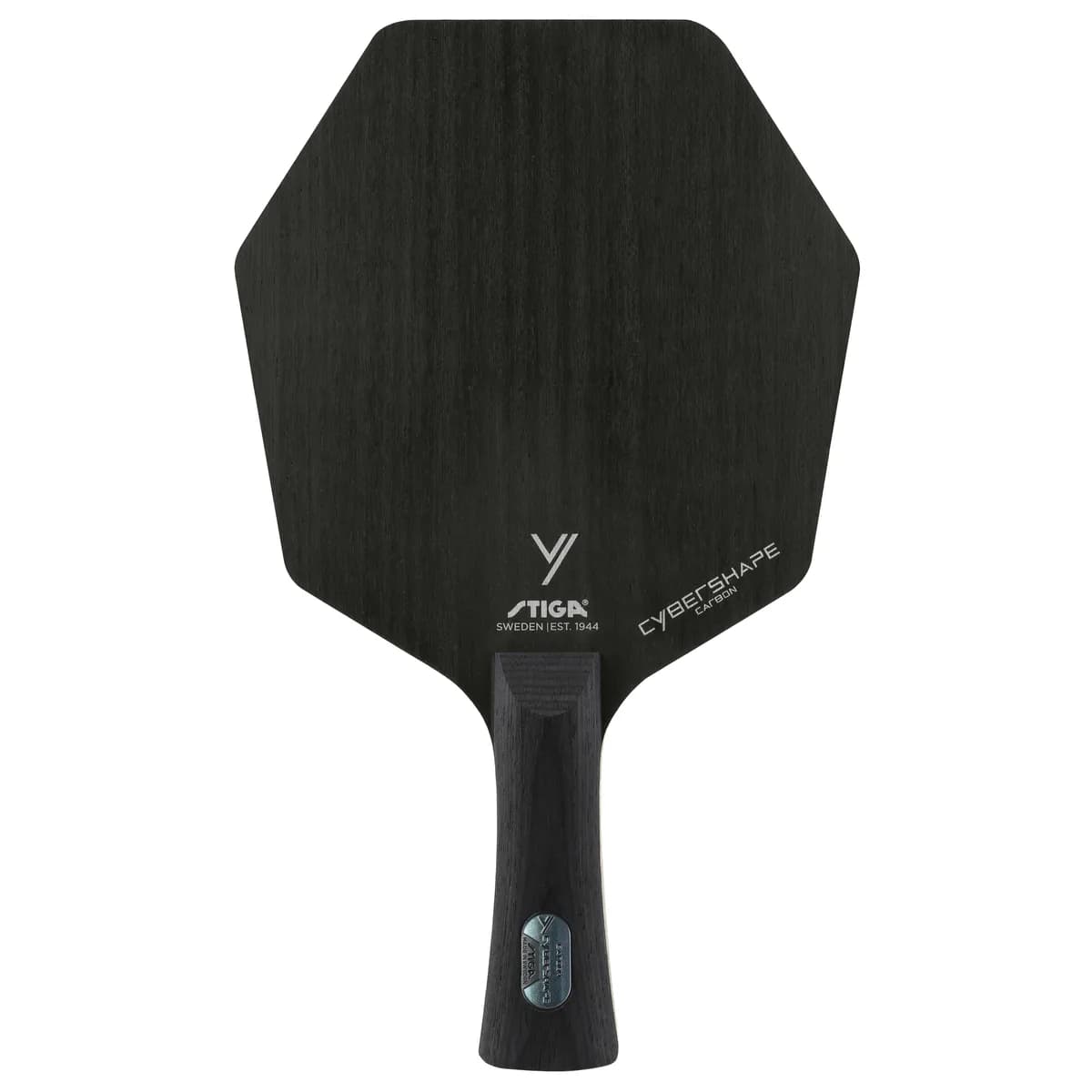
The blade that dares to change the shape of the bat. A hexagon with a technical purpose: more useful surface where the ball is actually struck, in exchange for a learning curve that not everyone will want to pay.
Gallery.
2 imagesFew blades have generated as much conversation in recent years as the Stiga Cybershape Carbon, and not because of what is inside it, but because of something visible before the first ball is struck: its shape. Instead of the rounded head everyone grew up with, the Cybershape adopts a hexagonal outline, wider at the top and trimmed at the bottom. It is neither an aesthetic whim nor a marketing exercise, but a proposal with a concrete technical intention that is worth understanding before judging it.
This review sets the visual novelty aside to get to what really matters: what that geometry changes on the table, what attacking blade sits underneath the shape, which player profile it makes sense for and where its limits are. The aim is not to repeat Stiga's sales pitch, but to help decide whether such a particular base fits a given game or whether its singularity is more of a hook than an advantage.
One note before starting: Stiga claims the usable striking surface is 11 % larger with a classic grip (shakehand) and 9 % larger with a penhold grip compared with an equivalent round head. Those are the manufacturer's own figures, measured on its own geometry; they are best taken as an indication of the concept, not as an absolute truth that transfers to every playing situation.
Context: shape as an argument
The Cybershape comes from an idea that is simple to state and hard to execute: the round head of a bat is a historical inheritance, not necessarily the optimal shape. On a round head, much of the lower surface —the part closest to the handle— sees little use, while the upper zone and the sides, where the ball actually lands on most attacking strokes, are constrained by the curvature.
Stiga's proposal is to redistribute that surface: widen the upper part of the head, where attacking strokes and volleys concentrate, and trim the lower part, which is used less. The result is a hexagon that, according to the brand, offers a broader sweet spot in the genuinely productive zone and brings the striking area closer to the table on returns —Stiga speaks of around 6.5 cm against the 2.5 cm of a round head—, which in theory makes it easier to attack low balls and play tighter to the net.
It is worth placing this in its regulatory context: the Cybershape is ITTF approved and legal in official competition. Table tennis rules regulate the playing surface (the rubber), but they are flexible about the shape of the blade, provided it is flat and rigid. That is where Stiga found room to innovate.
Construction and design philosophy
Underneath the striking shape sits an attacking blade with a fairly conventional material layout: seven plies, five of wood and two of carbon, with a thickness close to 6.2 mm. That puts it above the average of current topspin blades, many of which sit around 5.7-5.9 mm.
The constructional particularity is the technology Stiga calls CCF (Close Core Fibre): the carbon layers sit directly on the wooden core, instead of being placed nearer the outer plies as is usual in many ALC or classic carbon constructions. Putting the fibre against the core tends to produce a somewhat more contained response and a less "hard" sensation at impact than when the carbon sits just under the outer ply, where its effect on speed and stiffness is more immediate and aggressive.
The combination —generous thickness, carbon next to the core— aims at a fast blade with a feel that is neither completely dry nor excessively stiff. Stiga also mentions tests carried out with KTH university in Stockholm, according to which the Cybershape's frequency response would be more linear than that of a round head; in practical terms that would point to a more uniform impact sensation across the surface. It is an interesting technical argument, though hard for the ordinary player to verify.
On-table behaviour
It is worth being honest about the starting point: what follows rests on the manufacturer's specifications, on published tests and on the converging assessments of many players and reviewers, not on weeks of personal use with this blade. That said, the impressions in circulation are remarkably consistent and allow a reliable portrait to be drawn, especially because the Cybershape divides opinion in a very revealing way.
Speed and attacking character. The Cybershape Carbon is clearly a fast blade, sitting in OFF / OFF+ territory. It is not a transition base nor a product designed for the control player: it pushes the ball, has a direct launch and answers with punch when struck decisively. The 6.2 mm thickness and the carbon contribute to an energetic response, especially on flat hitting and on volleys close to the table, where several players note a marked improvement, above all on the backhand.
Feel and sweet spot. This is where the hexagonal shape makes its strongest case. Widening the upper zone of the head translates into a broad sweet spot placed exactly where the attacking player tends to meet the ball. The general sensation is described as "woody" and with good feedback despite the carbon, consistent with the idea of placing the fibre next to the core. On the block, stability is good on both wings, and the impression of always striking in a "useful" part of the bat is real for whoever adapts to the geometry.
The decisive factor: the learning curve. And that "whoever adapts" is the key to the whole assessment. By trimming the lower part of the head and widening the upper part, the hexagonal geometry changes the spatial references a player has internalised over years with a round bat. In practice this has two widely repeated consequences: the serve and the short game suffer at first —many players find the serving motion and short touches awkward during the first sessions—, and the blade demands a compact, precise stroke, because being fast and direct it punishes long, uncontrolled gestures. For a player with refined technique this is a non-issue; for one still building their stroke, it can become a source of inconsistency. This learning curve is probably the trait that best defines the Cybershape: it is not a blade that feels "natural" from day one, but one that asks for a period of adaptation in exchange for its advantages.
Spin and topspin. On spin generation the Cybershape is competent but not outstanding for its class. Being a fast, stiff and relatively thick base, it favours direct play and powerful hitting more than heavily loaded topspin with a pronounced arc. Some intermediate players report struggling to impart as much spin as with more flexible, softer-feeling blades. It is not a serious limitation for a direct attacking profile, but it is a nuance to bear in mind for a game built on heavy rotation from mid-distance.
Pros
- Broad, well-placed sweet spot: the hexagonal shape concentrates useful surface where the attacker actually strikes the ball
- Fast blade with a direct response: more than enough for OFF/OFF+ play, with particular ease on volleys and close-to-the-table hitting
- Good block stability on both wings
- Feedback despite the carbon: the CCF technology avoids the extreme dryness of other carbon blades
- Approved for competition: the unusual shape is no regulatory obstacle
- Balanced weight, around 85 g, manageable for an attacking base of this thickness
Cons
- A real learning curve: moving from a round head to the hexagonal one takes time; the serve and the short game suffer most
- Demands refined technique: its speed and direct response punish long or imprecise contact
- Spin generation only adequate: it favours direct play over heavily loaded topspin
- High-end price
- The shape is not to everyone's taste: there is a subjective element of comfort and aesthetics that may not fit
Who is it for?
The Cybershape Carbon suits the advanced attacking player, with settled technique, who plays close to or at mid-distance from the table and builds their game on direct hitting, volleys and powerful attack rather than heavily rotated topspin from a distance. It is a good choice for the close-to-the-table attacker looking for speed, block stability and a broad sweet spot in the upper part of the bat; for the technically curious player with a refined stroke, willing to invest several weeks of adaptation in exchange for the advantages of the geometry; and for anyone who notices that with round heads they tend to make contact high on the bat and "waste" the lower zone.
On the other hand, a beginner or intermediate still building their technique, a game that lives off spin and a long arc, or a preference for immediate comfort over a period of re-learning all point elsewhere: more conventional options will give better results from day one.
Compared with the direct alternatives
Against the Stiga Cybershape Wood NCT. Within the family itself, the carbon-free version (Wood) is the most logical alternative for anyone who wants the hexagonal shape with a somewhat slower, more flexible and more controllable response. It shares the advantage of the geometry but softens the explosive character of the carbon, which makes it more accessible for a mid-level player interested in the Cybershape concept without jumping to such a demanding base.
Against the Butterfly Viscaria and the classic ALCs. The Viscaria and, in general, arylate-carbon blades remain the benchmark the attacking market measures itself against. Compared with them, the Cybershape Carbon offers a similar proposal in speed and class, but with two underlying differences: the hexagonal shape (with its redistributed sweet spot and its learning curve) and a CCF construction that spreads the sensation differently. Whoever wants proven performance and the familiarity of a round head will still find a safe bet in the ALCs; the Cybershape is for whoever wants to explore whether the geometry adds something more.
Against the Stiga Carbonado 145 / 190. Within Stiga's own catalogue, the Carbonado line represents carbon attack in a classic format. The 145 favours feel and control; the 190, direct speed. The Cybershape overlaps above all with the 190 in attacking character, but adds the variable of the shape. If the geometry holds no interest, the Carbonados offer equivalent performance in a conventional format and with no adaptation period.
Frequently asked questions
Is the Cybershape's hexagonal shape legal in competition?
Yes. It is ITTF approved and valid in official competition. The rules regulate the playing surface and require the blade to be flat and rigid, but they impose no particular head shape.
Is it hard to adapt to the shape?
It depends on the player, but practically all users agree that there is an adaptation period, especially on the serve and the short game. The usual estimate is several sessions or a few weeks until the new spatial references become automatic.
Is it a blade for beginners?
It is not the most advisable one. It is fast, direct and unforgiving with imprecise contact, and it demands re-learning on top of that. A beginner or intermediate will find easier, more progressive options. For anyone who wants the Cybershape concept with less demand, the Wood NCT version is more accessible.
What does the shape really add over a round head?
On paper, a broader sweet spot in the upper zone —where most contact happens— and an attacking area slightly closer to the table on returns. In practice those advantages are real for whoever adapts, but they come alongside the initial awkwardness and a different sensation that is not to everyone's taste.
What is CCF technology?
Close Core Fibre. It means the carbon layers sit directly on the wooden core instead of nearer the outer plies. The goal is a fast response with a feel somewhat less dry than that of other carbon constructions.
Pairing with rubbers
Being a fast attacking base with a medium-hard feel, the Cybershape takes modern tensor rubbers of medium or medium-high hardness well. The specific choice will depend on the player's style, but it does not necessarily need the hardest rubber in the catalogue to perform.
Three set-ups that work
- Medium-high hardness tensor on both sides — the balance point for the direct attacker: it uses the speed of the base without making it ungovernable, ideal for close-to-the-table hitting.Direct attacker
- Hard, direct tensor on the forehand — to wring out the explosive character of the blade on the smash and the volley, accepting slightly less margin.Attack
- Medium hardness tensor on the backhand — it keeps a little more control and feel on the wing where the Cybershape already gains from the widened sweet spot.Balance
Rating by dimension
It dares to change the shape of the bat —and it works, for the right player.
The Stiga Cybershape Carbon is one of the boldest proposals of recent years, because it questions something almost nobody questions: the shape of the head. And it does so with a coherent logic —redistributing surface towards where the ball is actually struck— rather than as a gimmick, a point the competition approval backs up. For the right player the performance lives up to it: this is a fast attacking blade, stable on the block, with a broad sweet spot in the right place. But its virtue is inseparable from its condition: it demands adaptation and technique. It takes time to re-learn the spatial references, it punishes imprecise contact and it favours direct play over heavily loaded spin. The right question is not whether it is a good blade —it is— but whether it is the right blade for a given player.