
Stiga
Carbonado 145.
Carbon speed with a wood feel. TeXtreme carbon at 45° that forgives off-centre hits and lifts the ball without giving up touch.
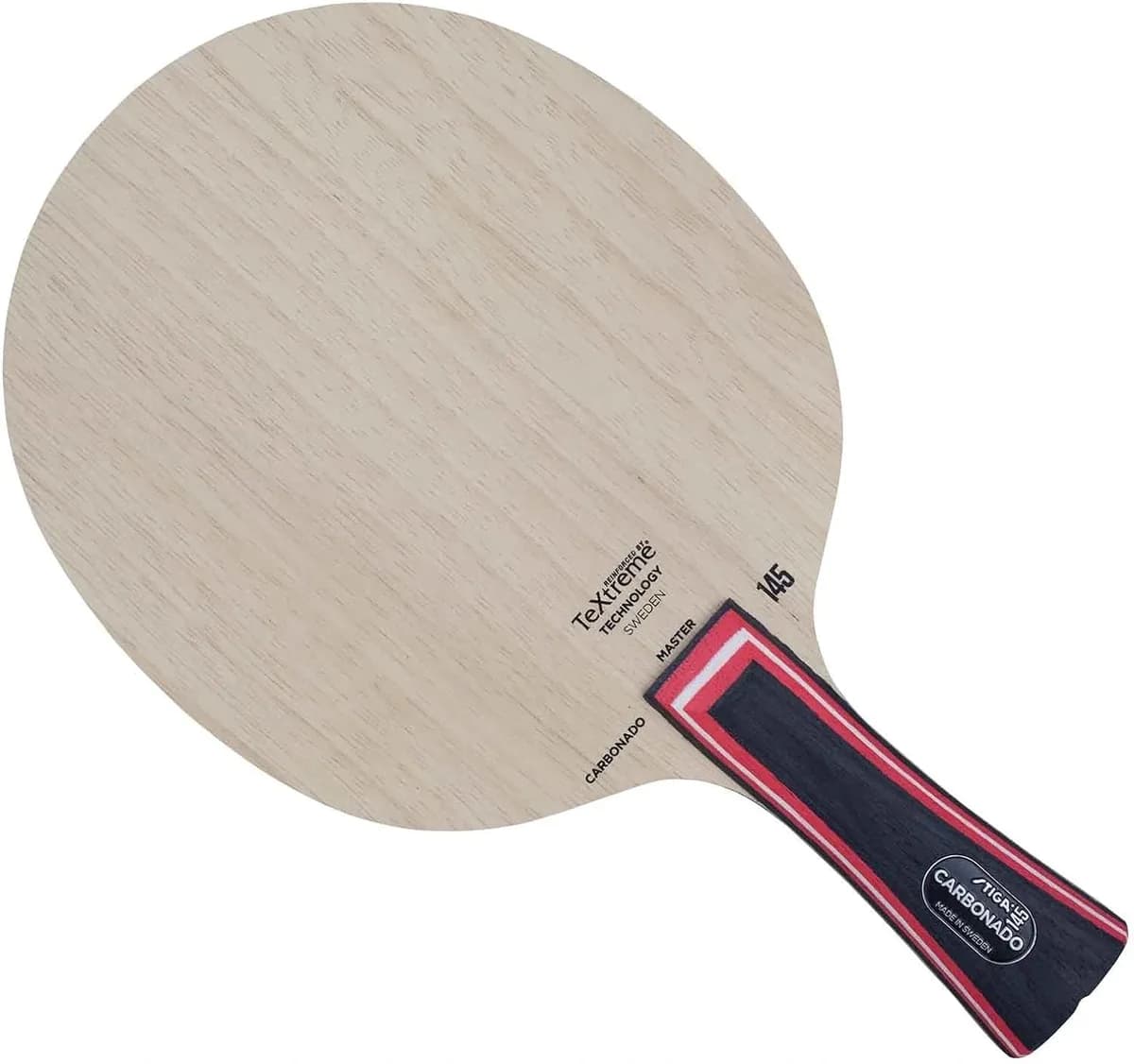
Gallery.
1 imagesThe Stiga Carbonado 145 is one of those blades that comes up again and again in conversations among players looking for an offensive carbon platform without giving up the feel and control of a more traditional blade. It belongs to the Carbonado series, Stiga's high-end composite range, and shares the spotlight with its sister the Carbonado 190. The difference between the two is far from a catalogue detail: it completely determines the kind of game each one is built for.
This review looks at what the Carbonado 145 actually offers on the table, which player profile it makes sense for, how it stands up to direct alternatives such as the 190 itself or the classic Butterfly Viscaria, and where its limits are. The point is not to repeat the manufacturer's sales pitch, but to help the reader decide whether this blade fits their game.
What the Carbonado series is
Stiga built the Carbonado series around one specific material: TeXtreme Spread Tow carbon fibre. Unlike conventional woven carbon, this fibre comes as flat, very thin tapes, which makes it possible to integrate the reinforcing layer with less thickness and less weight. The practical consequence is a blade that adds stiffness and speed without bulking up excessively or completely killing the wood feel, which is precisely the weak point of many carbon blades.
Within the series, the number identifies the orientation of the two carbon layers. The Carbonado 145 lays the fibre at 45°, which adds torsional stiffness (resistance to lateral twisting) while keeping a more natural longitudinal flex. The Carbonado 190 lays the fibre at 90°, the classic perpendicular orientation, which makes it stiffer along the hitting axis, faster and more direct. This distinction is the axis of the whole review: the 145 is not a "slower" version of the 190, but a blade with a different character.
Construction and design philosophy
The Carbonado 145 is a seven-layer construction: five of wood and two of TeXtreme carbon. The scheme is limba on the outer plies, a core of three ayous sheets and the two carbon layers sitting just under the outer limba.
This combination has a clear logic. The outer limba is a relatively soft ply with good grip, which favours prolonged contact with the ball (the dwell time, the time the ball stays "hooked" on the surface before it is flung away). Ayous, being light, keeps the weight in check and adds an elastic response. And the carbon at 45° does its work above all on off-centre hits: by reinforcing resistance to twisting, the bat destabilises less when the ball does not strike the exact centre. The intended result is an attacking blade that feels like wood. That, in essence, is the promise of the 145.
A note on the numbers: the speed and control ratings Stiga publishes (144 for speed and 44 for control on its own scale) belong to the brand's internal metric and are not comparable with those of other manufacturers. They are best read as relative guidance within the Stiga catalogue, not as absolute data.
Behaviour in play
It is worth being honest about the starting point: what follows is based on the manufacturer's specifications, on published laboratory tests and on the converging assessment of many players and reviewers, not on weeks of personal use with this particular blade. That said, the behaviour the sources describe is remarkably consistent, which makes a reliable portrait possible.
On speed, the Carbonado 145 is clearly an offensive blade, but not one of the most explosive in its category. It sits a step below benchmarks such as the Viscaria in pure speed, and below its sister the 190 as well. That "contained" speed is not a flaw but a design decision: the 145 gives up some raw power in exchange for margin of control and a more progressive launch. It is fast when the player really accelerates, but it does not fire the ball off at the slightest touch, which makes it easier to handle in transition play.
On feel and dwell time it makes its strongest case. The combination of outer limba and carbon at 45° produces a long dwell time for a blade with carbon in it. In practice this brings two advantages to the topspin player: more capacity to load the ball with spin and a more predictable launch. The laboratory tests comparing the two Carbonados confirm that the 145 flexes more and is somewhat softer than the 190, which fits the general impression of a blade that is more "wood" and less "stiff board".
As for trajectory and spin, the carbon orientation at 45°, by allowing more longitudinal flex, lifts the trajectory slightly compared with the 190. That marginally higher arc helps clear the net with margin and makes it easier to put spin on the topspin, especially on openings against backspin. It is not a high-trajectory blade in absolute terms — it is still an offensive platform — but it is more generous than the 190 in this respect.
The sweet spot and stability are what those who have played it mention most. The torsional stiffness the 45° carbon provides does exactly its job: off-centre hits lose less speed and feel closer to centred ones. For a player whose stroke is not yet millimetre-accurate, or for one who plays blocks and counters close to the table, that stability is a tangible advantage, not catalogue decoration.
Finally, the short game and control. Not being an extremely fast blade and offering good touch, the 145 handles the short game competently: pushes, flicks and control touches come out more easily than with stiffer, bouncier blades. It is one of the reasons it is recommended to allround players who want to make the jump to a carbon platform without losing the control they already had.
Pros
- A wood feel with carbon speed: the touch and dwell time of a traditional blade with the push of TeXtreme
- Wide sweet spot and great stability: the 45° carbon forgives off-centre hits
- Medium-high trajectory that favours topspin: easier to load spin and clear the net with margin
- Control above the average among offensive blades with carbon
- Balanced weight: the TeXtreme fibre adds stiffness without excessive weight
Cons
- Not the fastest option in its category: the 190 itself or the Viscaria hit harder
- Occasional doubts about the durability of the outer limba ply (it can lift or splinter over time)
- High-end price
- It may fall short for the player who works from long distance at maximum power
Which player it is for
The Carbonado 145 fits particularly well with the close-to-mid-range attacking player who works close to or at mid distance from the table and values feel and control above raw speed. It is a good choice for the advanced allround player who wants to move to a carbon platform without giving up touch and without going overboard with a blade that is too fast; for the topspin player who wants to load plenty of spin and appreciates a long dwell time; and for whoever puts consistency and a wide sweet spot first, for instance in a style built on blocks, counters and controlled openings.
On the other hand, a game defined by power from distance, smashes at maximum speed and an immediate launch will probably feel more at home with the Carbonado 190 or with blades of a more direct cut.
Pairing it with rubbers
Being an attacking blade with good touch, the 145 takes modern medium-hard tensor rubbers well. The specific choice will depend on the player's style and on the speed-spin balance they are after, but it does not demand an extremely hard rubber to perform: part of its appeal is that it already brings feel of its own, so a slightly more controlled sheet can go on without deadening the platform.
Three set-ups that work
- Medium-hard tensor on both sides — the point of balance: it uses the blade's dwell time to load spin without running away with the speed, ideal for close-to-mid-range topspin.Offensive control
- A hard, direct tensor on the forehand — for anyone wanting to squeeze the platform's speed and compensate for its contained character, accepting a little less margin.Attack
- A medium tensor rubber on the backhand — it keeps the touch and consistency of the 145 on the block and the opening, where its wide sweet spot shows best.Allround+
Compared with the direct alternatives
Against the Stiga Carbonado 190. This is the obligatory comparison. The 190, with its carbon at 90°, is stiffer, faster and more direct, with a somewhat lower trajectory. The 145 is more flexible, offers more feel, lifts the ball a little more and is more forgiving. In practice: the 190 for the player who wants speed and penetration; the 145 for whoever wants control, spin and touch. Neither is "better"; they answer different philosophies.
Against the Butterfly Viscaria. The Viscaria is the historic benchmark for ALC blades (Arylate-Carbon fibre) and remains the pattern half the market measures itself against. Next to it, the Carbonado 145 tends to offer slightly less pure speed and a somewhat softer, more "woody" feel, with a very competitive sweet spot. A player coming from a Viscaria and looking for more touch and control may find the 145 an interesting alternative; one who puts speed and explosive response first will probably prefer to stay with ALC.
Frequently asked questions
Is the Carbonado 145 faster or slower than the 190?
Slower and more flexible. The 190, with its carbon at 90°, is stiffer and faster; the 145, with its carbon at 45°, puts feel, control and a slightly higher trajectory first.
What does the 45° carbon of the Carbonado 145 mean?
That the two layers of TeXtreme fibre are oriented diagonally instead of perpendicularly. This adds stiffness against twisting (better behaviour on off-centre hits) while keeping a more natural longitudinal flex, with more of a wood feel.
Is it a good blade for making the jump from an allround platform?
Yes. It is one of the most recommendable carbon platforms for that step, because it keeps a fair amount of control and offers a wide, forgiving sweet spot.
Which rubbers does it pair well with?
Being an attacking blade with good touch, it takes modern medium-hard tensor rubbers well. The specific choice will depend on the player's style and on the speed-spin balance they are after, but the 145 does not demand an extremely hard rubber to perform.
Does it have durability problems?
Not across the board, but several users have reported that the outer limba ply can lift or splinter over time. Properly sealing the blade and taking care when peeling the rubbers off help prevent it.
Rating by dimension
Carbon speed with a wood feel.
The Stiga Carbonado 145 is a coherent, well-resolved attacking blade with a clear identity: it brings the push of TeXtreme carbon without killing the touch of a traditional blade. It does not set out to be the fastest platform on the market, and that deliberate restraint is exactly what makes it valuable for the right player. Its combination of long dwell time, medium-high trajectory, wide sweet spot and solid control makes it a very sound choice for the close-to-mid-range attacker who lives off topspin and values feel. Its two more serious drawbacks — the contained speed next to benchmarks such as the 190 or the Viscaria, and the occasional doubts about the durability of the outer limba ply — are worth keeping in mind. With those cards on the table, a player whose profile matches the one described will find little to regret.