
DHS
Hurricane Long 5X.
The inner-carbon blade of the Ma Long family: an all-wood feel on the soft touch and a catapult effect once the stroke turns full. Two faces on the same bat.
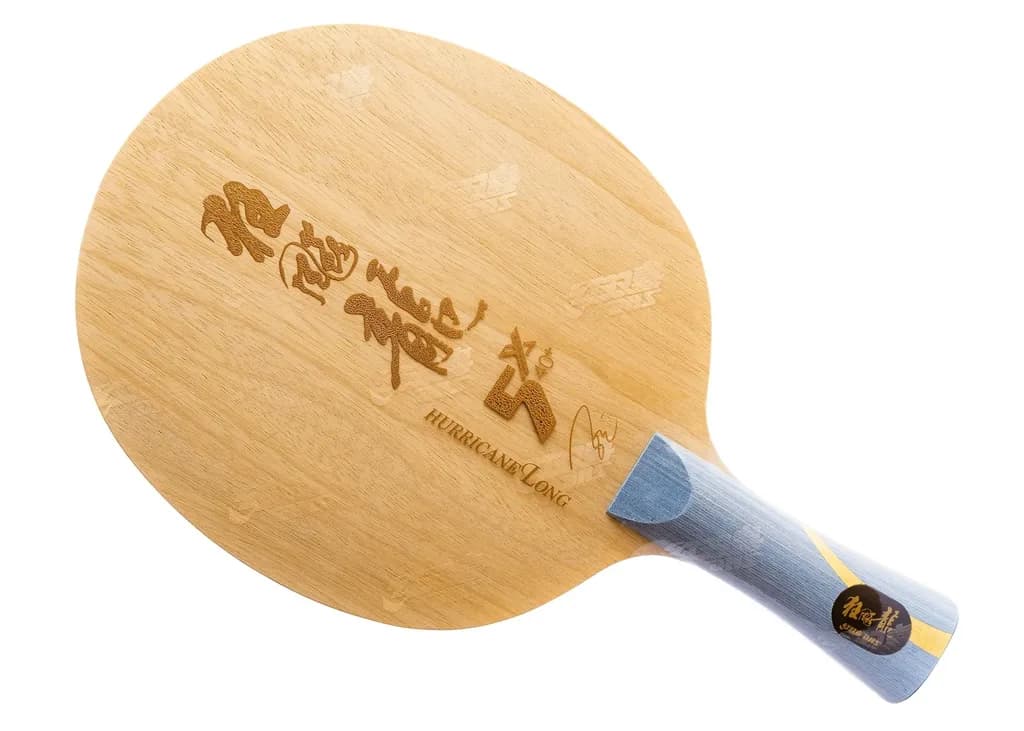
Gallery.
2 imagesDHS's Hurricane Long family is one of the attacking platforms most closely associated with elite Chinese table tennis, tied for years to the figure of Ma Long. Within that range, the Hurricane Long 5X occupies a particular place: it is not simply an "improved" version of the well-known Hurricane Long 5, but a blade built on a different philosophy. Where the classic Long 5 places the fibre under the outer plies — outer carbon — the 5X shifts it towards the inside of the structure, closer to the core. That apparently minor change alters the feel and the way the ball is worked completely.
This review looks at what it actually offers on the table, which player it is meant for, and how it stands against its most direct alternatives, starting with its own sister in the range.
Putting the product in context
To understand the Hurricane Long 5X it has to be placed within its range. DHS keeps the Hurricane Long 5 in the catalogue, a carbon blade with the fibre set under the outer plies — what is known as an outer carbon build. That approach tends to give a more direct, fast and firm response on impact, because the fibre comes into play very early, almost from the first contact.
The 5X starts from the same family but changes that premise. Here the two Aryl-Carbon fibre layers sit in the inner position, closer to the core and separated by ayous plies. This architecture — conceptually related to the "inner carbon" idea that other brands popularised — pursues a clear aim: to keep the feel and sensitivity of an all-wood blade on soft and touch strokes, and to let the fibre wake up only when the impact is full and the structure really flexes. The result is a blade that behaves in two different ways depending on how hard the stroke is.
Structurally, the 5X combines outer plies of limba — a medium-hardness wood, pleasant and communicative — with intermediate layers of ayous and a core, also ayous, that is notably thick. That wide core is the other key to the design. DHS does not chase speed through stiffness but through elasticity: the greater the distance between the two fibre layers, the greater the catapult effect when the blade bends under a powerful stroke. Much of its character comes from there.
It is worth pinning down the variant from the outset, because the name lends itself to confusion. This review is about the Hurricane Long 5X, the inner-fibre one. It should not be mistaken for the original Hurricane Long 5 nor for the Hurricane Long 3, related blades that behave differently.
Specifications that matter to the player
Beyond the spec sheet, the numbers are worth translating into what is felt with the bat in hand.
The thickness of close to 6.0 millimetres is considerable, slightly above that of the standard Hurricane Long 5. Those extra couple of tenths are not incidental: they come in large part from the widened ayous core, which is precisely what gives the blade its springy, progressive response. This is not thickness for raw speed, but for behaviour.
The weight usually sits between 87 and 89 grams, with the natural variation of any blade cut from natural plies. As always, the difference has real consequences: a lighter unit is more agile in fast play and in the block, while a heavier one gains stability and punch on the full stroke at the cost of some manoeuvrability. Since this blade is usually paired with a tacky Chinese rubber on the forehand — which is not exactly light — the weight of the finished bat is worth watching if a manageable assembly is the goal.
The outer limba plies define much of the 5X's personality. Against the drier, more direct response of an outer-carbon blade, limba offers a softer, more communicative surface on the first contact, which translates into a more "wooden" feel and a longer dwell — the time the ball stays on the blade. That is exactly what the player who wants to build spin safely before the fibre accelerates the ball away is after.
Behaviour in play
This is where the 5X justifies its approach. Its virtue is not any single figure but its dual character according to the intensity of the stroke, something that clearly sets it apart from the outer-carbon blades of its own house.
The first thing a player coming from an outer carbon notices is that the 5X does not "jump" on the soft touch. In control play, the push and the passive block, the fibre stays in the background and what dominates is the feel of the limba and the ayous: a soft, communicative response, surprisingly sensitive for a blade with fibre. That is its great advantage from the start: it offers a margin of forgiveness in delicate touch play that is unusual in its category.
It is in the topspin that its character is best explained. At medium intensity the ball lingers an instant on the blade — that dwell that lets the player build the spin — and leaves at a medium or medium-high angle, comfortable for clearing the net over a chopped ball. This is a blade that goes along with the building of the spin before accelerating, which makes it especially well suited to tacky Chinese rubbers, whose strong point is spin rather than speed. The combination of a springy core and a tacky rubber on the forehand is, in fact, this blade's reason for existing.
When the stroke becomes full and powerful, the 5X changes register. The thick core flexes, the inner fibre layers come into action and a clear catapult effect appears: the ball leaves with notably more speed and penetration than the soft feel of the light touch would suggest. That transition — soft on the touch, explosive on the stroke — is its most characteristic trait and, well used, very effective for the player who alternates building and finishing.
The block and the counter-hit benefit from that limba sensitivity: the passive block is comfortable and controllable, and the active counter has the power of the core available when intent is put into it. In exchange, the liveliness of the rebound demands attention: in the close block the blade returns more energy than a pure all-wood would, and the angle has to be closed properly.
Its limits are worth being honest about. The thick, springy core demands formed technique. In the short game and on the serve, even though the feel helps, the liveliness of the blade punishes imprecise touches: a badly metered push goes long easily. This is not a blade that indulges the player still consolidating control, and its "two-faced" behaviour needs a degree of calibration until one internalises when the fibre wakes up. Nor is it the fastest in absolute terms: its charm lies in the feel-and-punch combination, not in maximum terminal speed.
Pros
- A soft, communicative feel on the light touch, unusual in a blade with fibre
- Long dwell that makes spin easy to build, very well suited to tacky Chinese rubbers
- A clear catapult effect on the full stroke, with good power and penetration
- A useful dual character: control when building, punch on the smash
- A structure conceived for attacking with spinny loops and smashes, backed by its use at a high level
Cons
- The thick, springy core demands formed technique, above all in the short touch
- The liveliness of the rebound punishes imprecise touches: pushes and passive blocks call for precision
- It is neither the fastest nor the most direct in its own range
- The naming within the Hurricane Long family lends itself to confusion when buying
Who it is for
The DHS Hurricane Long 5X fits naturally with the modern Asian-style offensive player, intermediate to advanced or above, who builds the point with spinny loops and wants a blade that goes along with the spin before accelerating. It is an especially sound choice for whoever mounts a tacky Chinese rubber on the forehand and wants a platform that offsets the lower speed of those rubbers with a springy core and a medium-high launch angle.
It is also a very suitable blade for the player who values feel and dwell above the dry, immediate response of outer carbon, and who prefers a blade that gives warning on the soft touch and delivers power only when it is asked for with a full stroke.
The player still building a technical base, on the other hand, will find more forgiving and more predictable blades for that stage; and the hitter after direct terminal speed and a firm response from the first contact will probably prefer an outer carbon such as the Hurricane Long 5 itself.
Pairing with rubbers
The 5X is designed from the outset for pairing with tacky Chinese rubbers on the forehand, where its elasticity and medium-high angle offset the lower speed of those rubbers well. With European or Japanese tensors of medium-high hardness it gains speed and a more automatic topspin, though part of its charm — that soft feel when building — comes through less the faster and harder the rubber is.
Set-ups that work
- Tacky Chinese rubber on the forehand — the set-up it was designed for: the elasticity of the core offsets the lower speed of the rubber and the medium-high angle helps to clear the net over a chopped ball.As standard
- European or Japanese tensor of medium-high hardness — adds speed and a more automatic topspin, in exchange for feeling less of the soft touch when building.Faster
- Tacky Chinese on the forehand + a controlled tensor on the backhand — the classic split of the modern Asian attacker: spin and construction on the strong side, safety on the reverse.Modern Asian
How it compares with the alternatives
The most useful comparison for this blade is within its own house. The Hurricane Long 5 — without the "X" — is the obligatory reference. It shares the range and the spirit, but its outer-carbon build gives it a more direct, firm and fast character from the first contact: the fibre comes into play sooner and the feel is drier. The 5X, with its inner fibre and thicker core, offers more dwell in exchange, a softer light touch and a more marked transition between building and finishing. It is not that one is better than the other: they answer different preferences. Whoever puts immediate response and direct speed first will lean towards the Long 5; whoever wants feel when building and catapult on the full stroke, towards the 5X.
Against the widespread outer-carbon ALC concept — of which the Butterfly Viscaria is the archetype — the 5X plays in a different sensory league. A Viscaria offers firmness and a "crisp", defined response from the touch; the 5X, by contrast, is softer and more communicative on the soft stroke and keeps its energy for the full one. The player coming from an outer carbon should reckon with a period of adaptation, because the logic of the two blades is different.
Within the inner carbon universe, the 5X competes with proposals such as Butterfly's Innerforce family and other inner-fibre blades. What marks it out against those alternatives is the explicit orientation towards play with tacky Chinese rubber and spinny loops: the 5X is calibrated for that style, and there it is on home ground. As a reference for the sensation, its behaviour has been described as that of a five-ply blade with a classic feel — Korbel type — but with more speed and an added catapult effect, which gives a reasonable idea of its balance between control and punch.
Frequently asked questions
What is the difference between the Hurricane Long 5 and the Hurricane Long 5X?
The Long 5 places the fibre under the outer plies (outer carbon) and offers a more direct, firm and fast response from the first contact. The 5X puts the fibre in the inner position and adds a thicker ayous core, which gives it more dwell, a softer feel on the light touch and a more marked catapult effect on the full stroke. They are blades from the same family with different characters.
Is the Hurricane Long 5X suitable for an intermediate player?
Yes, provided the technique is reasonably formed and the game is clearly offensive. Its springy core returns a lot of energy and punishes imprecise touches, so the player still consolidating control will benefit sooner from a more forgiving blade, and can make the jump to the 5X when the technique calls for it.
Which rubbers pair best with the Hurricane Long 5X?
It is designed from the outset for tacky Chinese rubbers on the forehand, whose spin it exploits thanks to its elasticity and its medium-high launch angle. It also takes European or Japanese tensors of medium-high hardness, which bring it more speed and a more automatic topspin, though at the cost of feeling less of its soft touch when building.
Why does the 5X feel soft on the touch and powerful on the hard stroke?
Because of its inner-fibre build and thick core. On soft strokes the feel of the limba and the ayous dominates and the fibre barely intervenes; on the full stroke the blade flexes, the fibre layers come into action and the catapult effect appears. Hence its dual character according to the intensity of the stroke.
Is it a fast blade?
It is fast in its upper register — OFF / OFF+ — above all on the full stroke, but it does not stand out for maximum terminal speed or for immediate response. Its charm lies in the combination of feel when building and punch on the smash, not in pure direct speed.
Rating by dimension
Two faces on the same bat: feel when building, catapult on the smash.
The DHS Hurricane Long 5X is not the fastest blade in its range, nor the most direct, and it is certainly not the most forgiving. Its value lies elsewhere: in bringing together a soft, communicative feel when building the point and a clear catapult effect on the full stroke, two qualities that rarely live in the same bat. For the player who attacks with spinny loops and smashes, and who mounts a tacky Chinese rubber on the forehand, that combination is exactly what the style asks for. What it demands above all is technique: the thick, springy core gives back a lot of energy, and anyone without a refined touch will find the blade punishes imprecision in the short game. But whoever masters it finds a versatile platform, with two clearly distinct registers and a very defined character. This is not a Hurricane Long 5 with "more" of something, but a blade built on another philosophy.