DHS
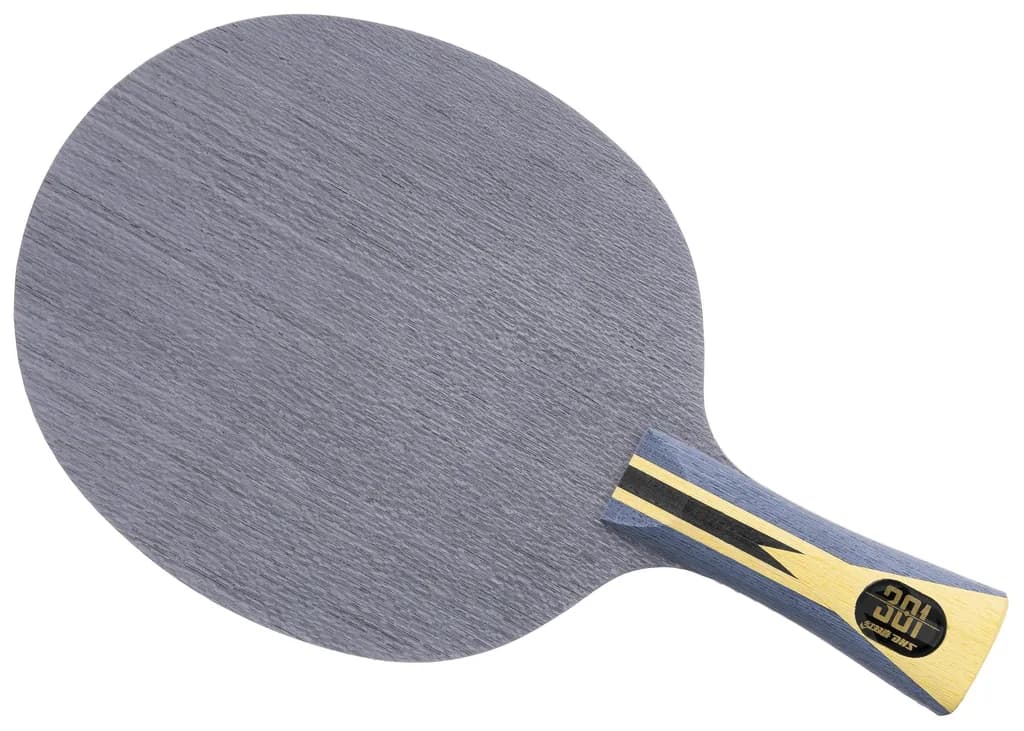
Hurricane 301.
The "DHS Viscaria": dry, direct, communicative arylate-carbon for a third of the Japanese price. Speed and penetration for the attacker who strikes cleanly.
Gallery.
2 imagesFew blades cause as much confusion over their name as this one. Many players go looking for "the Hurricane 3 Viscaria" or "the DHS Viscaria", mixing into a single label the name of a legendary rubber (the Hurricane 3), that of an iconic blade (the Butterfly Viscaria) and that of the Chinese manufacturer DHS. The misunderstanding is worth clearing up first, because a fair number of wrong purchases hang on it: this is not a rubber, nor a particular combination, but a blade — the DHS Hurricane 301, an arylate-carbon board that the market openly recognises as the Chinese, and far cheaper, answer to the Butterfly Viscaria.
This review looks at what the Hurricane 301 actually offers, how far that resemblance to the Viscaria really goes, which player it makes sense for and where it stands against its closest alternatives.
First things first: what the Hurricane 301 is and is not
The Hurricane 301 is a 5+2 blade: five wood plies reinforced with two layers of arylate-carbon (ALC) fibre, the same material family that made the Butterfly Viscaria and the Timo Boll ALC famous. It should not be confused with:
- The Hurricane 3 rubber, the tacky-topsheet Chinese rubber usually mounted on this kind of blade.
- The Butterfly Viscaria blade, with which it shares a concept but neither maker nor price.
- The variants within the 301 series itself — 301X, 301T and 301Z — which change the construction and the feel. They come up again below, because picking the wrong one inside the family is a common mistake.
This review concerns the base Hurricane 301, the reference model of the range.
Where the product sits
DHS is, above all, a giant in rubbers: the Hurricane 3 equips much of the Chinese national team and is a world reference among tacky rubbers. Its blades, by contrast, spent years in the shadow of the Japanese and European brands. The Hurricane 301 series exists precisely to fill that gap: an arylate-carbon blade built on the Viscaria concept — hard koto faces, fibre next to the core, an offensive and direct feel — at roughly a third of what Butterfly asks.
That positioning explains its success. Over the years the Viscaria has become the yardstick for every outer-ALC blade; and the 301 is, plainly, the most serious and affordable attempt to offer that experience without paying for the Japanese label. It is not a disguised copy the maker pretends about: it is a product that competes head-on in that territory.
One technical nuance is often overlooked. The Viscaria places its fibre in the outer plies ("outer" ALC), while the Hurricane 301 sits the arylate-carbon next to the ayous core ("inner" ALC). It is a real architectural difference: for all the "clone" label, the 301 is strictly an inner-ALC blade with hard koto faces, not an exact replica of the Viscaria's construction. Far from a catalogue subtlety, that distinction shapes the feel, as will become clear.
The specifications that matter in play
It helps to translate the data sheet into what the bat feels like in the hand.
The thickness, around 5.8-5.9 millimetres, is typical of an offensive arylate-carbon blade. Combined with the koto faces — a hard, dense wood — it produces a dry, crisp impact, with a shorter contact time (dwell, the instant the ball stays on the surface) than an all-wood blade. That directness is deliberate: the 301 is built for hitting with intent, not for caressing the ball.
The weight runs, unit to unit, between 82 and 90 grams, with the variation inherent in any product made from natural woods. It is worth bearing in mind when buying: a light unit is nimbler in fast play and blocking; a heavier one gains stability and punch on the power stroke, at some cost in manoeuvrability. Where the shop allows a choice of weight, it is worth picking one to suit the player's own style and the rubbers to be mounted — and there is an added factor here: thick, heavy Chinese rubbers of the Hurricane type push the final weight of the assembly up considerably.
The layout of the fibre is what most defines its character. The available lab testing shows that the base 301 runs the arylate vertically and the carbon laterally, an asymmetry that gives the blade a slightly different response depending on the direction of the stroke. It is not something the average player will dissect at the table, but it explains the sense of a board that feels "alive" yet controlled, as those who use it describe it.
Behaviour in play
Here it is worth being honest about the nature of this analysis: what follows is a technical judgement grounded in the specifications, in the available lab data and in the broad consensus of players and reviewers, not the account of a personal test at the table. That said, the portrait that emerges is remarkably consistent across sources.
The 301 behaves like an OFF-class offensive blade, not a runaway OFF+. It has what many players describe as "several gears": in the short touch and in feeding play it responds in a contained, predictable way, while under power it wakes up and delivers notable speed and spin. That progression is one of its best qualities and puts distance between it and the cliché of the Chinese "plank" — stiff and without nuance.
It is close to the table in topspin that it shines. The dry impact of the koto faces favours direct hitting, with a fairly flat trajectory and a medium-low launch angle. The ball comes off fast and low, which makes it very effective in the aggressive mid-distance exchange and on the smash. The block benefits from the same quality: firm, flat and controlled, with good information coming back to the hand.
Spin deserves a qualification. Arylate-carbon adds speed and stability, but the short contact of this construction imparts, all else being equal, somewhat less rotation than a more "wrapping" all-wood blade. It is not a blade poor in spin — fitted with a tacky rubber such as the Hurricane 3 itself it generates plenty of rotation — but its strength lies in speed and penetration, not in the slow, heavily loaded loop from distance.
Play away from the table is its least natural ground. The 301 holds power in reserve for the counter at mid-distance, but its direct character and contained launch angle penalise the player whose game rests on defensive topspin from three metres back. It is not incapable of it; it simply is not what it was designed for.
One important and recurring note: the 301 demands technique. Its margin for error is narrower than that of a softer, slower blade. It rewards clean striking and good footwork, and punishes imprecise mechanics with long balls or lost control. It is not the blade on which a beginner should learn to loop.
Pros
- Performance per euro that is hard to argue with: the Viscaria concept for a third of the cost
- Dry, direct, communicative feel, very effective in close topspin and on the smash
- Real progression: "several gears", far from the cliché of the Chinese plank
- Natural affinity with tacky Chinese rubbers, which it seems designed for
- Firm, flat block, with good information coming back to the hand
Cons
- Narrower margin for error: it demands good technique and punishes imprecise striking
- Contained launch angle: less comfortable in the slow topspin from distance
- Unit-to-unit variation greater than that of the Japanese benchmark
- Slightly less spin than a more wrapping all-wood blade
The variants: 301, 301X, 301T and 301Z
Choosing within the family matters as much as choosing the family. In short:
- 301 (base): the most balanced and communicative, with the slightly more "wrapping" contact of the series. The default option for most.
- 301X: thicker core and harder feel. Faster and more direct, with less "grip" on the ball; aimed at power hitting and the smash. Less forgiving.
- 301T: more elastic than the 301X despite its thinner construction; it favours continuous, linked topspin.
- 301Z: the softest in feel and the least elastic, with Z-type fibre. It asks more effort of the player, but offers a launch angle and a stability that some compare to those of a five-ply blade.
For the most recognisable and versatile "Viscaria" experience, the base 301 is the reference. For a game of pure power and flat hitting, the 301X fits better.
Who it is for
The Hurricane 301 has a fairly well-defined audience: the intermediate-to-advanced offensive player after a fast, direct arylate-carbon blade without paying premium-brand prices; whoever plays, or wants to play, with tacky Chinese rubbers (Hurricane 3 and the like) and is looking for a board suited to that dry, powerful style of striking; and the close-to-the-table and mid-distance attacker whose game rests on aggressive topspin, a firm block and the smash.
It is not, on the other hand, the ideal blade for the beginner still building their technique, nor for the defensive player or the one who loops slow and heavily loaded from distance, who will get more out of an all-wood blade or one with a softer, more forgiving feel.
Pairing it with rubbers
The 301 is designed above all for tacky Chinese rubbers such as the DHS Hurricane 3 itself, with which it forms a dry, powerful striking assembly and makes the most of its direct character. It also takes European tensor rubbers, which soften its character somewhat and add more spin and catapult, at the cost of part of that natural affinity with the Chinese style.
Three set-ups that work
- Tacky Chinese (Hurricane 3) on the forehand and a tensor on the backhand — the set-up the blade seems designed for: dry, powerful striking, heavily loaded with spin on the attack.Chinese style
- Medium-hard European tensor on both sides — it softens the 301's character and adds catapult and a more automatic topspin, keeping the speed.Modern offensive
- Hurricane on both sides for the purely Asian style — maximum affinity in feel, in exchange for a heavy assembly that demands physical condition and technique.Pure Asian
How it compares with the alternatives
Against the Butterfly Viscaria, the comparison is inevitable and nuanced. Lab data show that variants such as the 301X or the 301T can reach an elasticity similar to the Viscaria's, but the Butterfly blade shows higher vibration figures, which translates into an overall sensation that is somewhat stiffer and more "crystalline". Put practically: the Viscaria keeps a consistency and a manufacturing uniformity that the 301 does not always match — unit-to-unit variation in the Chinese blades is real — and it retains that touch of refinement in the feel that many still pay its price for. The 301 offers 80-90% of the experience for a fraction of the cost, with the risk that the particular unit a buyer ends up with strays somewhat from the average.
Against the Yasaka Ma Lin Soft Carbon or European ALC/carbon blades at contained prices, the 301 stands out for its drier, more offensive character and for its natural affinity with tacky Chinese rubbers, which it seems designed for.
Against the top arylate-carbon ranges of other Japanese brands, the 301 will not always match the finesse of the feel or the quality control, but it offers very competitive raw performance for considerably less money.
Frequently asked questions
Is the "Hurricane 3 Viscaria" a rubber or a blade?
It is a confusing name that in practice refers to the DHS Hurricane 301 blade, nicknamed "the DHS Viscaria". The Hurricane 3, for its part, is a separate rubber usually mounted on this kind of blade.
Is it really comparable to the Butterfly Viscaria?
It comes very close in raw performance and shares the material family (arylate-carbon), but differs in architecture (inner versus outer ALC) and in manufacturing consistency. It offers much of the experience for a fraction of the price, with more variation between units.
Which variant of the 301 series should one choose?
The base 301 is the most balanced and the default recommendation. The 301X is harder and faster, aimed at power hitting; the 301T, more elastic for continuous topspin; the 301Z, softer and more stable.
Is it suitable for a beginner?
It is not the ideal option. It demands good technique and offers less margin for error than a softer, slower blade. A player starting out will learn better on a more forgiving board.
Which rubbers does it pair best with?
It is designed above all for tacky Chinese rubbers such as the DHS Hurricane 3 itself, with which it forms a dry, powerful striking assembly. It also takes European tensor rubbers, which soften its character somewhat and add more spin and catapult.
Rating by dimension
The Chinese Viscaria that delivers what it promises.
The DHS Hurricane 301 does exactly what it was conceived to do, and more: bring the concept and much of the performance of the Butterfly Viscaria to a radically more affordable price. It is not a perfect clone — its inner ALC architecture gives it a character of its own — nor does it match the manufacturing consistency of the Japanese benchmark, but it offers a dry, communicative offensive blade that stands up to products costing three times as much. Its main virtue is performance per euro, hard to argue with in its segment; its main demand is technique: it rewards the clean striker and punishes the imprecise one. For the intermediate-to-advanced attacker who knows what they are after — speed, direct hitting and affinity with Chinese rubbers — it is one of the most sensible purchases on the current market. For anyone still learning to control the ball, there are more forgiving options.