
DHS
Hurricane Long 5.
Ma Long's blade and the benchmark of modern Chinese attack. Five plies and two ALC layers tuned from a different philosophy: firmness and speed, but with just enough feel to load the ball with tacky rubbers.
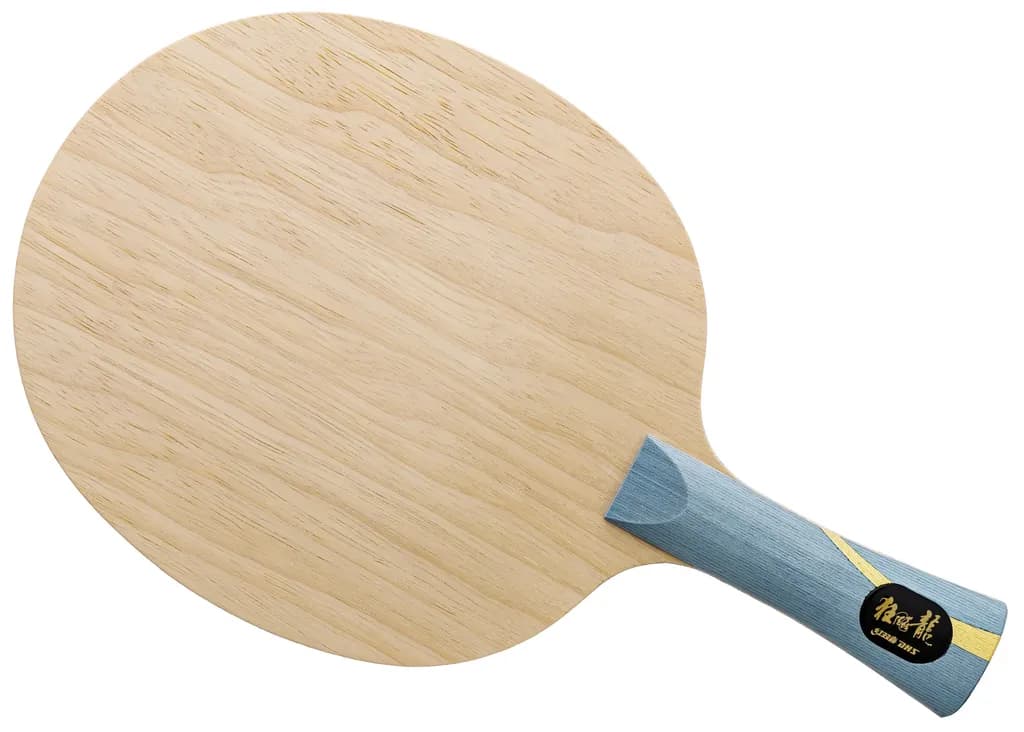
Gallery.
2 imagesFew blades carry a symbol as recognisable as the DHS Hurricane Long 5. For many enthusiasts it is simply "Ma Long's bat": the fibre construction that accompanied one of the greatest players in history through much of his reign and that, by extension, has become one of the reference points of contemporary Chinese attack. Part of that aura is marketing, but part of it is real: the Hurricane Long 5 is an excellent blade, coherent with one very specific way of understanding the game.
This review looks at what it actually offers, which player it was designed for and how it stands against the alternatives, starting with its own sister, the Long 5X.
One naming confusion is worth clearing up first, because it leads to mistaken purchases. Under the "Hurricane Long 5" umbrella live the original Long 5, the Long 5X (a faster, stiffer blade, not a mere update) and the so-called New Hurricane Long 5 (MY 2022), a later revision with nuances of its own. This review concerns the classic Hurricane Long 5, the one with ALC fibre between wood plies. The differences with the 5X come up again later, because they matter.
Where the product comes from
The Hurricane Long 5 is born of two traditions crossing. On one side, the Chinese school of close and mid-table attack, built on topspin of enormous rotation played with DHS's own tacky rubbers — the well-known Hurricane range. On the other, the use of ALC fibre (arylate-carbon), the same family of material Butterfly popularised in blades such as the Viscaria. The combination is no accident: DHS wanted a blade firm and fast enough for the modern power game, yet one that kept the feel needed to "load" the ball with Chinese rubbers, far harder and less elastic than a European tensor.
The result is a construction of five wood plies with two ALC layers set towards the outside of the core. That arrangement brings stiffness and a quick response, but DHS tunes the whole so that it is neither as "dead" nor as explosive as other carbon blades: the ball stays on the surface just long enough to take the spin characteristic of the Chinese game. In a sense, it is an ALC blade conceived from a philosophy other than the European one.
Being the weapon of a player of Ma Long's stature has done the rest. The Hurricane Long 5 has turned into an aspirational purchase, with everything good and bad that entails: it is a top-tier blade, certainly, but also one that many buy for the name without a style that puts it to use.
Specifications that matter to the player
Beyond the data sheet, the numbers are worth translating into what is felt with the bat in hand.
The thickness, around 6.0 millimetres, is somewhat greater than that of a five-ply all-wood offensive blade, and consistent with a construction after firmness and speed. This is not a thin, flexible blade but a rather stiff platform that responds promptly to the full stroke.
The weight sits, on most units, between 88 and 92 grams, with the variation inevitable in any product made from natural wood. The figure matters particularly here: fitted with two Chinese Hurricane rubbers — dense and heavy — the complete bat can end up considerably heavy, which penalises manoeuvrability in the fast backhand game. Where the shop allows a choice of blade weight, it is worth taking into account alongside the intended set-up.
The presence of ALC fibre is what defines its character. It brings a fast, stable response, a reserve of power that is released on the strong stroke, and a firmness that holds the mid-distance rally well. In exchange, it introduces that touch of stiffness and energy "kick" typical of fibre blades, more demanding of technique than an all-wood one.
How it behaves in play
The Hurricane Long 5 shows its best face when it is played as it was conceived: close and mid-table topspin attack, with a powerful, heavily spun opening stroke. There it offers a combination of firmness and sensitivity that is hard to match.
The first thing the player notices is a fast but not uncontrollable response. The fibre accelerates the ball and adds stability, but DHS has managed to leave a margin of feel that allows the stroke to be metered. This is not the most explosive carbon blade on the market — nor does it try to be; its virtue is that the speed arrives with reasonable control alongside it, something rare in constructions of this level of firmness.
The blade shines in the opening topspin against backspin, especially with a tacky rubber on the forehand. The contact time is enough to "wrap" the ball and impart very high spin, with that descending, heavy trajectory so characteristic of the Chinese game. The launch angle, rather direct, calls for a closed bat angle and a structured stroke, but it rewards the technical player with notable spin and placement.
In the power game and at mid distance the fibre does its job: the blade holds the hard rally firmly and returns a fast, tense ball. It is not as comfortable away from the table as some European blades with more bounce, but it copes soundly in the mid-court topspin exchange, which is its territory.
Block and short touch are competent, though this is where its more demanding side appears. The feel is firm and somewhat "dry" for the taste of many European players used to more communicative all-wood blades; the push and the passive block come off well, but they forgive angle adjustments less and ask for a more precise hand. This is not an indulgent blade: it asks for technique in return for what it gives.
Where it shows its limits is, precisely, in hands that do not exploit it. Paired with soft European tensors, it loses part of its reason for being and can feel fast and rather hard without the reward of the spinny topspin it was designed for. And for the beginner or lower-intermediate player, its firmness and technical demands make it a poor choice, however prestigious the name.
Pros
- Excellent balance of firmness, power and feel for spinny topspin
- ALC fibre that brings speed and stability without becoming uncontrollable
- Outstanding behaviour in the close and mid-table attacking game
- Notable synergy with tacky Chinese rubbers on the forehand
- High build quality, backed by use at the very top level
- Good reserve of power released on the full stroke
Cons
- Demands sound technique; unforgiving for the beginner or lower-intermediate player
- Firm, somewhat "dry" feel for European tastes used to all-wood blades
- Fitted with two Chinese rubbers it can become a heavy bat, less agile on the backhand
- Less comfortable away from the table than some European blades with more bounce
- The naming confusion (Long 5, Long 5X, New Long 5) makes it easy to buy the wrong one
Who it is for
The DHS Hurricane Long 5 fits naturally with the advanced attacker whose game is built on close and mid-table topspin of heavy rotation, and very particularly with whoever uses a tacky Chinese rubber on the forehand. For that profile — the player who opens the point with a heavy topspin against backspin and presses from mid-court — the Long 5 offers exactly what is needed: firmness, contained power and enough feel to load the ball.
It is also a coherent choice for the player who wants to move towards the Chinese style "by the book", with a set-up of firm ALC blade and Hurricane rubbers, and who has the technique to govern a demanding blade. In that context, it is one of the reference platforms.
The beginner or lower-intermediate player, by contrast, will do better looking at slower, more tolerant and more communicative blades; the Long 5 will punish their imprecision without returning the sensations that justify it. And the European attacker on soft tensors who is not after Chinese spinny topspin will probably find ALC blades better suited to their taste and their equipment.
Pairing with rubbers
On rubbers, the Long 5 gets along superbly with tacky Chinese sheets — starting with DHS's own Hurricane — on the forehand side, where it unfolds its most characteristic topspin. On the backhand it takes a medium-hard European or Japanese tensor well, gaining speed and ease, a very widespread combination that balances forehand power with a more manageable backhand. With two European tensors it loses part of its identity, though it remains a fast and competent blade.
Three set-ups that work
- Tacky Chinese on the forehand (DHS Hurricane) and a medium-hard tensor on the backhand — the Chinese set-up "by the book": it wrings out the forehand spin and leaves a more manageable backhand.Chinese style
- Tacky Chinese on both sides — for the player of Chinese background after heavy topspin on both wings; a heavier, more demanding bat, maximum spin.Chinese national
- Medium-hard European or Japanese tensor on both sides — sacrifices part of the spinny identity in exchange for a faster, more automatic game.Modern offensive
How it compares with the alternatives
The most important comparison is, again, in-house. The Hurricane Long 5X shares the appearance and the family, but it is not a mere update: it carries a thicker core that makes it faster, stiffer and bouncier, at the cost of some control and of the sensitivity for spin that distinguishes the 5. The 5X is the choice of the player who prioritises speed and raw power; the 5, of whoever puts control, spin and placement first. Anyone after one must make sure not to buy the other by mistake, because the behaviour differs appreciably. The New Hurricane Long 5 (MY 2022), for its part, is a later revision with its own nuances of feel and bounce; it is worth verifying exactly which version is being bought.
Against the European benchmark of the segment, the Butterfly Viscaria — also a five-ply ALC — the contrast is one of philosophy rather than category. The Viscaria offers a livelier feel and a bounce more comfortable for European tensors, with a somewhat more elastic sensation; the Long 5 is firmer, more direct and clearly conceived for spinny topspin with tacky rubbers. The Viscaria is the modern European attacker's choice; the Long 5, that of the player of Chinese background or of whoever is after that synergy with the Hurricanes. Both are top-tier blades; the difference lies in style, not in quality.
Within DHS's own catalogue, the Long 5 sits alongside the Hurricane Long 3 — similar in character, somewhat more restrained — and alongside faster or more all-wood-oriented constructions. Among them the choice comes down to nuances of speed and feel. And against the many ALC blades from other brands, the Long 5 keeps one specific advantage: it is the one that converses best with the Chinese rubber and style ecosystem, for whoever plays exactly that way.
Frequently asked questions
Is the DHS Hurricane Long 5 suitable for a beginner?
It is not the most advisable choice. It is a firm, demanding ALC blade that punishes imprecise technique and offers a dry, unforgiving feel. The beginner will enjoy and improve more with a slower, more tolerant and more communicative all-wood blade. The Long 5 comes into its own in the hands of an already formed attacker, however attractive the name.
What is the difference between the Hurricane Long 5 and the Long 5X?
It is not a mere update. The 5X has a thicker core that makes it faster, stiffer and bouncier, at the cost of control and sensitivity for spin. The 5 prioritises control, spin and placement; the 5X, speed and power. They are blades of different behaviour; it is worth not confusing them when buying.
Which rubbers pair best with the Hurricane Long 5?
Tacky Chinese sheets — such as the DHS Hurricanes — on the forehand, where it unfolds its characteristic spinny topspin. On the backhand a medium-hard European or Japanese tensor works very well, adding speed and ease. The combination of a tacky forehand and a tensor backhand is the most widespread and the most balanced.
How does it differ from the Butterfly Viscaria?
Both are five-ply ALC blades of the first rank, but of different philosophy. The Viscaria offers a livelier feel and a bounce more comfortable for European tensors; the Long 5 is firmer and more direct, conceived for spinny topspin with tacky Chinese rubbers. The Viscaria is the European choice; the Long 5, the Chinese-rooted one.
Does the Hurricane Long 5 work for play away from the table?
It copes soundly at mid distance, which is its territory, thanks to the firmness of the fibre. Away from the table it is rather less comfortable than certain European blades with more bounce, but it keeps a good reserve of power on the full stroke. Its character is oriented towards close and mid-table attack rather than rallying from well back.
Rating by dimension
A legend's weapon that genuinely performs at that level.
The DHS Hurricane Long 5 is far more than a blade with an illustrious name attached. It is a coherent, very well resolved ALC construction that does exceptionally well the one thing it was designed for: sustaining a close- and mid-table topspin attack of heavy rotation, with firmness, power and just enough feel to load the ball with tacky rubbers. Its limitation is clear and honest: this is a demanding blade, unforgiving of imprecise technique and with a feel firmer and drier than many European players expect. It is not a blade for everyone, and it is certainly not a sensible purchase on the prestige of the name alone. But for the right player, with the right set-up, it comfortably justifies its reputation. Being a legend's weapon helps sell it; genuinely performing at that level is what keeps it a benchmark.