
Yasaka
Rakza 9.
The fastest, most direct tensor rubber in the Rakza family. Built for the attacker who is no longer content to control and wants to take charge with speed and a flat topspin from mid-distance.
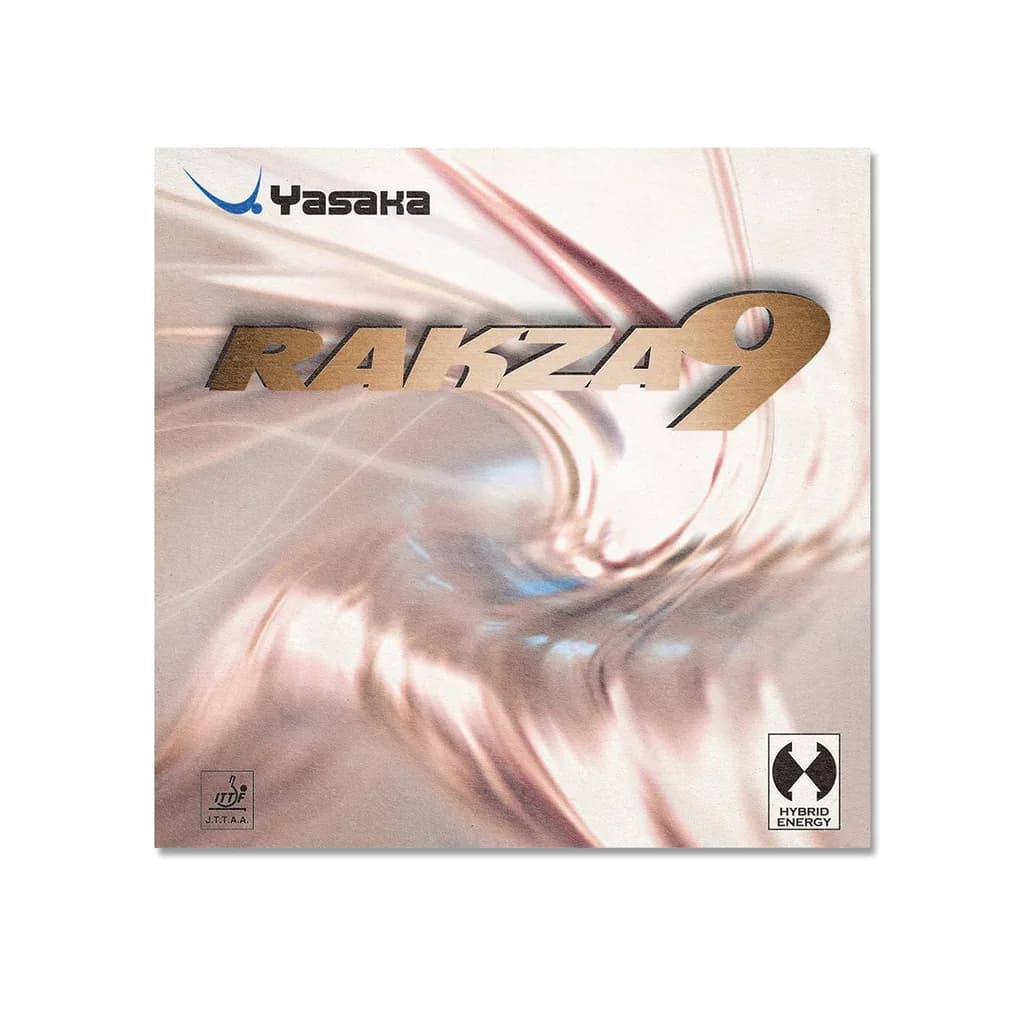
Gallery.
3 imagesFor the last fifteen years the Rakza family has been Yasaka's answer to the dominance of European tensor rubbers. Within that range, the Rakza 7 deservedly earned its reputation as a versatile, highly spinny tensor, fit for almost anything. The Rakza 9 arrives with a different intent: to step up in speed and hardness and offer a more direct rubber, built for the offensive player who is no longer content to control and wants to take charge from mid-distance.
The question that matters to anyone thinking of gluing it on is not whether the Rakza 9 is fast — it is — but what kind of speed it offers, what it gives up to get there, and which player profile it makes sense for against the many alternatives in its bracket, starting with the Rakza 7 itself and the European and Japanese references it competes with directly. That is what this analysis sets out to clarify.
Where the Rakza 9 sits
Yasaka — a Japanese manufacturer founded in 1947 — groups much of its tensor range under the Hybrid Energy label, a sponge technology meant to combine bounce and spin without resorting to the sticky tack of Chinese rubbers. Within that family, the Rakza 9 is presented as the fastest of the series.
The premise matters to understanding it. The classic Rakza 7 is a medium-hardness rubber, very spinny and comfortable close to the table, forgiving, and suited to a broad range of players. The Rakza 9 is not out to replace it but to fill a different gap: the player who wants more launch speed, a slightly flatter arc, and a rubber that answers more firmly when hit hard. To achieve that, Yasaka redesigned both the outer rubber and the sponge — described as a more homogeneous, larger-pore material — and raised the hardness relative to the Rakza 7.
The result is a rubber that sits squarely in the territory of modern attacking tensors, that fiercely contested bracket where the Tenergy 05, the high-end Rasanters, the Tibhar Evolutions and Butterfly's Rozena and Dignics all live. It is a demanding market, and the Rakza 9 competes in it leaning on a classic Yasaka argument: high performance at a price noticeably more contained than the top-tier Japanese references.
The specifications that actually matter
Beyond the spec sheets, three parameters explain the character of the Rakza 9 on the table.
Sponge hardness. It is medium-high. It does not reach the stiffness of the very hard sponges aimed at pure power hitting, but it sits clearly above the Rakza 7 and the soft control tensors. That hardness is directly responsible for its speed and its flatter trajectory, but it also means it demands a correct impact technique: the player who does not close the stroke well or does not bring enough arm speed will find that the rubber asks for more than it gives. This is not a rubber that "plays itself".
Surface (topsheet). The outer rubber has very light tack, almost none. The Rakza 9 is not a Chinese-style tacky rubber; it generates spin through the combination of friction and deformation of the tensor sponge, not through tack. This has two practical consequences: on one hand it is relatively insensitive to incoming spin, which helps on reception; on the other, the maximum spin it can generate in the short game and on first contact is a little lower than a tacky rubber's — as is to be expected from a tensor of this kind.
Thicknesses. It comes in 1.8 mm, 2.0 mm and MAX. Unlike rubbers geared more toward control, the range here is narrow and deliberately offensive: there are no thin sheets because this is not a rubber conceived for passive blocking or defensive play. To make the most of its character, MAX is the natural choice on the forehand; 1.8 or 2.0 mm can make sense on the backhand for whoever wants a little more control without giving up speed entirely.
On-table behaviour
Topspin and attacking from mid-distance
This is its home ground. Against backspin, the Rakza 9 opens with a fast, flat-trajectory topspin that arrives early on the other side and forces the opponent to decide quickly. Where it truly shines is in the topspin exchange at mid-distance: the tensor sponge returns the energy with a firm launch and a progressive acceleration when hit harder, which many users describe as more linear and more predictable than other tensors in the bracket. For the player who has made the move from the table to mid-distance and wants to keep pressing from there, this is one of its great assets.
Short game and reception
Here the reading is more nuanced. The low tack and a contained — not extreme — hardness make serve reception and the short game manageable, but the rubber's speed takes its toll: it asks for a more deliberate hand and a softer touch so that the short push does not run long. It is not a difficult rubber in the short game, but neither is it as forgiving as a soft tensor or as the Rakza 7 itself. That is the usual toll of a rubber with this level of ball launch.
Block and counter
The block is fast and effective once the angle is settled, though its speed calls for an active, well-controlled block: played passively, the ball tends to run off. On the close counter and the counter-topspin it responds very well, with that direct launch that lets the player answer pressure with pressure. It is a rubber that rewards the player who wants to take the initiative, not the one who waits.
Spin and consistency
The spin is high, though with one important caveat: being harder and faster than the Rakza 7, the Rakza 9 is somewhat less spinny in absolute terms, above all on pure spin at low speed. In return, when spin is combined with speed — the powerful topspin of mid-distance — the load it imparts is more than enough and very consistent. It is a typical trade-off: directness and speed are gained, a little pure rotation on the slower strokes is given up.
Pros
- High speed with a progressive, predictable acceleration when hit hard
- Flat, direct trajectory, very effective in the mid-distance exchange
- Good speed-to-spin balance within the attacking category
- Low sensitivity to incoming spin, thanks to its low-tack topsheet
- Favourable performance-to-price ratio against top-tier Japanese tensors
- Consistency on the powerful stroke, with a uniform response
Cons
- Demands settled technique: it does not forgive the player with a poor impact or insufficient arm speed
- More demanding short game: it asks for a deliberate touch so the ball does not run long
- Less spinny than the Rakza 7 on pure spin at low speed
- Medium-high weight, worth considering when gluing it onto an already heavy blade
- Not very versatile toward control: it is not the rubber for passive blocking or defensive play
Who it is for
The Rakza 9 makes sense, above all, for the offensive player with already-settled technique who bases their game on topspin and feels comfortable opening up distance from the table. It is a rubber for the forehand of whoever wants speed and a flat trajectory, and for the backhand of whoever does not give up attacking on that side too.
It is equally a very reasonable option for the player coming from a Rakza 7 who feels it falls short on speed and bite when they want to finish points from mid-distance. The Rakza 9 is the natural step up within the range itself.
On the other hand, the player still learning or in a control phase will find a rubber that asks for more than is good for them: its speed and hardness penalise anyone who does not yet have a refined impact. For that profile, the Rakza 7, the Rakza 7 Soft or a soft control tensor are more sensible choices. Nor is it the ideal rubber for the player who prioritises pure spin and the game glued to the table over speed.
Compared with its direct alternatives
The comparison with the Rakza 7 sums up the premise well: the 7 is spinnier, more curved and more comfortable at the table; the 9 is faster, flatter and more effective once distance is opened up. It is not that one is better than the other, but that they answer to different styles. Against the Tenergy 05 — the category reference — the Rakza 9 offers a somewhat more linear launch and a flatter trajectory, with less of the pure spin on the high arc that is characteristic of the Tenergy, but at a notably lower price. For many players that cost difference, sustained over time by the replacements, tips the balance with no real loss of performance. That is, precisely, the historic argument of the Rakza series: high-end performance without the surcharge of the pricier labels.
How to set it up to suit the aim
- Offensive blade with carbon/ALC + Rakza 9 MAX on the forehand — speed and a flat trajectory to press from mid-distance.Attack
- OFF− all-wood blade + Rakza 9 2.0 mm on the backhand — attack with a little more control and touch.Balance
- Coming from the Rakza 7 — Rakza 9 MAX on the forehand and Rakza 7 on the backhand: raises the speed on the dominant side without giving up spin.Transition
Rating by dimension
The Rakza that opens up distance and puts its foot down.
The Rakza 9 delivers exactly what it promises: it is the fastest, most direct tensor in the family, built for the attacker who wants to take charge with speed and a flat topspin from mid-distance. It does not reinvent the category, but it moves through it with assurance and with one weighty argument: high performance at a more contained price than the top-tier Japanese references. Its limits are the limits of its character: it demands technique, it is not the most forgiving in the short game, and it gives up a little pure spin against the Rakza 7. Whoever is looking for control, a first rubber, or grippy tacky spin should look elsewhere; whoever wants a fast, balanced, sensibly priced tensor will find a fully deserving candidate.