
Yasaka
Rakza 7.
The balanced tensor that earned its reputation through sheer reliability. It dazzles at nothing in particular: it does almost everything well, forgives the imperfect stroke and lasts months rather than weeks.
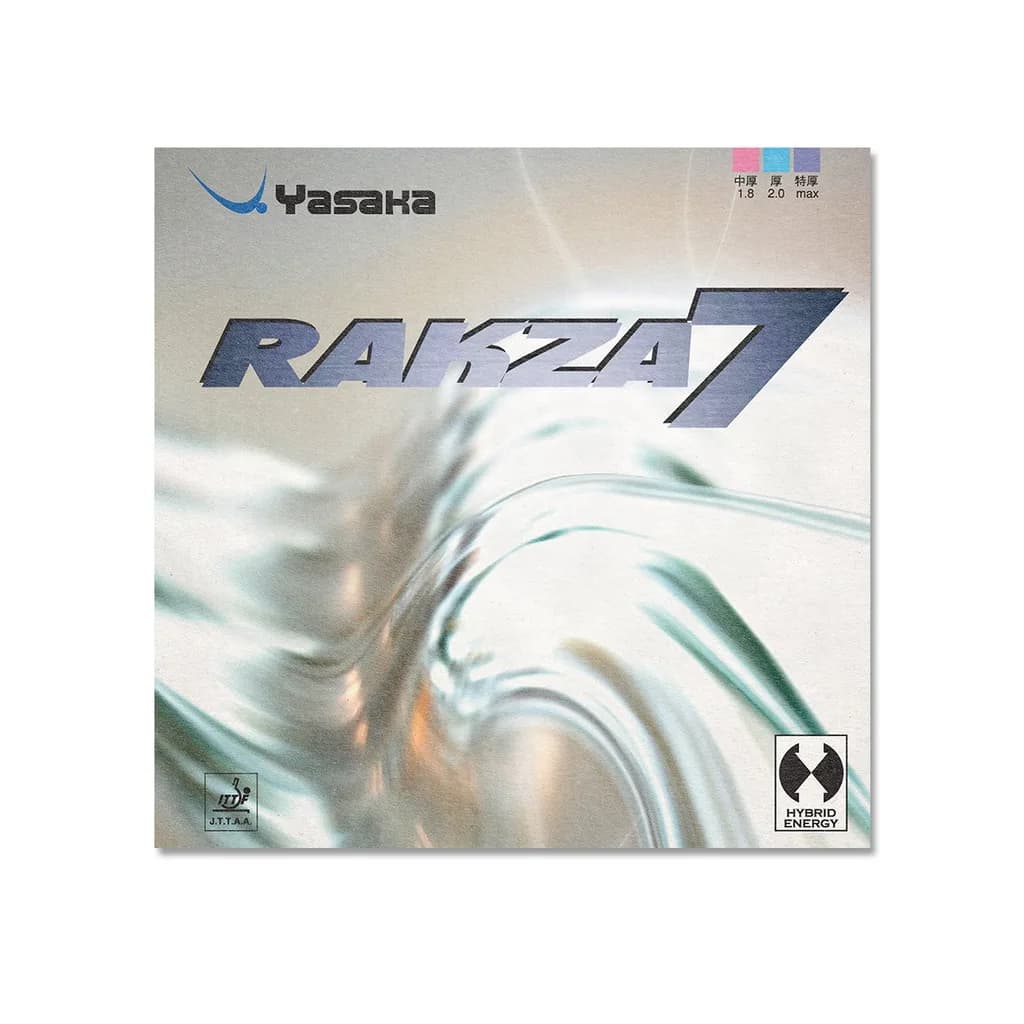
Gallery.
3 imagesIn a segment dominated by the big names — Butterfly, with its Tenergy and Dignics, setting the pace — there are rubbers that have carved out a place not by dazzling in any one respect, but by doing almost everything well and at a sensible price. The Yasaka Rakza 7 is probably the best example of that category. It has been in the catalogue for more than a decade, it has accompanied countless players in their move from the mid-range towards serious offensive play, and it keeps appearing, year after year, on the recommendation lists for anyone looking for their first "proper" tensor rubber.
It is not a headline rubber. It does not promise the highest speed or the most brutal spin on the market. What it offers is something else, often more valuable to the real player: balanced, predictable and decent behaviour, with durability well above the average for its category. This analysis looks at what defines it on the table, where it shines, where it falls short, and which player it remains, even today, one of the smartest buys in its price bracket for.
What it is and where it fits
The Rakza 7 is an inverted rubber — pimples-in or inverted: a smooth contact surface with the small projections, the pimples, facing inwards, against the sponge — of the kind known as a tensor rubber. This type of rubber uses a pre-tensioned topsheet and sponge assembly, like a loaded trampoline, which returns the ball with extra speed and launch without the player having to supply all the energy with the arm. It was the industry's answer to the ban on the old fast glues (speed glue), whose catapult effect was permanently built into the rubber itself.
Yasaka — a long-established Japanese manufacturer — introduced the Rakza family to take on high-end tensors on equal terms but from a more contained price position. The Rakza 7 is the central model of the series and its bestseller: it combines a natural-rubber topsheet with plenty of grip and a medium-hard sponge, in a deliberately balanced formula. It does not set out to be the fastest or the spinniest, but the most well-rounded.
It is worth placing it alongside its siblings in the range, because the naming invites confusion. The Rakza 7 Soft shares the same topsheet but fits a softer sponge: it gives up some speed and top-end power in exchange for more control, a more elastic feel, a little more sound and a slightly higher arc. The Rakza Z, by contrast, is a different rubber in character: it uses a slightly tacky topsheet aimed at maximising spin, with less catapult effect and more contact time, and it asks for a fast blade to perform. When someone talks about "the Rakza" without qualification, they almost always mean the standard 7 discussed here.
The specifications that actually matter
Only a few decisive figures on the spec sheet are of interest.
Sponge hardness. The Rakza 7 fits a medium-hard sponge, around 47.5° on the ESN scale common in Europe. It is a very well-chosen hardness point: firm enough to sustain offensive play with punch, but without reaching the demands of the genuinely hard sponges that punish an imprecise stroke. It is a forgiving hardness, and much of its reputation as an accessible rubber rests there.
Topsheet grip. The topsheet is natural rubber with very little chemical treatment, and it offers notable grip despite not being tacky. That generous grip is what allows it to generate plenty of spin on the stroke with travel, especially on the topspin opening, and it is one of its most celebrated traits.
Sponge thickness. It comes in 1.8 mm, 2.0 mm and MAX. For the offensive play the rubber aspires to, MAX or 2.0 mm are the natural choice, since they make the most of the catapult effect. The 1.8 mm cuts speed and weight in exchange for a little more control, and makes sense on the backhand of a player who prioritises placement.
Durability. It is, along with the price, its great argument. The Rakza 7 holds its performance for far longer than most high-end tensors. Where a rubber such as the Tenergy 05 starts to fade within a few weeks, the Rakza 7 keeps its performance through several months of regular use. For the player paying for their own rubbers, that is a real cost difference sustained over time.
On-table behaviour
The trait that best defines the Rakza 7 is its balance and consistency. There is no facet in which it stands out above the rest, but none in which it falters either. The description that suits it best is the one many players repeat: it offers around 80 % of the speed and spin of top-tier tensors, but with considerably more control and margin for error. For the vast majority of players, that manageable 80 % wins more matches than a 100 % that is hard to tame.
Its natural ground is the topspin opening. The combination of generous grip and a long contact time (dwell time) makes opening with spin easy and intuitive: the ball "sinks" into the sponge, loads up with rotation and comes off with a medium-high arc that gives plenty of safety over the net. That ease in putting safe, spinny openings on the table is probably its greatest practical virtue, and what has made it so popular among those building an offensive game.
On the counter-attack and in mid-distance play, the Rakza 7 responds soundly. It has enough punch to finish when the ball calls for it, though against an advanced player it demands a decisive stroke: it is not a rubber that wins points on its own through speed, but one that rewards good mechanics. On the block, it behaves very stably: its medium-hard sponge absorbs incoming spin well and does not jump excessively against heavily spun balls, which makes it a comfortable, reliable rubber in active defence close to the table. Its solidity on reception, with lower sensitivity to opposing spin, is another of its acknowledged strengths.
In the short game and touch play, it handles naturally for a tensor. The not-excessively-hard sponge and the controlled arc help in measuring the drop shot and the short touch. That said, like every non-tacky tensor, it does not forgive a lack of sensitivity: an imprecise contact on the short ball readily translates into a return that runs long. That is the usual toll of this family of rubbers, and the Rakza 7 pays it somewhat more gently than the faster ones, but it pays it.
The aspect where honesty requires marking its limit is the performance ceiling. The Rakza 7 does not have the top-end speed or the maximum spin of the great modern tensors. In the hands of a high-level player who strikes with quality and looks to close points with raw power, the rubber falls a rung short: the ball has to be worked harder to produce a winner, and on the aggressive third ball a little more bite and launch is missed. It is not a defect, but the logical flip side of its balance: the very decency that makes it so accessible is what stops it competing on explosiveness with the tier above.
Pros
- Exemplary balance: it does almost everything well, with no marked weak points
- Easy, safe topspin opening, with plenty of grip and a confidence-inspiring medium-high arc
- Very stable block and reception, with good absorption of incoming spin
- High control for an attacking tensor: it forgives the imperfect stroke and supports the learning process
- Outstanding durability for its category: it lasts months, not weeks
- Very competitive price, one of the best performance-to-price ratios in the segment
Cons
- Limited performance ceiling: it lacks the top-end speed and spin of the top-tier tensors
- Demands a decisive stroke to close points against advanced opponents
- Less explosive on the third ball than the faster, more aggressive options
- Moderate-to-high weight, a consequence of its medium-hard sponge
- A short game that, like every non-tacky tensor, asks for sensitivity and does not forgive imprecision
Who it is for
The Yasaka Rakza 7 has a very clear addressee: the offensive player at beginner-intermediate or intermediate level who is building an attacking game and wants to step up to a tensor rubber without buying into the problems of the faster, more demanding ones. For that profile, it is one of the soundest recommendations on the market: it gives real offensive performance, control that supports their progression and durability that does not empty their pocket while they learn.
It is also an excellent choice for the allround player who uses medium-speed blades and is after a balanced, reliable rubber, and for anyone who, at a higher level, prioritises consistency and economy over maximum power. It works very well on both the forehand and the backhand; on the backhand in particular, its control and its stability on the block make it a very solid option.
It is not, on the other hand, the best choice for the advanced or competition player who squeezes out top-end speed and spin and needs that extra explosiveness on the third ball. That profile will find more scope in faster, harder tensors. Nor is it a rubber for the purely classical defensive player, being an attacking tensor with bounce.
Comparison with the alternatives
The most useful comparison is with the European tensors in its own bracket. Against the Andro Rasanter R45 — one of the benchmarks of the balanced segment — the difference is one of character rather than level: the Rasanter tends towards a somewhat more elastic and "lively" feel and a more modern launch, while the Rakza 7 offers a more classical, direct sensation and, often, more favourable durability and price. Against the Tibhar Evolution MX-P, the relationship is one of steps: the MX-P is faster and more powerful but also more demanding and less durable; the Rakza 7 is the more controllable and longer-lasting option.
The comparison with the Butterfly Tenergy 05 is revealing of where it sits. The Tenergy beats it on top-end spin and launch and offers that characteristic high, curved arc, but it costs practically twice as much and lasts considerably less. The Rakza 7 does not reach the Tenergy's ceiling, but it delivers a very high percentage of its performance at a fraction of the cost and with far more resistance to wear. For the player who is not going to squeeze out that difference in performance, the Rakza 7 is, quite simply, the more rational buy. Within the family itself, anyone after more control and a softer feel should look at the Rakza 7 Soft; anyone prioritising more speed and a flatter trajectory, the Rakza 9; and anyone putting spin above all else, the Rakza Z.
How to set it up to suit the aim
- Allround or OFF− all-wood blade + Rakza 7 MAX — the classic combination: balanced attack with plenty of control for building an offensive game.Balance
- Medium-speed blade + Rakza 7 on the forehand and 2.0 mm on the backhand — easy topspin opening and a solid block on both wings.Allround
- First tensor rubber — Rakza 7 on a comfortable blade: real performance that forgives while progress is made, and lasts months.Progression
Rating by dimension
The rubber that does not win comparisons, but wins seasons.
The Rakza 7 is one of those rubbers that do not win laboratory tests but do win matches, and above all win seasons. Its virtue lies in no single number but in the sum of them: a well-resolved balance between speed, spin and control, crowned by a durability and a price that very few rivals match. Its limits are those of its own philosophy: anyone after maximum speed, the most aggressive spin or the explosiveness of a competition tensor will be left wanting more, and would do well to look one rung higher. But for the vast body of offensive players who are building their game, who value consistency over spectacle and who want a decent, reliable rubber that does not wreck the budget, it remains, many years after its launch, one of the smartest decisions available.