
Stiga
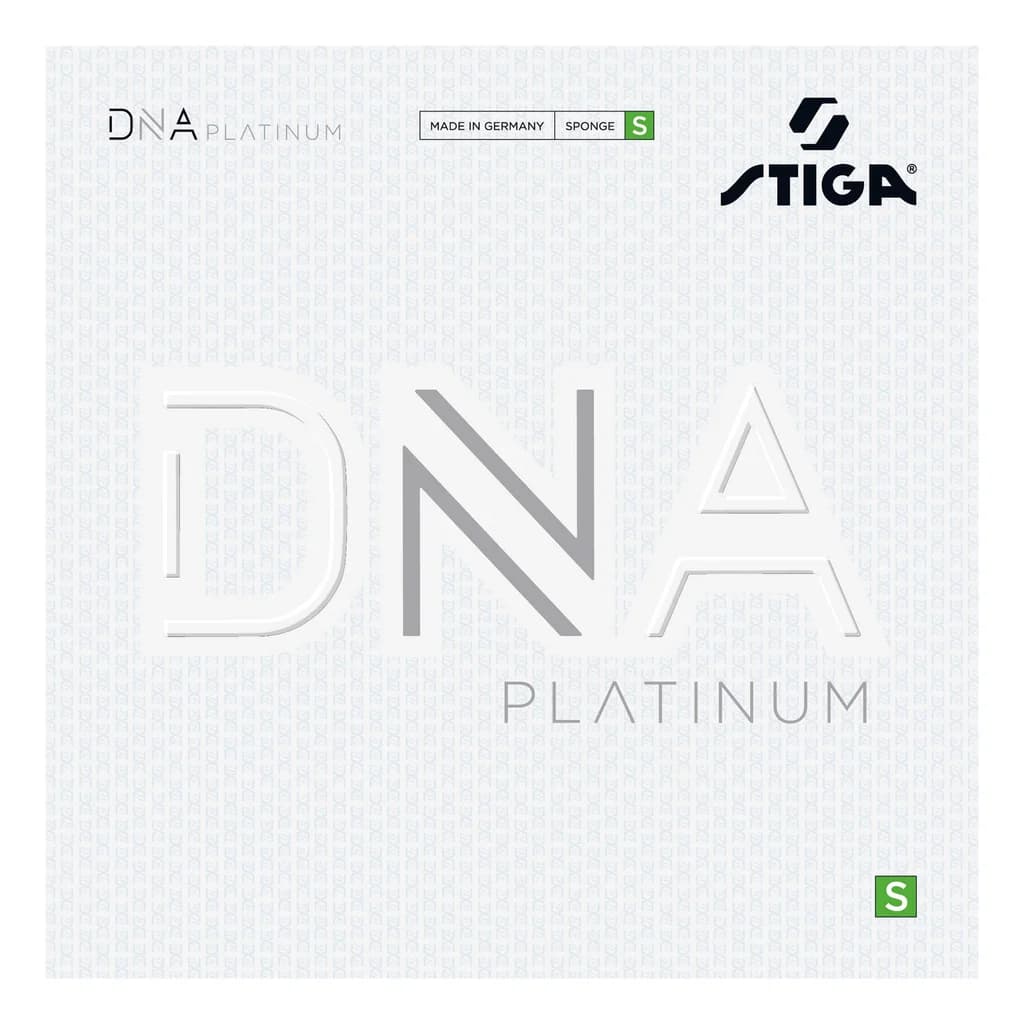
DNA Platinum S.
The soft entry point to a top-tier range. The same high-grip topsheet as the rest of the Platinum series, sitting on a forgiving sponge that switches the spin on earlier and forgives more.
Gallery.
3 imagesThe DNA Platinum family is, as things stand, STIGA's flagship in offensive rubbers. Four hardnesses live inside it — XH, H, M and S — designed to cover very different playing profiles with a single construction philosophy. The S (Soft) version is the softest of the four and, for that very reason, the most misunderstood: it is not a "beginner's" rubber, but the most forgiving and sensitive reading of a clearly competitive range.
This review looks at what the DNA Platinum S actually offers, who it makes sense for, and how it stands against its direct rivals on the market.
Where the S sits within the Platinum range
STIGA presents the DNA Platinum series as its top-tier proposal, developed in Germany and aimed at the demanding attacking player. The logic of the range is simple and well thought out: one technical base — a very tacky topsheet and a power-cell sponge — declined across four hardnesses so the player can choose according to their level of acceleration and their ability to load the rubber.
The XH (Extra Hard) and H (Hard) versions target the player with real arm speed, able to compress very hard sponges and get the most out of them at mid distance. The M (Medium) aims for balance. And the S (Soft) drops the hardness to gain sensitivity, forgiveness and easy activation at medium power.
This is the key to understanding the S: it does not compete on hardness with the most aggressive rubbers in the catalogue, it offers the same high-grip topsheet on a softer, more accessible sponge. The result is a rubber whose catapult switches on earlier and which forgives more in the short touch, without entirely giving up the speed of the range.
PSC technology and what it means in practice
STIGA calls the sponge structure of this range PSC (Power Sponge Cells). Beyond the commercial name, what matters to the player is how it behaves: a very fine-pored sponge which, combined with a thin topsheet on short pimples, leaves room for generous thicknesses — up to 2.3 mm — and favours long trajectories with a pronounced arc on the topspin.
In practical terms this comes down to two traits worth stating honestly. The first is a high, controllable ball arc: the rubber tends to lift the ball easily, which helps clear the net with margin when looping against backspin, a quality the player who opens the point with spin will appreciate. The second is a linear response: unlike some very "explosive" European rubbers, whose catapult fires in a barely progressive way, the DNA Platinum S feels predictable, with a response that grows in proportion to the force applied. That is a clear virtue for control and for the player who values repeatability over raw peak power.
On the table
Active play: topspin and counter-attack
Against backspin, the S behaves exactly as a soft top-tier rubber should: it brings the spin to life without demanding maximum acceleration, which makes it particularly comfortable on the opening topspin and at mid distance. The grip of the topsheet is its least arguable strength; it allows plenty of rotation and lets the player deal with balls from awkward angles.
Close to the table, the combination of soft sponge and good grip makes active blocks and spinny counters straightforward, with a clear sense that the rubber bites the ball well. In exchange, at mid to long distance and full power, the same terminal speed and the same firm feel as the H or XH versions should not be expected: the S trades part of that power ceiling for sensitivity.
Passive play: short touch, pushes and blocking
This is where the choice of a soft sponge makes complete sense. The greater deformation of the sponge gives a more settled touch on the short ball, with a wider margin for error on pushes and flicks. For the player who struggles with very hard rubbers over the table, the S offers a far gentler transition without surrendering offensive potential once the point opens up.
Overall feel
The phrase that best sums up the S is top tier made accessible. It is fast without being intimidating; it has spin to spare without demanding flawless technique to extract it. That combination makes it a versatile rubber, suited to a wide range of attacking styles.
How it compares
Within its category — soft top-tier sponge, high grip, linear response — the DNA Platinum S competes with some very well-known names. Against the Butterfly Tenergy 05, the Platinum S offers comparable grip and rotation, with a response that tends to be more linear and predictable and a slightly less explosive catapult. For the player after consistency, that linearity is an argument in its favour; for anyone chasing maximum spark, the Tenergy keeps its character.
Against rubbers of the Yasaka Rakza X Soft type, the Platinum S sits in a similar hardness range — perhaps a shade softer — while delivering a notable sense of power for how soft it is. The conclusion is a measured one: the Platinum S does not reinvent the category, but it settles confidently among the reference options, with linearity and control as its signature against more explosive rivals.
Who it is for
The DNA Platinum S fits particularly well with the intermediate or upper-intermediate attacking player who wants a top-tier rubber without the technical demands of the hard versions; with anyone who puts spin and control ahead of maximum terminal speed; with the looping, mid-distance player, who benefits from the high arc and the early activation of the spin; and with anyone looking for a gentle step up from softer or more commercial rubbers towards a genuinely competitive one.
It is not the logical choice for the pure hitter with plenty of acceleration chasing maximum punch from distance: that profile will be better served by the M, the H or the XH.
Pros
- Outstanding topsheet grip, with very dependable spin generation
- Linear, predictable response: a real gain for control and consistency
- High ball arc, comfortable when looping against backspin
- Behaves well in the short game thanks to the soft sponge
- Optimised for the ABS plastic ball and ITTF approved (up to 2.3 mm)
Cons
- Lower power ceiling than the harder versions of its own range (M, H, XH)
- Like every soft high-grip sponge, more sensitive to incoming spin on the return
- Priced at the top-tier end: worth weighing up whether its qualities will be used
- Peak grip tends to fade with heavy use (a trait of the category in general)
Which blade to pair it with
Being a soft, fast offensive rubber, the DNA Platinum S goes well with controlled offensive blades (Off / Off−) that provide feel, and also with faster blades where the aim is to reinforce the speed. The soft sponge already contributes the arc and the forgiveness, so a base with some directionality helps keep the whole thing from feeling too spongy. The final choice will depend on the style and on what goes on the other side.
Set-ups that work
- Five-ply allround-offensive blade + DNA Platinum S 2.1 mm — a controlled set-up with a good arc for building the point.Allround
- Inner carbon blade (Off−) + DNA Platinum S 2.3 mm — extra speed without losing the sensitivity of the soft sponge.Offensive
- DNA Platinum S 1.9–2.0 mm on the backhand alongside a harder rubber on the forehand — steady control and grip on the passive side.Backhand
Rating by dimension
Top tier without the small print.
The DNA Platinum S is a coherent, well-resolved rubber: it takes the technical base of a clearly competitive range and makes it accessible through a soft sponge that puts sensitivity, control and spin generation first. It is not the fastest or the most powerful member of its family — nor does it try to be — and that is exactly what it gets right. For the attacking player who values predictability, solid grip and comfort in the short game without giving up serious offensive potential, the S is one of the most complete options in its category. The all-out power hitter, on the other hand, would do well to look further up the range.