
Nittaku
Fastarc C-1.
The Fastarc that most players can genuinely make use of: enough speed to attack and a forgiving control, without the demands of a pure tensor rubber.
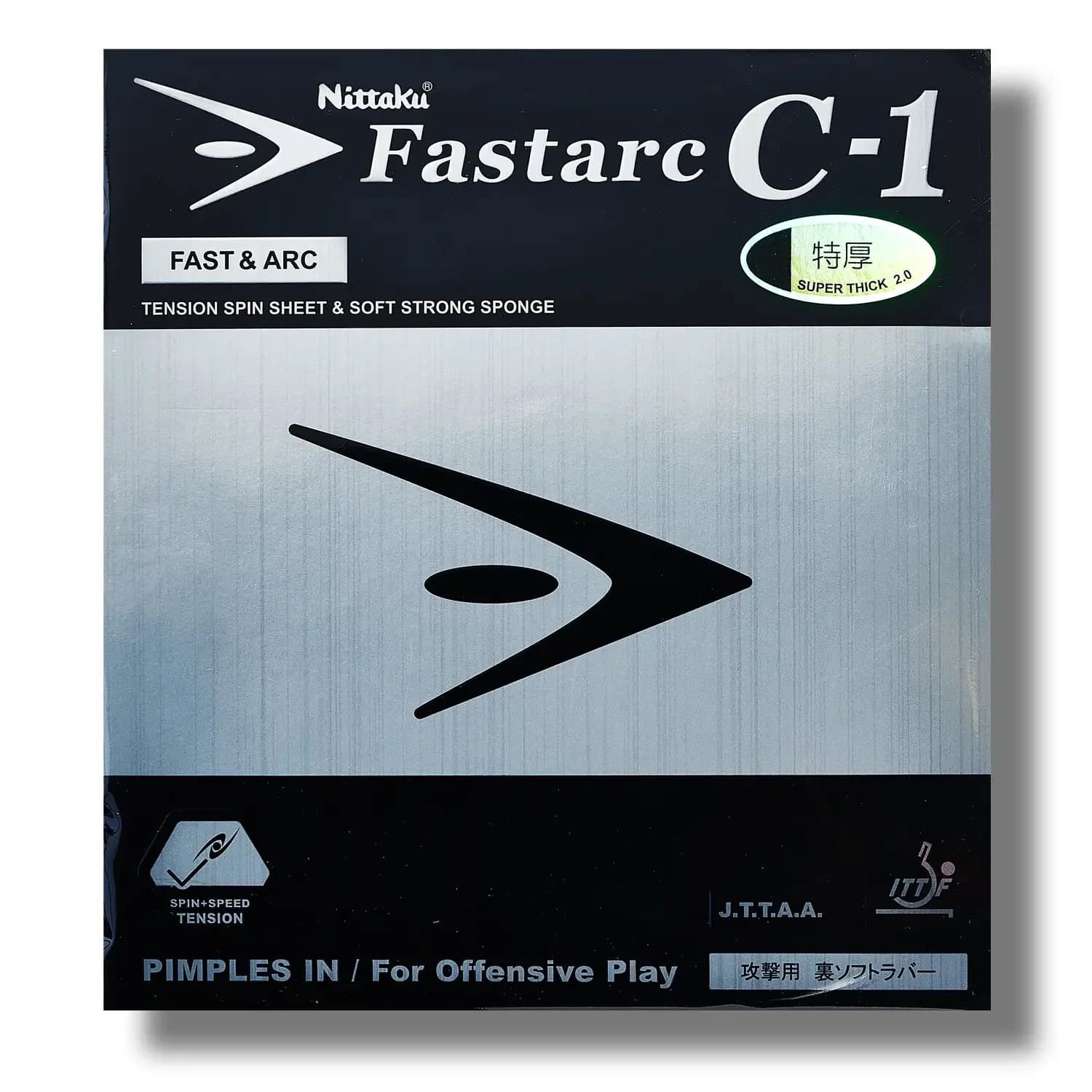
Gallery.
3 imagesNittaku's Fastarc series was born with a clear idea behind it: to offer Japanese-style tensor rubbers, fast and with good spin, without the stiffness or the price of the most exclusive references in the segment. Within that family, the Fastarc C-1 occupies a particular place. It is not the quickest nor the most explosive — that role belongs to its sisters the G-1 and the P-1 — but the most balanced and accessible member of a group conceived, from the outset, to hit hard. It is, in a way, the Fastarc that most players can genuinely make use of.
This review looks at what it offers on the table, how it differs from its sisters and which kind of player it makes sense for.
What it is and what it sets out to be
It is worth placing the product before going into detail. The Fastarc C-1 is a smooth rubber — inverted, meaning a smooth contact surface with the small pimples turned inwards, against the sponge — of the kind known as a tensor rubber.
That deserves a word of explanation, because it is the key to everything else. A tensor rubber has a topsheet and a sponge built so that the assembly sits under permanent tension, like a loaded trampoline. When the ball lands, the rubber sends it back with extra speed and launch — the so-called catapult effect — without the player having to supply all the energy through the arm. In exchange, this kind of surface demands better technique to control than a classic untensioned rubber.
Nittaku's Fastarc family is organised by hardness and character. The G-1 and the P-1 are the faster versions with the firmer sponge; the S-1 is the softest and most controlled; and the C-1 sits right at the midpoint, a little softer than the first two and a little faster than the S-1. That position is no accident: the C-1 aims to gather into a single rubber enough speed to attack and control wide enough not to penalise combination play. Its name gives it away — the "C" points to control — and its behaviour confirms it.
Specifications that matter to the player
Only a few parameters on the spec sheet are of interest, but they are decisive ones.
Sponge hardness. It sits around 45°, which places it in medium-soft territory. That is an important point of hardness: firm enough to sustain offensive strokes with a long swing, yet soft enough to let the ball sink into the rubber on gentler touches. Curiously, despite having a softer sponge than the P-1, the C-1 gives a slightly firmer feel at contact, a nuance many players appreciate because it delivers clear information about what is happening at impact.
Sponge thickness. It is usually offered in 1.8 mm, 2.0 mm and max. For the offensive all-round game the rubber aspires to, the thicker options (2.0 and max) are the natural choice: they maximise the catapult effect and the spin potential. A slightly thinner sponge trims speed in exchange for extra control, a reasonable option for anyone who prioritises play close to the table.
Weight. This is a medium-weight rubber, of the order of 47 grams cut to a standard bat. Here it marks a clear difference from the heavier European rubbers with porous sponge: the C-1 does not overload the assembly, which favours handling close to the table and reduces fatigue in long matches. It is a point in its favour, and one worth keeping in mind when putting a bat together.
Tack. The surface has a slight but noticeable tack: it is not a sticky rubber in the Chinese manner, but neither is it completely "dry" like some European tensor rubbers. That measure of grip, combined with the wide, tightly packed pimples of the topsheet, explains how easily it generates spin across every kind of stroke. It is a distinctive trait within the segment and one of the keys to its character.
On-table behaviour
This is where a rubber truly defines itself, beyond the manufacturer's numbers.
The dominant trait of the C-1 is its balance. It does not stand out in a single area at the expense of the rest; it distributes its performance remarkably evenly. On attacking strokes with a full swing it responds with high speed and a quick launch, enough to smash and to sustain a topspin exchange without falling short. But unlike the more explosive rubbers in the segment, it does not force the player to go flat out every time: it accepts a measured stroke and returns a controlled ball, which greatly widens the available repertoire.
The trajectory is a distinctive feature and, to a large extent, the reason for its reputation. The C-1 traces a medium-high arc, more curved than that of the flatter European tensor rubbers. That high arc is an ally of control: it provides a generous margin over the net and forgives the small errors in contact point that a low arc would punish without mercy. For the player who attacks with a full swing, that curve translates into safe topspins with dip, crossing the net with room to spare and kicking on the bounce.
On spin the rubber performs at a high level, and not only on the full stroke. Thanks to its slight tack and the geometry of the topsheet, it generates rotation easily on the powerful topspin as much as on finer touches: chops, serves and spin-loaded touches come out naturally. It is one of the virtues that separate it from the purely fast tensor rubbers, which demand quality of contact to turn the ball and punish an imprecise touch.
The short game and the block are perhaps its most surprising territory for a rubber of this speed. The C-1 allows drop shots and touches over the table with a precision that is not common in the offensive segment, and it blocks with a controlled firmness that makes neutralising the opponent's attack easier. This is the rubber's great argument: it offers attacking performance without giving up precision play.
As an honest counterweight, it should be said that at very low speeds the rubber conveys a somewhat muted feel, a slightly "dead" quality on the softest touches, and that its click on fast strokes is less pronounced than that of other Fastarcs. That is not a flaw but the reverse of its balanced character: anyone after the explosive response and the solid sound of a pure attacking rubber will find the C-1 rather more restrained. And, like every tensor rubber with a marked catapult, it offers its best version during the first few weeks and gradually loses some of its liveliness with use, a real cost over time that is worth anticipating.
Pros
- Outstanding balance between speed, spin and control
- Notable control for an offensive tensor rubber, with a forgiving high arc
- Strong spin generation across every kind of stroke, from the topspin to the short game
- Excellent in the block and in play over the table, uncommon in the segment
- Modest weight, which favours handling and does not tire the arm
- Genuine versatility: it serves the attacker and the combination player alike
Cons
- Somewhat muted feel at low speed, with a slightly "dead" quality on soft touches
- Less explosive than the faster Fastarcs (G-1, P-1) and than high-end European tensor rubbers
- Click and sound less pronounced than on a pure attacking rubber
- Performance that fades with use, as is usual with tensor rubbers
Who it is for
The Nittaku Fastarc C-1 has a broad but clearly defined audience: the intermediate-to-advanced player looking for a reliable, versatile offensive rubber, able to attack soundly without sacrificing control and placement. It is an excellent choice for anyone who combines topspin with the block and the short game, and for anyone who values the safety of a high arc over outright speed.
It works just as well on the forehand, for the player who attacks with a full swing, as on the backhand, where its control and its ease of spin make it a very comfortable companion. It is also a serious candidate for anyone moving up from a standard rubber who wants to make the jump to a modern tensor rubber without suddenly facing a tool that is too demanding.
Conversely, it is not the rubber for the player chasing maximum speed and explosiveness, nor for anyone who enjoys the lively response and the solid sound of a pure attacking rubber. That profile will find the G-1 or the P-1 from the same family — or the faster European tensor rubbers — a closer answer to what they are after.
How it compares
The most useful comparison is the one drawn within the Fastarc family itself, because it pins down precisely where the C-1 sits. Against the G-1, the C-1 plays a little softer, livelier on the medium touch and, above all, more accessible: if the choice lies between the two, the C-1 is for whoever prioritises control and the G-1 for whoever wants that extra measure of speed and spin. Against the P-1, the C-1 is the slightly slower version, a little less spinny and more controlled; and against the S-1, the softest of the series, the C-1 adds a little more speed without giving up excellent control. Taken together, the C-1 is the balance point of the family, the one that asks the fewest compromises of the player.
Outside the brand, the inevitable reference in the segment is the Butterfly Tenergy 05, the Japanese standard for years. The C-1 shares the philosophy of a high arc and good spin, but it sits a step below in explosiveness and in that premium liveliness the Tenergy is known for, in exchange for a noticeably more contained price. For the player after Japanese tensor performance on a moderate budget, the C-1 is a very reasonable alternative.
Against the European tensor rubbers with medium-hard sponge and a marked catapult — in the mould of a Tibhar Evolution MX-P — the C-1 plays in a different key: more direct speed and a lower arc on the European side, against the high arc, the greater control and the slight tack of the Japanese. Whoever prioritises penetration and a flat trajectory will lean towards the former; whoever values safety, easy spin and versatility, towards the C-1.
Where it fits on the bat
- The C-1 in max or 2.0 mm on the forehand, to wring out the catapult effect and the topspin potential.Forehand
- The C-1 in 1.8 mm on the backhand: it trims a measure of speed in exchange for extra control in the block and the short game.Backhand
- For anyone moving up from a standard rubber: the C-1 is the natural first step to a modern tensor rubber without facing a tool that is too demanding.Transition
Final assessment
The Nittaku Fastarc C-1 is neither the fastest rubber in its family nor the one that grabs the headlines, and that is precisely where its greatest virtue lies. It is an offensive tensor rubber that has known how to give up extreme explosiveness in exchange for something harder to achieve: a real balance between attack and control, with a forgiving high arc, spin that comes easily and notable reliability in the short game and the block. Its modest weight and accessible character round out a very well resolved package.
Its limits are the coherent flip side of that philosophy: a somewhat muted feel at low speed and less explosiveness than a pure attacking rubber. They are not flaws but design decisions. Placed in the right hands — an intermediate or advanced player who values versatility over raw power — the Fastarc C-1 is one of the most balanced and easiest to recommend options in its segment. It is, in short, the Fastarc for anyone who wants the virtues of a modern Japanese tensor rubber without its harsher demands.
Frequently asked questions
Is the Fastarc C-1 suitable for an intermediate player?
Yes, and that is one of its strengths. Its high arc, its notable control and its modest weight make it one of the most accessible offensive tensor rubbers on the market, ideal for making the jump from a standard rubber without facing a tool that is too demanding.
How does it differ from the G-1?
The C-1 plays a little softer, more controlled and more accessible; the G-1 offers an extra measure of speed and spin. Control first points to the C-1; more punch points to the G-1.
Which thickness should be chosen?
To make the most of the rubber's offensive character, the thicker options (2.0 mm or max) are the natural choice. A slightly thinner sponge brings more control at the cost of speed.
Does it work on the backhand?
Yes. Its ease of spin, its control and its good behaviour in the block make it a very comfortable option for the backhand side, as well as for the forehand.
How does it compare with the Tenergy 05?
They share the philosophy of a high arc and good spin, but the C-1 sits a step below in explosiveness and liveliness, in exchange for a noticeably more contained price. It is a reasonable alternative for anyone after Japanese tensor performance on a moderate budget.
Rating by dimension
The Fastarc for anyone who wants a modern Japanese tensor rubber without its harsher demands.
The Fastarc C-1 is neither the fastest rubber in its family nor the one that grabs the headlines, and that is precisely where its greatest virtue lies. It gives up extreme explosiveness in exchange for something harder to achieve: a real balance between attack and control, with a forgiving high arc, spin that comes easily and notable reliability in the short game and the block. Its modest weight and accessible character round out a very well resolved package. Its limits — a somewhat muted feel at low speed and less explosiveness than a pure attacking rubber — are the coherent flip side of that philosophy: they are not flaws but design decisions.