
Nittaku
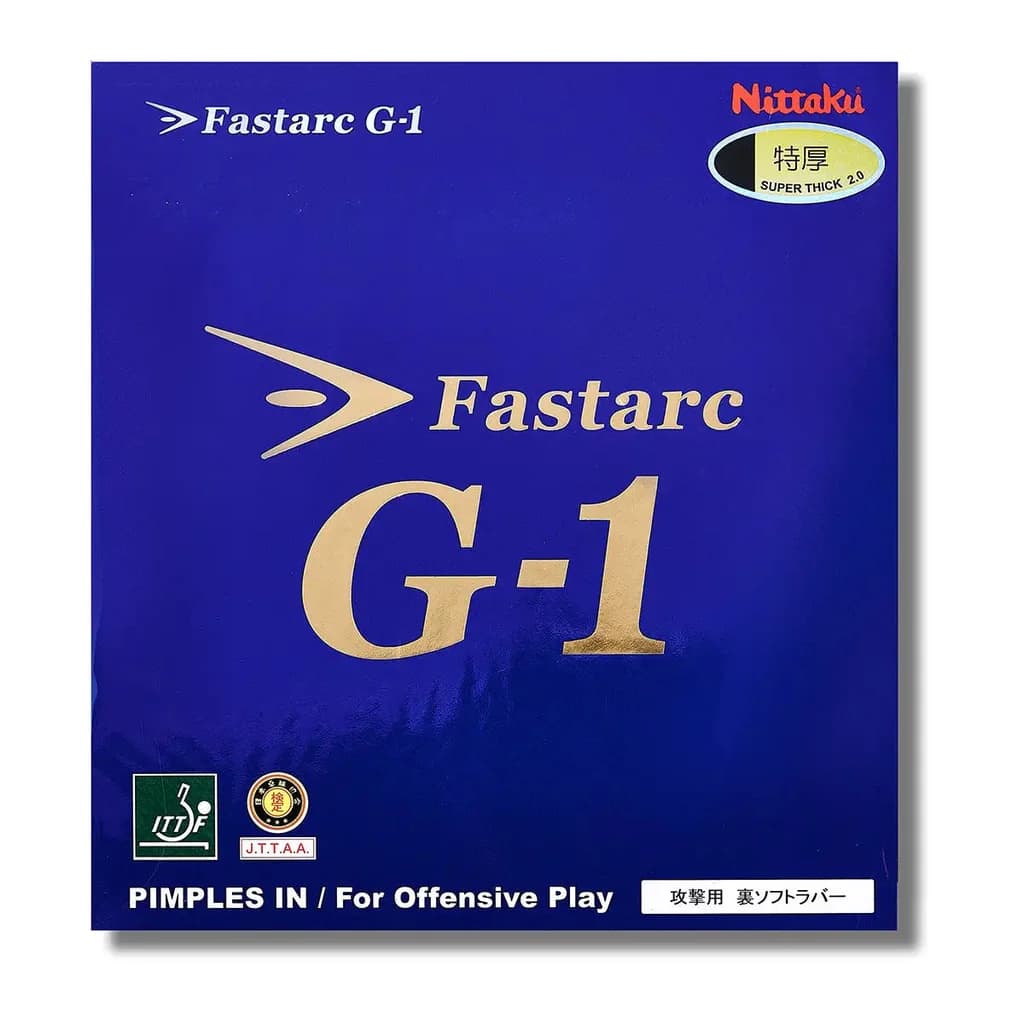
Fastarc G-1.
The Japanese tensor with a German soul that earned its reputation on its own merits: a high arc, dependable spin and a durability that leaves much of the competition behind.
Gallery.
0 imagesSome products reach the market with a label that follows them for the whole of their commercial life. The Nittaku Fastarc G-1 is one of them: since it appeared it has carried the tag of "affordable alternative to the Tenergy 05", a comparison repeated so often that it threatens to eclipse what the rubber actually is. And what it is, beyond the slogan, turns out to be rather interesting: a high-end tensor, made in Germany and sold under a respected Japanese brand, with a character of its own, a very generous arc and a durability well above that of most of its direct rivals.
This review sets the shadow of the Tenergy aside as far as that is possible — the comparison is unavoidable and gets its own space — in order to judge the Fastarc G-1 by what it brings to the table: its spin, its safety, its limits and, above all, the kind of player who can get the most out of it.
A Japanese rubber made in Germany
One point that often causes confusion is worth clearing up from the outset. Nittaku is a historic and highly respected Japanese brand — among other things, the maker of the official balls for many international competitions — but the Fastarc G-1 is not a "Japanese" rubber in the way the Butterfly rubbers are. It belongs to the extensive family of tensors developed with ESN technology, the German manufacturer behind the vast majority of European tensor rubbers and a good share of those sold under brands from other countries. Put another way: the G-1 shares its manufacturing "genetics" with families as well known as the Rasant, the Tibhar Evolution or the Andro Rasanter, even though each brand sets its own sponge and topsheet specifications.
That is no black mark, quite the opposite: it places the Fastarc G-1 among the European tensors of proven quality, with their characteristic balance between performance and durability, but tuned to Nittaku's criteria. The "G" in the name refers to its grip-type topsheet, and "Fast Arc" sums up the design brief: speed with arc. In essence, it is a rubber conceived for the spin game with a wide margin of safety.
The Fastarc G-1 is a smooth rubber — inverted: a flat contact surface with the small projections, the pimples, facing inwards and glued to the sponge — of the kind known as a tensor rubber. Rubbers of this type carry a pre-tensioned topsheet and sponge, like a loaded trampoline, so that they return the ball with extra speed and launch without the player having to supply all the energy with the arm.
Specifications that matter to the player
Only a handful of figures on the data sheet matter, but they are decisive ones.
Grip topsheet and high arc. The trait that defines the G-1's character is the combination of a grip-type topsheet, with wide pimples and relatively narrow spacing, and a naturally high launch arc. That geometry lets the rubber bite into the ball on a tangential contact and produce a curved, high and safe trajectory. It is the feature that most shapes its behaviour, and it explains both its virtues and its main drawback.
Sponge hardness. The G-1 runs a medium-hard sponge, in the region of 47.5° on the ESN scale. That degree of hardness places it in the same range as most high-end offensive tensors: firm enough to sustain an attacking game and to give a direct sensation, but short of the stiffness of the hardest sponges on the market. In practice it translates into a feel many players describe as crisp and precise, with a degree of firmness that conveys what happens at impact.
Sponge thickness. It comes in a wide range of thicknesses, from 1.4 mm up to maximum. For the offensive game the rubber is aiming at, maximum thickness is the natural choice, since it makes full use of the sponge's catapult effect. Intermediate thicknesses add a little control and cut weight, and can make sense on the backhand of a player who puts placement ahead of power.
Weight. It is a rubber of contained, if moderate, weight, in the region of 49 grams once cut to the shape of the bat. It is neither especially light nor especially heavy; it sits in the middle of its category, which makes it easy to build a balanced bat with no surprises.
Tack. This is not a sticky rubber. Its spin does not come from a tacky surface, Chinese style, but from friction and deformation at impact. Its grip topsheet does, however, hold the ball firmly and barely slips, which lets it generate plenty of spin on a stroke with travel.
Behaviour in play
This is where an offensive rubber is really defined, beyond the numbers.
The trait that best characterises the Fastarc G-1 is its safety. Its high arc and grip topsheet produce a curved trajectory with plenty of margin over the net, which makes it a forgiving rubber and makes it easy to close the topspin down inside the table. That quality makes it especially comfortable on the opening topspin against a backspin ball and on the counter-topspin, two situations in which a player is grateful for a ball that rises safely and drops with force. The rubber goes along with the stroke without demanding pinpoint technique to land the ball, something the developing player and the veteran after reliability appreciate equally.
As for spin, the G-1 is well served. Its grip topsheet lets it generate abundant spin on a stroke with travel, and that, together with its safety, is its main selling point. It does not reach the "magic", lively spin sensation of the very top Japanese tensors, but it moves confidently at a solid level, enough for the spin game of a demanding offensive player.
Speed is perhaps the most qualified section. The G-1 is fast, but it is not a rubber of overwhelming speed and does not set out to be one. Its character leans deliberately towards control and arc rather than raw power. Close to the table and at mid-distance it moves easily; at long range, a player with a very powerful punch may miss a little more carry in the ball. It is a rubber for whoever builds the point with spin and consistency, not for whoever is after the outright winner from the back.
On the block and the counter-attack, the medium-hard sponge and its relative insensitivity to incoming spin work in its favour: the rubber behaves in a stable, predictable way against spun balls and absorbs the opponent's spin more confidently than softer, more elastic tensors. The block is solid and easy to control.
In the short game and touch play, the G-1 is reasonably manageable for a tensor of its category, thanks to a sponge that stops short of being extremely hard. Even so, like every non-tacky tensor rubber, it does not forgive a lack of sensitivity: an imprecise contact on a short ball easily turns into a return that is too long or too high. That is the usual toll with rubbers of this type, and the G-1 pays it like the rest.
That said, the high arc that is its greatest virtue is also its main burden. The rubber tends to lift the ball, and a player with a very vertical attacking stroke, or one who does not adjust the angle of the bat, will find balls going long without much effort. Getting the most out of it calls for a stroke with travel forwards and a closed bat angle; whoever hits "upwards" will have to correct their technique to tame that trajectory.
The other great point in its favour — and this one really does weigh against much of the competition — is durability. The Fastarc G-1 has a deserved reputation for holding up well over the weeks, keeping its performance for considerably longer than many high-end tensors, and very markedly so next to the Tenergy rubbers, whose rapid loss of performance is a known flaw. For a rubber at this price, that longevity multiplies an already good balance between cost and performance.
Pros
- Safety and a high arc, giving a notable margin over the net and consistency on the topspin
- Abundant spin thanks to its grip topsheet, above all on the stroke with travel
- Durability well above the average for its segment, a real cost factor in the long run
- A stable block and good tolerance of incoming spin, thanks to its medium-hard sponge
- Excellent value for money, appreciably cheaper than the benchmark Japanese tensors
- Direct, precise feel that conveys the information from the impact well
Cons
- A very high arc that can send balls long and calls for adjusting the bat angle and the stroke
- Contained speed: less top-end power than the fastest tensors, above all at long range
- Solid but not elite spin: it does not reach the lively sensation of the best Japanese tensors
- A short game that demands sensitivity, as with every non-tacky tensor rubber
- A character built on reliability rather than spectacle, poorly suited to anyone after maximum raw power
Which player is it for?
The Nittaku Fastarc G-1 has a very clear addressee: the intermediate-to-advanced or advanced offensive player whose game is built on spin topspin and who values safety, consistency and durability over maximum raw power. It is a rubber especially suited to whoever constructs the point with spin and placement, to whoever plays many hours and wants a rubber that will not fade in a few weeks, and to whoever is after high-end performance without paying the price of the benchmark Japanese tensors.
It works very well on both the forehand and the backhand. On the forehand it gives a spin attacker a safe arc and abundant spin, ideal for the topspin game from mid-distance. On the backhand, its controllable character, stable block and tolerance of spin make it a very solid option for the opening topspin and the active block; it is in fact a backhand choice many players recommend.
It is not, on the other hand, the best choice for the player who puts maximum speed and top-end power first — that profile will find more carry in faster, more direct tensors — nor for whoever has a very vertical attacking stroke and does not want to correct it, since they will struggle with balls going long. Neither is it a beginner's rubber: it remains a fast tensor that demands a topspin technique already up and running.
How it compares with the alternatives
The obligatory comparison is with the Butterfly Tenergy 05, the benchmark the G-1 has dragged behind it since birth. Both share a spinny character and a high arc, and their sponge hardness is very similar. The differences are of nuance and philosophy. The Tenergy 05 offers a livelier, more elastic sensation, a somewhat more pronounced catapult effect and that "magic" spin that is hard to replicate; the G-1 responds more directly and firmly, with a shade less life in the ball but with very considerable reliability and control. Where the G-1 clearly wins is on two decisive fronts: durability — it lasts considerably longer than the Tenergy, whose rapid decline is a historic flaw — and price, appreciably lower. For many players that combination makes the G-1 the more rational purchase; whoever is specifically after the lively character and the extra spin of the Tenergy will find that the difference, real as it is, comes dear.
Against the European tensors of its own ESN family — the Andro Rasanter, the Tibhar Evolution, the Rasant — the G-1 competes on level terms, and the differences are again ones of tuning rather than of category. Broadly speaking, the G-1 stands out for its particularly high arc and its marked leaning towards safety, while rivals such as the Rasanter R47 offer a somewhat more direct and linear trajectory. Choosing between them depends largely on the player's style and on the sensation they prefer; all of them sit at a similar level of performance and durability, and they share the virtue of offering high performance at a contained price.
Taken as a whole, the Fastarc G-1 sits confidently in that crowded, competitive middle segment of high-end tensors with good value for money. It is neither the fastest nor the spinniest, but it is one of the safest and most balanced, and its durability places it among the most cost-effective options in its category.
Where it fits on the bat
- The G-1 in maximum thickness on the forehand, to wring out the catapult effect and the spin potential of the topspin attacker at mid-distance.Forehand
- The G-1 on the backhand is one of its strongest cards: a stable block, control and a safe arc for the opening topspin. An intermediate thickness puts placement first.Backhand
- For anyone looking for an alternative to the Tenergy: high-end performance with more durability and a lower price, accepting a shade less liveliness.Tenergy alternative
Final assessment
The Nittaku Fastarc G-1 is an example of a rubber that deserves to be judged on its own terms rather than in the shadow of the product it is forever measured against. It is an honest, balanced and very dependable high-end tensor whose high arc and grip topsheet make it one of the safest options on the market for a spin game. On top of that come two weighty arguments: above-average durability and a price clearly below that of the benchmark Japanese tensors.
Its limits follow from its own philosophy. It is neither the fastest rubber nor the one with the liveliest spin sensation, and its pronounced arc calls for a suitable attacking stroke if the player is not to pay for it in long balls. But for the offensive player who values consistency, safety and cost-effectiveness over raw power, the Fastarc G-1 is an outstanding choice. It does not need to introduce itself as "the cheap Tenergy": it stands perfectly well on its own as one of the most recommendable tensors in its segment, and very particularly as a backhand option that is hard to better at the price.
Frequently asked questions
Is the Fastarc G-1 really an alternative to the Tenergy 05?
It is, in so far as the two share a spinny character, a high arc and a similar hardness, and in so far as the G-1 offers close performance for considerably less money and with better durability. But it is not a copy: the Tenergy has a livelier sensation and a little extra spin, while the G-1 responds more directly and dependably. It is best seen as a rubber with a personality of its own, not as a substitute.
Is the Fastarc G-1 a Japanese rubber?
The brand, Nittaku, is Japanese, but the rubber is made in Germany with ESN technology, the same technology behind most European tensors. It therefore shares its manufacturing "genetics" with families such as the Rasanter, the Evolution or the Rasant, tuned to Nittaku's specifications.
What do the "G" and the "1" in the name mean?
The "G" refers to the grip-type topsheet, geared towards spin. The Fastarc family includes other variants — P-1, C-1, S-1 — with different topsheets and hardnesses: the P-1 is a little softer and slower, and the S-1 is the softest and slowest of the series. The G-1 is the one most oriented towards a balance of spin, speed and safety.
Forehand or backhand?
It works well on both, but it stands out especially on the backhand, where its stable block, its control and its safe arc make it a much-recommended option. On the forehand it is a solid rubber for the spin attacker who plays at mid-distance.
Which thickness is the one to choose?
To make use of the rubber's offensive character, maximum thickness is the natural choice. Intermediate thicknesses add a little control at the cost of speed and spin, and can make sense on the backhand of a player who puts placement first.
Is it a difficult rubber to control?
On the contrary: its great virtue is its safety. The only thing to watch is the high arc, which tends to lift the ball. A player with a forward attacking stroke and a closed bat angle will control it easily; whoever hits "upwards" will have to adjust their technique to avoid balls going long.
Rating by dimension
The rubber that does not need to introduce itself as "the cheap Tenergy".
The Nittaku Fastarc G-1 deserves to be judged on its own terms rather than in the shadow of the product it is forever measured against. It is an honest, balanced and very dependable high-end tensor whose high arc and grip topsheet make it one of the safest options on the market for a spin game. On top of that come two weighty arguments: above-average durability and a price clearly below that of the benchmark Japanese tensors. Its limits follow from its own philosophy: it is neither the fastest nor the liveliest for spin, and its pronounced arc calls for a suitable attacking stroke if the player is not to pay for it in long balls.