
Butterfly
Lin Yun-Ju Super ZLC.
Butterfly's stiffest, densest fibre put at the service of mid-table attacking play: forceful speed, an enormous sweet spot and a feel a shade friendlier than the rest of the Super ZLC range.
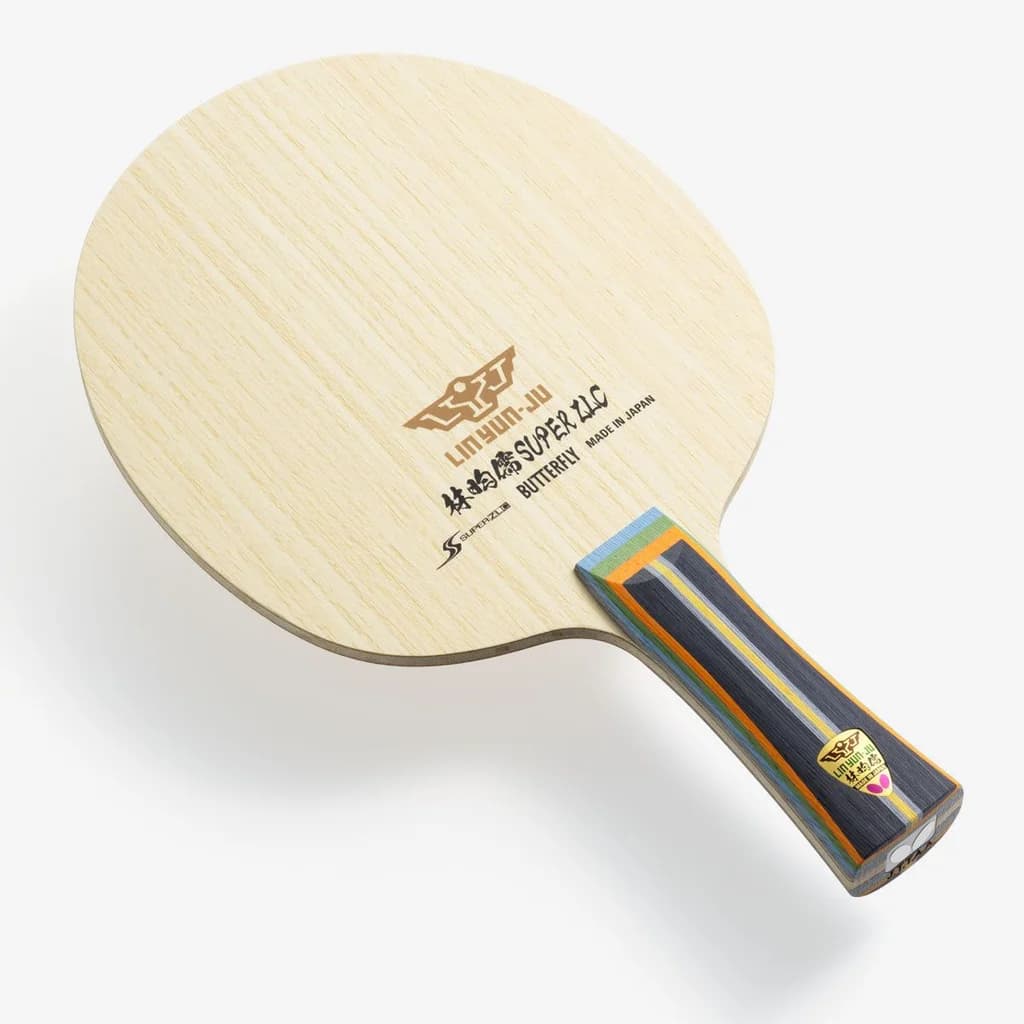
Gallery.
3 imagesButterfly has made a habit of naming its blades after its great players, and the Lin Yun-Ju Super ZLC is one of those cases where the name is not just marketing: it describes rather well the kind of game the blade was conceived for. Lin Yun-Ju, the gifted Taiwanese player, stands out for fast, explosive table tennis of great precision close to the table, with notably heavy use of the flick over the net.
This blade, built around Super ZL Carbon, the stiffest and densest fibre in the brand's catalogue, is after precisely that: a fast, stable, firm-feeling platform for two-winged attacking play. This review looks at what it actually offers on the table, which player it makes sense for, and how it stands against its closest alternatives, starting with those from its own house.
Placing the product
Understanding this blade means starting with the fibre that defines it. Butterfly's ZLC family takes its name from ZL Carbon, a weave that combines ZL fibre —a light, elastic aramid, a close relative of arylate— with carbon. Against the ALC fibre of the Viscaria, ZLC is somewhat faster and offers a larger sweet spot, while still keeping a reasonably communicative feel.
Super ZL Carbon (SZLC) goes a step further. Butterfly weaves the fibres at close to double the density of conventional ZLC. The result is a stiffer layer with greater energy return, which widens the sweet spot further still and raises the speed, at the cost of a drier, more direct feel. In the brand's hierarchy of fibres it is one of the fastest and firmest materials available.
Structurally, the Lin Yun-Ju Super ZLC is a classic seven-layer build: two outer koto plies, two layers of Super ZL Carbon beneath them, two intermediate limba plies and a kiri (paulownia) core. On paper it is the same composition scheme the Viscaria made popular; the decisive difference lies in the fibre and in how it transforms the character of the blade.
It is worth placing the product clearly to avoid confusion. There is a Lin Yun-Ju ALC, slower, softer and more forgiving, aimed at a different player. This review refers exclusively to the Super ZLC version, the fast, stiff variant of the range. They are blades related by name but very different in behaviour, and one should not be taken for the other.
Specs that matter to the player
Translating the spec sheet into sensations helps in deciding with judgement.
The thickness sits around 5.5–5.6 millimetres, modest for a blade with a double layer of stiff fibre. The speed here does not come from raw thickness but from the SZLC fibre itself: it is the density of the weave that accelerates the ball, while the build stays relatively thin and lively.
The weight usually moves around 84–86 grams, with the variability normal to a natural wood. It is a moderate weight which, together with a feel somewhat softer than that of other Super ZLC blades from the house, helps make the bat manageable in fast play at the table. As always, where the shop allows a choice of weight, it is worth deciding by style: a lighter unit rewards agility in the block and the counter; a heavier one adds stability and punch. Given that this blade is usually fitted with tensor rubbers that are far from light, the final weight of the whole set-up is worth watching.
The outer koto plies bring firmness and a direct return, consistent with the character of the fibre. The light kiri core helps keep the weight in check and the response lively despite the stiffness of the build.
Behaviour in play
The first thing that defines this blade is its speed. It sits clearly in the upper part of the offensive range, above the Viscaria and above ALC blades in general. The return is fast and forceful, with an energy that shows especially on the power stroke and in counter-hitting at high pace.
That speed, though, does not come with the loss of control one might fear, and the reason is its sweet spot. The density of the SZLC fibre notably widens the useful area of the blade, which translates into very high stability and tolerance of off-centre contact for a blade this fast. The ball leaves on a predictable trajectory even when the contact is not perfect, and that is one of its great virtues: it forgives more than its speed would suggest.
The launch angle is low, and this shapes its style. The Lin Yun-Ju Super ZLC is not a blade for heavy, looping topspin but for the loop-drive: tense, fast, flat trajectories, oriented more towards speed than spin. In the topspin exchange at medium range it answers with penetration and solidity, but whoever is after heavy spin and a pronounced arc will notice that the blade pushes towards a more direct game.
Where it really shines is close to the table. The flick over the net —Lin Yun-Ju's own hallmark— comes out explosive and precise; the active block, fast and defined; the smash, forceful. It is a blade meant for the player who commands the point from the start, applies pressure at short range and punishes the first comfortable ball. The firm, direct feel of the whole favours this kind of aggressive, decisive stroke.
It is worth being honest about its limits. Away from the table it loses part of its charm: the stiffness of the fibre, so helpful in fast, flat play, offers less help when spin and arc have to be loaded from the back, and the player has to put in more energy to keep the quality of the topspin at distance. In the short game and the serve, the firmness and the low angle take away some sensitivity: metering a drop shot or putting a deep chop on the ball demands more precision than it would with a more flexible, more communicative blade. These are not flaws but the logical trade-off of its character: this is a blade specialised in speed and precision at mid-table, not an all-terrain instrument.
Pros
- Very high speed, with a forceful energy return on the power stroke
- An enormous sweet spot, which brings great stability and tolerance despite the stiffness
- Excellent for aggressive play close to the table: flick, active block, counter and smash
- A tense, precise trajectory, very well suited to a direct, penetrating style
- Contained, manageable weight for a blade with Super ZLC fibre
- Proven build quality and brand consistency
Cons
- Less spinny than an ALC blade: not the choice for heavy, looping topspin
- Loses part of its performance away from the table, where it asks more of the player
- The low launch angle and the firmness take away sensitivity in the short game and the serve
- Demands a formed technique and a fast stroke to exploit its speed without losing control
- A high price, in keeping with the top of the Butterfly range
Who it is for
The Butterfly Lin Yun-Ju Super ZLC fits naturally with the advanced two-winged attacking player whose game is built on speed and pressure close to the table. It is an especially sound choice for whoever constructs the point at short and medium range, leans heavily on the flick over the net and looks to punish the first ball with a fast, direct stroke. To that profile the blade returns speed, stability and a surprisingly wide margin for error.
It also makes sense for the experienced Viscaria or ALC user who wants to take a step towards more speed and firmness without losing forgiveness altogether, provided the move towards a flatter, less spinny game is accepted.
The player who entrusts the attack to heavy topspin from medium and long range, on the other hand, will find more flexible, spinnier options better suited to that style. And whoever is still settling their base technique will benefit sooner from a slower, more communicative blade: the speed of the Super ZLC rewards the player who already knows what to do with it and punishes hesitation.
Pairing with rubbers
On rubbers, its speed and its low angle go well with tensors of medium-high hardness that bring arc and control to the whole, helping to offset the flat trajectory of the blade. Pairing it with rubbers that are equally fast and hard can result in a bat that is excessively demanding, fit only for players of a very good level.
Three set-ups that work
- Medium-high hardness tensor with arc on both sides — the benchmark set-up: the rubber brings the arc and the control that offset the flat trajectory of the blade without giving up speed.Attacking at the table
- Fast tensor on the forehand and a rubber a shade more controllable on the backhand — for the two-winged player who wants maximum forehand punch and safety in the active backhand block.Two-winged
- Tacky Chinese on the forehand and tensor on the backhand — for a high level only: it squeezes out the forehand spin, but demands ample technique to govern a stiff, fast whole.Advanced
Compared with the alternatives
The most useful comparison is again within Butterfly's own catalogue.
The inevitable reference is the Zhang Jike Super ZLC, the other great blade in the range with the same fibre. Both are fast, stiff and wide in the sweet spot, but the Lin Yun-Ju is usually perceived as somewhat softer and more manageable, while the Zhang Jike conveys a harder feel and an even drier, more penetrating response. Whoever puts maximum force and power play first may lean towards the Zhang Jike; whoever is after a Super ZLC a shade friendlier and easier to direct close to the table will find the Lin Yun-Ju a very well-executed alternative.
Against the Viscaria (ALC), the difference is one of philosophy. The Viscaria offers more feel, more spin and a higher launch angle, with a speed-control balance that makes it versatile at all distances. The Lin Yun-Ju Super ZLC is faster, flatter and more specialised in direct play at the table, with a larger sweet spot but less capacity to generate spin. It is not a "better" blade than the Viscaria, but an answer to a different need: that of the player who puts speed and precision ahead of spin and feel.
Outside the Butterfly catalogue, other brands offer blades of outer koto and stiff fibre of the ZLC type or above at lower prices, some with a notably close behaviour. The Lin Yun-Ju Super ZLC nonetheless keeps the usual advantages of the house: very high manufacturing consistency and the backing of a range proven at the highest level.
Frequently asked questions
Is the Lin Yun-Ju Super ZLC suitable for an intermediate player?
It is a very fast, stiff blade, better suited to advanced players with a formed attacking technique. An intermediate player can handle it, but will probably get more out of a slower, more communicative blade while settling the stroke, and can make the jump when their game calls for more speed.
What is the difference between the Lin Yun-Ju Super ZLC and the Zhang Jike Super ZLC?
Both share the Super ZL Carbon fibre and are fast, stiff and wide in the sweet spot. The Lin Yun-Ju is usually perceived as somewhat softer and more manageable, while the Zhang Jike is harder, drier and more forceful. The choice depends on whether manageability or maximum punch comes first.
How does it differ from the Viscaria?
The Viscaria (ALC fibre) is spinnier, with more feel and a higher launch angle, and turns out more versatile at all distances. The Lin Yun-Ju Super ZLC is faster, flatter and more specialised in direct play close to the table, with a larger sweet spot but less capacity to generate spin.
Does it work for play away from the table?
It can be used, but that is not its ideal ground. The stiffness of the fibre favours fast, flat play at short and medium range; away from the table it asks more of the player to load spin and arc. A style based on topspin from the back will find more suitable blades.
Which rubbers pair best with it?
Tensors of medium-high hardness that bring arc and control help to offset its flat trajectory. Pairing it with rubbers that are equally fast and hard can result in a bat that is excessively demanding, fit only for players of a very good level.
Rating by dimension
Speed and precision for the player who attacks at the table.
The Butterfly Lin Yun-Ju Super ZLC is a specialised blade, and that is at once its virtue and its limit. It does not set out to be an all-terrain instrument or the spinniest thing on the market; its aim is to deliver speed, stability and precision to the player who attacks close to the table, and that aim it meets with distinction. Its enormous sweet spot makes it surprisingly forgiving for how fast it is, and its feel, somewhat friendlier than that of other Super ZLC blades, makes it one of the more approachable options within a very demanding category. Its main trade-off is the specialisation: whoever is after heavy spin, a pronounced arc or comfort in play away from the table will find better companions in the ALC family. But for the two-winged player who lives off the flick, the active block and the fast, flat stroke, this blade offers exactly what its name promises: the speed and the precision of a modern game built close to the table.