
Andro
Hexer Powergrip.
The German tensor that stands toe to toe with the top end: first-rate speed and spin, dependable control and durability well above average.
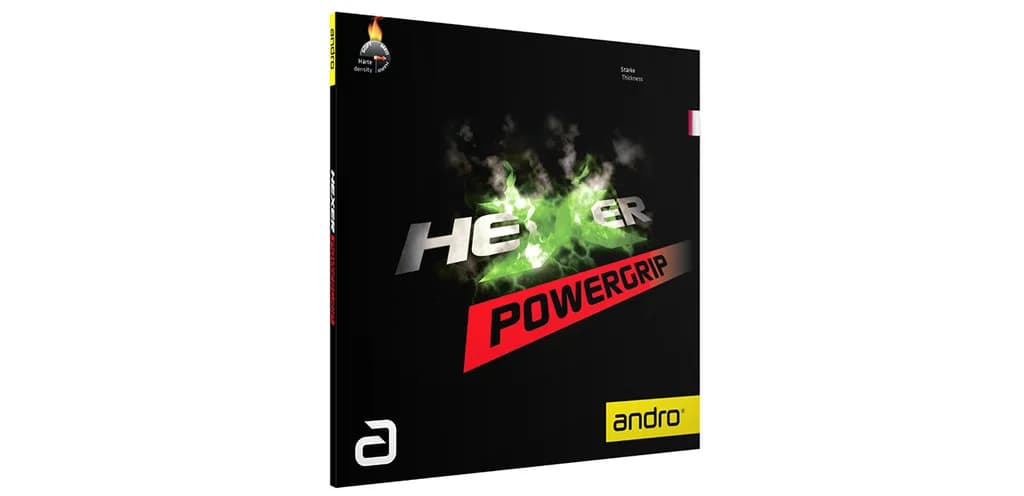
Gallery.
2 imagesWhen the talk turns to high-performance tensor rubbers, the conversation tends to circle the usual names: Butterfly's Tenergy and Dignics, or the most celebrated tensors of the European stable. In that crowded field, Andro has been defending its Hexer series capably for years, and within it the Hexer Powergrip holds a prominent place as a top-end offensive option with an argument not all of its rivals can make: first-rate performance with durability noticeably better than the segment average.
The Powergrip is not a rubber that tries to impress through marketing, but through its behaviour on the table. It is a "Made in Germany" tensor from the ESN family, conceived and optimised from the outset for the plastic ball, with a character that combines excellent grip with a medium-hard sponge aimed at offensive play with a long stroke.
What it is and where it fits
This review rests on the specifications published by Andro and ESN, on the published tests and on the broadly consistent verdict of a good number of players and reviewers — not on weeks of personal use with this particular rubber. The caveat matters especially here, because the Powergrip's strongest argument — its durability — is precisely the sort of quality that only shows up over prolonged use: the reputation for longevity described below comes from that wide consensus, not from wear measured in our own hands.
After the ban on speed glue, manufacturers had to build permanently into the rubber the tensioning effect that used to be applied by hand before every match. The European answer to that challenge came in large part from ESN, the big German manufacturer that produces the sponges and topsheets of a huge share of the tensors on the market, including the ones Andro fits to its Hexer series. To speak of a "Made in Germany" ESN tensor is therefore to speak of one of the two great schools of modern equipment, the European one, as against Butterfly's Japanese school.
The Hexer Powergrip is an inverted rubber — pimples-in: a smooth contact surface with the small pimples facing inwards, glued to the sponge — of the kind known as a tensor rubber. Topsheet and sponge are held under pre-tension, like a loaded trampoline, so the ball comes off with extra speed and launch without the arm having to supply all the energy.
Within the Hexer series itself, the Powergrip is the fastest and firmest sister. The Hexer Grip, its stablemate, carries a softer sponge, gives more catapult at medium power and sits one step below on speed. And for anyone after the Powergrip's character with a gentler feel there is the Powergrip SFX, with a distinctly softer sponge (≈ 42.5°).
The specifications that matter
Sponge hardness. The Powergrip carries a sponge of roughly 47.5° on the ESN scale, a medium-hard figure that is today one of the most common points in the offensive segment. It is firm enough to sustain a power game and to transmit a crisp, direct sensation on a hard impact, without reaching the stiffness that punishes a player who does not always strike the ball cleanly. It asks for technique, but it is not merciless.
A very grippy topsheet. The topsheet, natural rubber with a slightly textured surface, offers excellent grip without being tacky. This is not a sticky rubber in the Chinese style: its spin comes from friction and deformation on impact, not from the surface clinging to the ball. That firm grip is what lets it bite the ball convincingly on a long stroke and generate plenty of spin.
Optimised for the plastic ball. Unlike rubbers conceived in the celluloid era, the Powergrip was designed for the 40+ mm plastic ball from the start. It therefore does not carry the performance penalty that previous-generation tensors suffer with the current ball.
On the table
The trait that best defines the Powergrip is its balance of speed and spin with a firm, crisp feel. On a topspin played with a long stroke — the mid-distance loop and loop-drive — the rubber is on home ground: it answers with quick launch, firm grip and abundant spin, with that loaded-ball sensation reminiscent of the old speed glue effect.
Against a rubber with a very curved arc such as the Tenergy 05, the Powergrip draws a flatter, tighter trajectory. It is neither as springy nor as curved, which makes it a little more predictable and gives it an extra edge of perceived speed, at the cost of slightly less margin over the net. It is a difference of character rather than of level.
One area where the rubber clearly stands out is control. Despite being a top-end offensive tensor, its medium-hard sponge and its grip give it notable stability: the ball goes where the player sends it, and that firmness reduces the sense that the rubber fires off on its own in awkward strokes. On the counter and the block, the firmness of the sponge absorbs incoming spin well and stays steady against heavily spun balls; in the short and touch game, it keeps the bounce under control and makes drops and short pushes easier.
That said, honesty demands one qualification. The Powergrip asks for technique and arm speed. Its firm sponge and direct character give their best when the player strikes cleanly and really accelerates through the ball; a slow-armed player will struggle to activate the sponge's catapult. This is not a beginner's rubber.
Durability as the differentiating argument
It deserves a section of its own because it is probably the Powergrip's strongest commercial argument. In a segment where a short service life is a recurring complaint — the classic Achilles heel of the Tenergy range — the Powergrip enjoys a reputation for durability clearly above average: it holds its performance for considerably longer before the sponge starts to show a loss of elasticity.
That factor changes the value calculation. A rubber that performs at a high level and also lasts longer delivers a far more favourable cost per hour of play than a tensor of similar performance but short life. For the player who trains many hours and does not want to be changing rubbers every few weeks, the Powergrip is one of the most sensible options in its category.
Pros
- A balance of speed and spin, with a top-end offensive ceiling.
- Notable control and stability for a fast tensor: the ball goes where it is sent.
- Durability well above average, its great differentiating and value argument.
- Excellent topsheet grip, generating abundant spin on a long stroke.
- Optimised for the plastic ball from the outset, without the penalty of earlier generations.
- Behaves well on the block and in the short game thanks to the firmness of the sponge.
- Favourable value for money against the benchmark Japanese tensors.
Cons
- Demands technique and arm speed: it does not give its best to a slow striker.
- A less generous arc than an 05: slightly less margin over the net and less of the curved, "magic" effect.
- Not a beginner's rubber: it remains a fast, top-end tensor.
- Less spin off the tip than tacky rubbers in the pure touch game.
- Mid-range weight, not one of the lightest in the segment.
Who it is for
The Andro Hexer Powergrip has a clear addressee: the intermediate-to-advanced or advanced offensive player who builds their game on mid-distance topspin, the loop-drive and the counter, and who strikes the ball cleanly and with arm speed. It is a rubber for anyone who wants top-end speed and spin but values control, predictability and durability above all else, and prefers a somewhat flatter trajectory to the very curved arc of the springier tensors.
It works well on both forehand and backhand, though its firm character and offensive ceiling make it especially logical on the forehand of an attacker who hits hard. On the backhand it performs capably for anyone with an active backhand; a player who prioritises control on that side may find the softer Hexer Grip or Powergrip SFX more comfortable. It is not, on the other hand, the choice for a beginner or for anyone chasing the tacky effect of Chinese rubbers.
Recommended set-ups
- On a controlled offensive blade or a balanced ALL+, the Powergrip gives a fast, dependable forehand without running away.Offensive forehand
- On an active backhand, in 1.9 mm, it gains a measure of control and placement at the cost of some speed.Backhand
- For anyone after the same character with more comfort, the softer Powergrip SFX (≈ 42.5°) or the Hexer Grip are the logical alternative.Softer alternative
Ratings
Rating by dimension
How it compares
The unavoidable comparison within Andro's own catalogue is with the Rasanter range, the brand's higher series. Against a Rasanter R47 — in the same hardness bracket — the Powergrip is usually felt to be more accessible and more controllable, while the Rasanter aims at an even higher ceiling of power and feel, and at a more demanding player.
Against the universal benchmark of the segment, the Butterfly Tenergy 05, the difference is one of character and of value. The Tenergy offers a higher, more curved arc and that lively, slightly magical sensation on spin, but it suffers from a short life and a higher price. The Powergrip answers with a flatter trajectory, very solid control and, above all, considerably better durability for less money. More broadly, it competes in the crowded field of medium-hard European ESN tensors — Tibhar's Evolution range among them; its argument for standing out is precisely the combination of dependable control with above-average durability.
Top end without the fireworks — and it lasts.
The Hexer Powergrip does not lean on a legendary name: it makes its case on the table. It balances speed and spin, offers remarkable control for how fast it is, and adds a lifespan that places it among the best-value options in its category, at a more contained price than the benchmark Japanese tensors. It asks for technique and arm speed, and gives up the very curved arc of an 05 in exchange for a flatter, more predictable trajectory.