
Yasaka
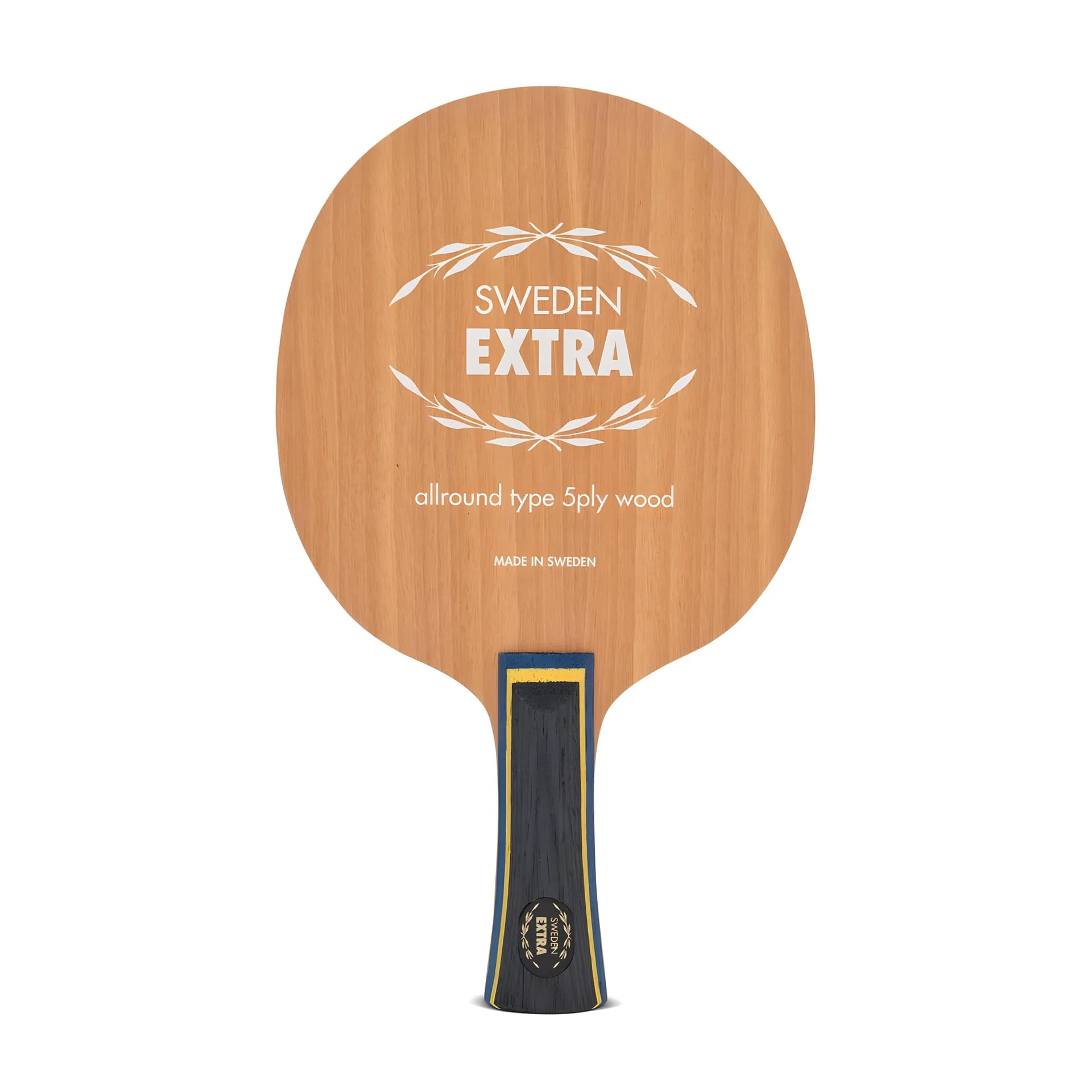
Sweden Extra.
The Swedish blade without carbon that still shapes players: control, feel and coherence ahead of raw power.
Gallery.
3 imagesSome blades age badly and others simply do not age at all. The Yasaka Sweden Extra belongs to the second group. It is a veteran model, with no carbon fibre, no grandiose names and no promises of "revolutionary technology", and that is precisely why it deserves a closer look: it represents a way of understanding table tennis that today's marketing tends to push aside, yet one that keeps shaping players year after year.
This review goes over what exactly this blade is, how it behaves on the table, who it makes sense for, and which alternatives it is worth comparing against before deciding.
What the Yasaka Sweden Extra is
The Sweden Extra is a five-ply blade made entirely of wood, with no layers of carbon, aramid or any other synthetic reinforcement. That construction — five plies of wood glued together — is the classic table tennis pattern of the last few decades, the same one popularised by the Swedish blades that dominated the circuit in the eighties and nineties.
One point is worth clearing up from the outset, because Yasaka keeps several models within the "Sweden" family: there are versions with carbon (such as the Sweden EK Carbon) that play very differently. The Sweden Extra reviewed here is the pure wood blade, with no fibre. For anyone after speed and stiffness, the carbon model is a different product; the Extra deliberately goes the other way.
On Yasaka's scale it is classed as ALL+, that is, allround with a slight offensive leaning. In practice this means a blade conceived to play every stroke competently — block, touch, drop shot, topspin — rather than to impose itself through raw power.
The specifications that actually matter
Beyond the figures the manufacturer supplies, three parameters genuinely shape how this blade feels in the hand and in play.
Five plies of wood. This is the defining trait. An all-wood composition conveys more information to the player — what is known as feedback or feel — than carbon blades, which tend to "silence" that vibration in exchange for speed and stiffness. Anyone learning to read the quality of their own stroke appreciates that communication.
Flexibility. The Sweden Extra is a flexible blade, not a stiff one. On impact the bat flexes slightly and the ball stays a fraction of a second longer on the rubber. That extra contact time — the dwell time — is what makes it easier to impart spin and control the trajectory, especially in the game close to the table.
Contained weight. It sits around 84–86 grams in its standard format, a moderate weight which, once the rubbers are on, results in a manageable bat that is not excessively head-heavy. As always with natural wood, each unit varies by a few grams from the next.
On-table behaviour
This is where the Sweden Extra earns its reputation, and it is worth being honest about what this review represents: it is a technical assessment grounded in knowledge of the product, its construction and the broad consensus of the community, not the chronicle of a prolonged personal test.
That said, the behaviour of a blade with these characteristics is fairly predictable and consistent across players.
Control is its great argument. It is probably the first thing anyone notices. The combination of flexibility and five wood plies produces a bat that "forgives": blocks land, short drop shots stay short, and the touch over the net comes off with a generous margin for error. For anyone building their technique, that safety net is worth its weight in gold.
It is at home in the spin game close to the table. The opening topspin against backspin comes off naturally, and the spin achieved is notable thanks to that prolonged contact. It is not a blade that pushes the ball on its own; it is a blade that responds to what the player asks of it. For learning, that is a virtue, not a defect.
The limit appears at distance and in power. When the rally moves away from the table and turns into an exchange of powerful topspins at mid or long range, the Sweden Extra asks for more arm. It has neither the speed nor the "spring" of a carbon blade or a modern OFF-. A player whose game is built on an offensive storm from far back will notice that the blade lags behind their intentions.
This is not a criticism: it is its definition. The Sweden Extra does very well what it was designed to do and does not pretend to be an all-out attacking blade.
Pros
- Outstanding control and feel, especially in the short game and at mid-distance.
- Clear feedback thanks to the all-wood construction, very useful for developing technique.
- Excellent value for money: finish and behaviour above what the price suggests.
- Spin comes easily on opening topspins and in the touch game.
- Allround versatility: it holds its own across every basic stroke in the repertoire.
Cons
- Limited power and speed in the game away from the table.
- Less "free" than carbon blades: it demands sound mechanics for offensive performance.
- Vibration is somewhat discreet for anyone after a particularly "loud", expressive blade.
- It may fall short for the intermediate-to-advanced player with a clearly attacking bent.
Which player it makes sense for
The Sweden Extra fits two profiles particularly well.
The first is the developing player who wants to learn properly. Not the typical sports-shop beginner bat, but an honest competition blade on which to build correct strokes. Its control and its feedback help develop technique without the bat itself introducing errors. Fitted with control or medium-hardness rubbers, it is an excellent starting point and, above all, a product that is not outgrown within a few months.
The second is the allround or touch player, whatever their level, who puts placement, spin and consistency ahead of raw power. For anyone who plays close to the table, blocks, chops and opens the rally with spin rather than blowing it apart from the back, this blade is a natural companion.
The modern attacker who lives off the powerful topspin from distance, on the other hand, should look at other options. It is not their tool.
Recommended set-ups
- Medium-hardness rubbers that respect its control character and add a little extra feel. The most coherent starting point for learning and for the allround game.Control / Allround
- A control rubber on the backhand and a medium tensor on the forehand, for anyone who wants to open the rally with more spark without giving up the blade's safety net.Allround+
Comparison with the alternatives
No blade is chosen in a vacuum. These are the comparisons that bring real judgement to the decision.
Against Yasaka's own carbon blades (the Sweden Carbon family): carbon brings speed, stiffness and a little more tolerance for error on the powerful stroke, at the cost of feel and fine control. If a player's game is already formed and calls for speed, they make sense. If technique is still being built, the Extra teaches more.
Against the classic five-ply allround blades (the benchmark Stiga Allround models, for instance): they play on the same conceptual ground. The differences are matters of nuance — the Sweden Extra tends to be perceived as somewhat firmer and more linear than some softer alternatives — and the final choice depends more on personal feel in the hand than on any objective superiority. In this segment, trying the handle and the touch is more decisive than any spec table.
Against OFF- blades for players moving into attack: if the stated goal is to evolve soon towards an offensive game at distance, a slightly faster blade can save a future change. But it is paid for with less control while learning. It is the classic dilemma between ease today and ceiling tomorrow.
Final assessment
The Yasaka Sweden Extra is one of those blades that can be recommended without reservation within its own territory. It is not fast, it is not spectacular and it does not try to be: it is a blade of control, feel and coherence, with value for money that is hard to match.
For the player who is starting seriously and wants to learn on good foundations, or for the touch allrounder who values control above power, it is an outstanding choice. For the attacker after speed from the back of the court, it is simply the wrong tool.
Its greatest virtue is also its greatest demand: the Sweden Extra gives back exactly what the player puts into the stroke. Anyone with technique, or wanting to acquire it, will see that as a blessing. Anyone who wants the bat to do the work will find it ungenerous. Knowing which of the two groups one belongs to is, in reality, the whole decision.
Rating by dimension
The blade that gives back what the player puts in.
The Sweden Extra is neither fast nor spectacular, and it does not try to be: it is control, feel and coherence, with value for money that is hard to match. Outstanding for anyone starting seriously or for the allrounder who plays by touch; the wrong tool for the attacker who lives off the powerful topspin from distance.
Frequently asked questions
Does the Yasaka Sweden Extra have carbon?
No. It is a five-ply blade made entirely of wood, with no carbon fibre or other reinforcements. The carbon versions belong to other models in Yasaka's Sweden family.
Is it suitable for beginners?
Yes, especially for anyone who wants to learn on good foundations. Its high control and clear feedback make it very instructive, and it is not outgrown in a short time the way the most basic beginner bats are.
Which rubbers pair best with it?
Being a control blade, it takes medium-hardness rubbers very well, ones that respect its character and add a little extra feel. Fitting very fast, hard rubbers can undermine its main virtue, which is precisely control.
Does it work for an offensive player?
For a touch-based offensive player working close to the table, yes. For an attacker whose game is built on the powerful topspin at mid and long distance, it falls short on speed and power.
Is it worth it for the price?
Yes. That is one of its greatest attractions: it offers a construction and a behaviour above what its price, in the budget-to-mid range, would lead anyone to expect.