
Xiom
Vega Europe.
The tensor rubber many players learn to attack with: lively bounce and good grip, but with a safety net that allows loose, fearless play — and at a price within almost anyone's reach.
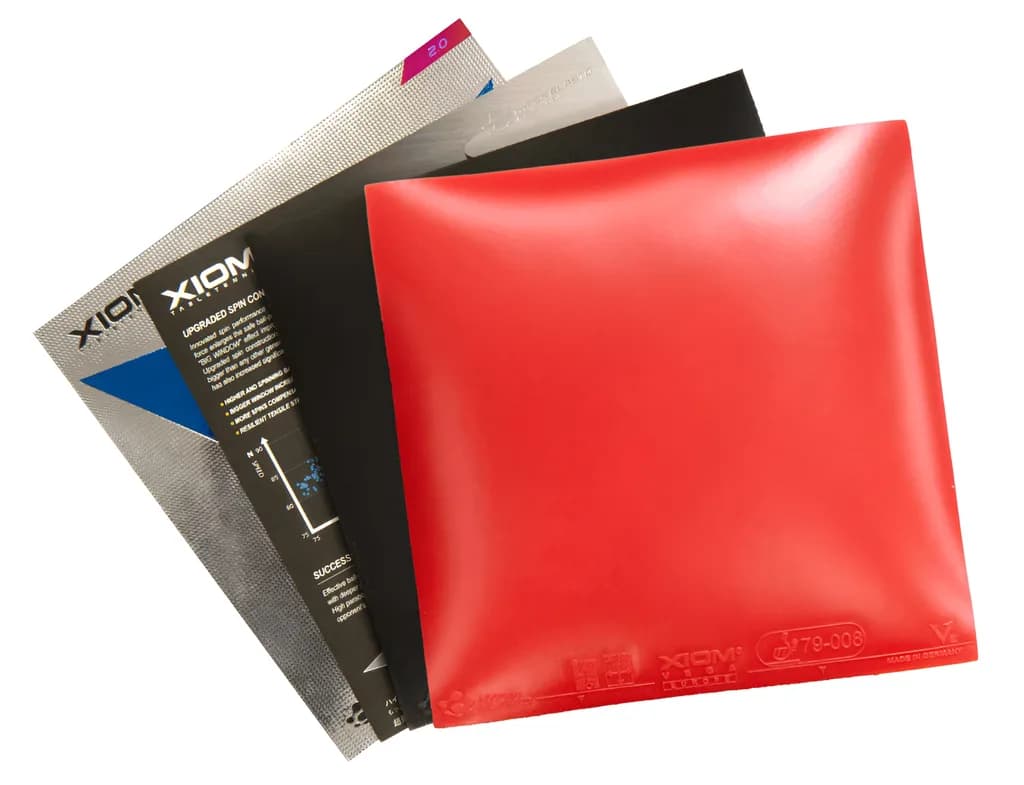
Gallery.
2 imagesWithin Xiom's Vega family, the Pro has always taken the limelight: it is the fast one, the demanding one, the one that shows up in rankings of offensive rubbers with good value for money. But there is another sister that, without making any noise, has spent years as one of the most repeated recommendations for a very particular kind of player: the one leaving control rubbers behind and wanting to start attacking in earnest, but whose stroke is not yet fine enough for an unforgiving rubber to go unpunished. That rubber is the Vega Europe.
This review goes over what the Vega Europe really offers on the table, which player it makes sense for and how it sits against its direct alternatives, starting with its own sisters in the range. It is worth saying up front: this is not a rubber designed to impress, but to accompany. And that, precisely, is its greatest merit.
Context: what it is and where it fits
The Vega Europe belongs to the Vega family, the range with which Xiom made a name for itself in Europe from the late 2000s onwards. Within that family it occupies the most accessible rung in terms of technical demands: below the Vega Pro and the faster or more modern versions, and aimed, as its name suggests, at the European style of play built on topspin and control rather than raw speed.
It shares part of the technical vocabulary of its sisters. It carries the Hyper Elasto top layer, the same tensioned topsheet technology Xiom uses across the range, and a Carbo sponge in its softest version. The essential difference from the Pro lies in hardness: while the Pro is built on a sponge of around 47.5°, the Europe stays close to 42.5°, which places it firmly in medium-soft territory. And here an honest caveat is in order: Xiom classifies that hardness as "medium", but the majority view among players is that it feels considerably softer than the spec sheet suggests. In practice, this is a soft-feeling rubber.
It is worth recalling what "tensor" means for the less technical reader: it is a rubber that comes with built-in internal tension which increases the spring effect — the so-called catapult — with no need to treat it with oils. That spring effect is what supplies speed and kick to the ball. In the Vega Europe it is present, but calibrated towards safety: the rubber does have a lively bounce, yes, but a flight arc that forgives.
On-table behaviour
A soft feel and a wide margin for error
The first thing the Vega Europe conveys is comfort. The medium-soft sponge and the elastic topsheet produce a rubber that "wraps" the ball on impact, with a cushioned sensation that eases the contact. Against the dry firmness of the Vega Pro, here the player notices that the rubber works with them, not against them.
That softness has a direct consequence: a notably wide margin for error. The Vega Europe allows a slightly imprecise stroke, a contact that is not entirely clean, and still returns a reasonable ball to the table. For the player still in formation, this is exactly what is needed: a rubber that does not punish every hesitation or every half-millimetre error in the bat angle.
Topspin and rallying: its natural ground
Where the Vega Europe is most convincing is in the constructive topspin and in the mid-distance rally. The grip of the topsheet, combined with a long contact time — the ball stays an instant longer on the rubber — produces safe loops, with a high arc and well loaded with spin. No perfect whip of the arm is needed to lift the ball: the rubber makes opening the point and sustaining the exchange easier.
On the matter of spin it pays to be precise. The Vega Europe generates good spin, above all at low and medium speeds, where the soft topsheet bites the ball well. It is not an extreme-grip rubber for devastating serves or for opening from very low with maximum rotation, but for regular topspin play it offers spin to spare and, most importantly, spin that is very consistent.
Speed: sufficient, not the main act
Here expectations need tempering. The Vega Europe is not a fast rubber, and does not set out to be. Its speed is medium: it goes along well with offensive play close to and at mid-distance, but it lacks the crushing punch to settle points in a single stroke or to impose itself from a long way back. A player looking to close out with emphatic winners will notice that the rubber carries them up to a certain limit and then falls short. It is a rubber for building the point safely, not for blowing it away.
That moderation in speed is, in truth, the flip side of its virtue: part of what it gives up in power it hands back in control.
Blocking and the short game
The block is solid and predictable, very much in line with the rubber's tolerant character. It absorbs the opponent's spin well and returns a stable ball without demanding millimetric adjustment of the angle. In the short game, being a non-tacky rubber, it is not the ideal tool for the specialist in manipulating spin with the finest of touches, but it copes comfortably with the receive and with the drop shot, behaving in a direct and controlled way.
Who it is for
The Vega Europe has a clear addressee: the player beginning the transition towards attack and the consistent intermediate who puts control and consistency ahead of speed. It is an ideal rubber for anyone who already commands the basic topspin stroke and wants a genuine tensor rubber — with lively bounce and good grip — but with a safety net that allows loose play without the fear that every error will end in the net or off the table.
It works well on both sides of the bat, and many players choose it for the backhand looking for precisely that security. It is also a very sensible choice to fit on the weaker side of a more advanced player after reliability on that flank.
It would not be a recommendation for the explosive attacker who lives on the smash, nor for the specialist in fine short-game manipulation: both will find more specific options. And, forgiving though it is, its lively bounce can be somewhat excessive for the absolute beginner who has yet to control the elementary stroke; for that profile there are more suitable pure control rubbers.
Comparison with the alternatives
Placing the Vega Europe against its competitors helps in deciding. The most revealing comparison is with the Xiom Vega Pro, within its own family: the Pro is harder (~47.5°), faster, more direct and more demanding; it rewards the player with a settled stroke who hits with conviction and punishes the one who hesitates. The Europe does exactly the opposite: it gives up speed and penetration in exchange for a soft feel, control and tolerance. Put simply, the Europe is the rubber many players learn to attack with, and the Pro the rubber they step up to once their technique justifies it.
The Butterfly Rozena is a very direct competitor in philosophy: both set out to be a bridge between control and high tension, with lively bounce but a wide margin for error. The Rozena, with its Spring Sponge, perhaps offers a touch more dynamism and kick; the Vega Europe usually sits below it in price and with a slightly softer feel. They are two very reasonable answers to the same need. The Yasaka Rakza 7 Soft, an alternative of similar hardness aimed at control with good spin, competes in the same price-performance band; the choice between them depends more on the preferred feel than on any difference in class. And against the classic control rubbers (the Mark V and its kin), the Vega Europe is a clear step forward in speed, spin and liveliness: it is, in fact, the answer to that sense of blandness many players begin to notice when their technique outgrows a purely control-oriented rubber.
Conclusion
The Xiom Vega Europe is not a rubber that will turn up in the hands of an elite player, and it makes no such claim. Its value lies elsewhere: it is one of the best gateways into attack the market offers. It combines the lively bounce and grip of a genuine tensor rubber with a level of control and tolerance that invites fearless play, and all of it at a contained price. For the player who wants to start attacking with a safety net, it is a recommendation that is hard to argue with.
Pros
- Very high control, probably its strongest argument and what sets it apart within the segment
- Wide margin for error, forgiving imprecise strokes and easing the learning of attack
- Good spin at low and medium speeds, with safe and consistent topspins
- Soft, comfortable feel, pleasant for the player coming from control rubbers
- Contained weight, which does not overload the blade
- Recognised durability: the tensioned structure stands up well over time
- Keen price, coherent with its proposition as an accessible rubber
Cons
- Limited speed: not the rubber for anyone basing their game on power or the emphatic smash
- Modest offensive ceiling: the fast-progressing player may outgrow it sooner than expected
- Less spin than extreme-grip rubbers, poorly suited to anyone prioritising pure rotation or short-game manipulation
- Less penetrating from a distance: its calibration towards safety costs it bite away from the table
Which blade to pair it with
Being a soft, tolerant rubber with a safe arc, the Vega Europe asks for a base that adds a degree of speed and feel without compromising its control. With allround blades (All / All+) the set-up comes out balanced and highly instructive, ideal for learning to attack; with a slightly more offensive blade (Off−) it gains drive without losing too much of the safety net. It is a frequent choice for the backhand, so many players fit it on that side and keep something faster for the forehand.
Set-ups that work
- Five-ply allround blade + Vega Europe max. — the most instructive set-up: control and a safe arc for learning to build the point.Allround
- Light offensive blade (Off−) + Vega Europe — a touch more speed without giving up tolerance.Off−
- Vega Europe on the backhand + a faster rubber on the forehand — security on the control flank, punch on the dominant one.Backhand
Rating by dimension
Frequently asked questions
Is the Vega Europe a good rubber for starting to attack?
Yes, that is one of its strong points. Provided the player already commands the basic topspin stroke, it offers a genuine tensor rubber with a very wide margin for error, which makes it an excellent bridge between control rubbers and high-end ones.
What is the difference between the Vega Europe and the Vega Pro?
The Pro is harder (~47.5° against ~42.5°), faster, more direct and more technically demanding. The Europe is softer, more controllable and more tolerant, at the cost of less speed and less penetration. The Europe is for learning to attack; the Pro, for when technique already justifies it.
Does it work for both forehand and backhand?
Yes. Its balance and tolerant character make it work well on both sides. It is a very common choice for the backhand when security and control are the priority.
Which thickness should be chosen?
Maximum thickness (max or 2.0 mm) is the usual pick for offensive play, since it makes better use of the sponge and the spring effect. Intermediate thicknesses add a little more control and feel, suiting anyone who prioritises safety.
Is it a tacky rubber?
No. It is a non-tacky tensor rubber: it grips the ball by friction, with good spin at low and medium speeds, but without the tack of Chinese-style rubbers.
How long does it last before losing performance?
It has a reputation for standing up well. Xiom argues that its tensioned structure extends the working life compared with other ranges, and user experience backs that up. Even so, like every tensor rubber, the sponge loses part of its properties under intense use over the months.
The gateway into attack, with a safety net.
The Vega Europe is not a rubber that will turn up in the hands of an elite player, and it makes no such claim. Its value lies elsewhere: it is one of the best gateways into attack the market offers. It combines the lively bounce and grip of a genuine tensor rubber with a level of control and tolerance that invites fearless play, and all of it at a contained price. As tends to happen with honest rubbers, its main limitation is the flip side of its virtue: a player in full progression may end up asking it for more speed and a higher ceiling than it can give. But for the stretch of the journey it is aimed at, it plays its part soundly and without fireworks.