
Xiom
Omega VII Pro.
First-rate speed with a measure of grip. The fastest and most direct variant of the seventh Omega series: it does not set out to be comfortable or forgiving, but to reward whoever strikes with technique and swing speed.
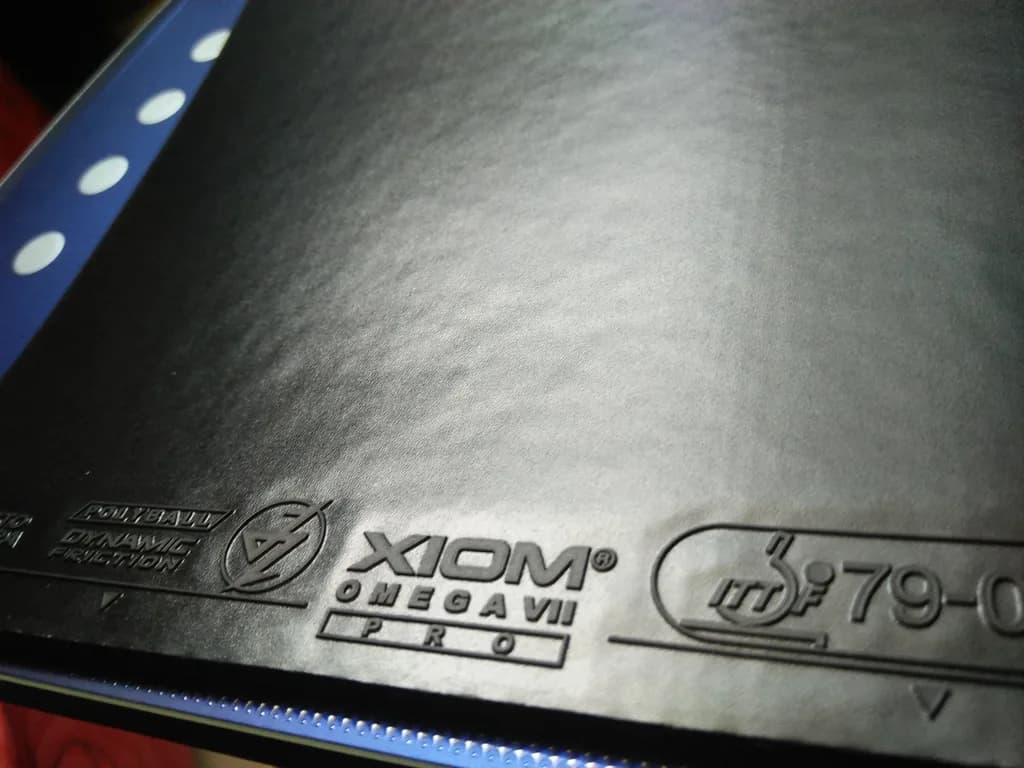
Gallery.
2 imagesWhen Xiom introduced the seventh generation of its Omega series, the Korean brand was chasing a specific goal: adapting its most offensive range to the plastic ball and recovering the sense of speed and grip that the change of material had dulled. Within that family, the Omega VII Pro is the fastest and most direct variant, the one aimed at the player who wants to hit the ball hard and punish from mid and long range.
This review looks at what it actually delivers on the table, which player profile it makes sense for and how it stands against its direct alternatives, its own sisters in the range included. It is worth saying from the outset that this is a rubber with a strongly marked character: it does not set out to be comfortable or forgiving, but to reward the player who brings swing speed and an already settled technique.
Context: what it is and where it comes from
For more than a decade the Omega series has been the offensive spearhead of Xiom, the Korean brand that helped consolidate the rise of European tensor rubbers against the historical dominance of Butterfly. The seventh generation was launched with the 40+ mm plastic ball squarely in mind — larger and less elastic than the old celluloid, and responsible for taking speed and spin out of the game. The declared purpose was to recover that lost performance with a grippier topsheet.
One concept is worth placing first. A tensor rubber is an inverted rubber whose topsheet and sponge assembly is manufactured pre-tensioned, like a loaded trampoline, so that it returns the ball with extra speed and launch without the player having to supply all the energy with the arm. It is the effect once obtained with speed glues, now banned, which manufacturers built permanently into the rubber itself.
The seventh Omega series is organised into several variants of clearly differentiated character. The three most relevant in Europe are the Omega VII Euro, softer, more controllable and with a classic European feel; the Omega VII Pro, the subject here, harder, faster and more direct; and the Omega VII China, hybrid in approach, with a tackier topsheet to Asian taste. Within the family, the Pro is clearly the option oriented towards speed and the power stroke.
Technically, the Omega VII Pro combines two elements that Xiom presents as its signatures in this generation: the Dynamic Friction topsheet, designed to maximise tangential grip on the plastic ball, and the Carbo Sponge, fine-pored and hard, aimed at converting swing speed into ball speed efficiently. The intended result is a fast rubber with grip superior to that of the more neutral pure tensor rubbers.
The specifications that matter
Sponge hardness. This is a hard-sponge rubber, in the region of 47° to 50° depending on the source consulted. That firmness is responsible for its dry, crisp feel, for its enormous speed potential and for its demands: the hard sponge does not deform until the stroke loads it with enough energy, so it rewards the player who strikes with quality and penalises the timid or technically imprecise touch.
Dynamic Friction topsheet and grip. Unlike a purely neutral tensor rubber, the Omega VII Pro has a topsheet with a slightly tacky measure of grip, nowhere near the stickiness of the classic Chinese rubbers. That nuance of grip is what allows it to generate abundant spin despite its markedly fast character, and it is one of the signatures of this seventh generation.
Thickness. It is offered in 2.0 and 2.3 mm, plus the maximum (MAX). For the offensive game the rubber aims at, the maximum or the 2.3 mm are the natural choice, since they make the most of the catapult effect of the sponge. A slightly thinner sponge trims speed and weight in exchange for a little more control, and it can make sense on the backhand of a player who puts placement first.
Weight and the plastic ball. Despite its hard sponge, this is a rubber of contained weight for its performance, which makes it easier to build a balanced bat that is not excessively head-heavy. And its reason for being is worth underlining: it was designed from the ground up for the current plastic ball, and that is one of its arguments against tensor rubbers of earlier generations conceived for celluloid.
On-table behaviour
First-rate speed
The trait that best defines the Omega VII Pro is its speed. It is among the fastest tensor rubbers in its segment, with an explosive launch and that characteristic dry, crisp sound at impact which betrays the catapult effect of the hard sponge. On the power stroke at mid and long range, the ball comes off with notable life and a depth that troubles the opponent. It is a rubber that invites acceleration and rewards handsomely the player who accelerates with technique.
Grip and spin
Alongside that speed, the Dynamic Friction topsheet brings a high grip that sustains abundant spin. It is not a rubber that spins by itself on the soft touch, in the manner of the softer, high-arc tensor rubbers; its spin is born of the stroke played with length and acceleration. Given that swing speed, the combination of grip and launch produces heavily loaded, penetrating topspins, with a medium-high arc that is tauter and more direct than that of pronounced-curve rubbers such as the Tenergy 05.
Its ground: the counter away from the table
Its natural ground is the counter-attack at mid and long range. In counter-topspin play away from the table, where the opponent's ball has to be turned into an attack of one's own with power, the Omega VII Pro shines: the hard sponge sustains the energy of the exchange and returns fast, consistent balls. Several assessments place it among the best rubbers of its era precisely for that register of countering away from the table.
Close to the table and the short game
On the counter-attack and the close block it behaves with ease for anyone who has the stroke under control, but its hard sponge and fast launch demand precision: it absorbs less of the incoming spin and tends to return the ball with life, so a poorly adjusted angle against a heavily spun ball easily turns into an error. It is not a rubber that forgives the passive block. And it is in the short, soft game that its character shows most: with a hard sponge, a fast launch and only slight grip, the drop shot and the short touch demand sensitivity and technique, and an imprecise contact easily becomes a return that is too long or too high. This is the usual toll of fast hard-sponge tensor rubbers, and the Omega VII Pro pays it like the rest.
Durability and maintenance
One aspect that honesty requires qualifying. The structure of the Omega VII Pro has a reputation for standing up well over time, a point in its favour against other high-end tensor rubbers. Its grippy topsheet, however, calls for frequent cleaning to preserve the spin: with use, the surface tends to lose bite if it is not kept clean, and several players point to the need to clean it regularly during training itself so that it keeps spinning as it did on the first day. It is not a serious flaw, but it is a habit worth taking on.
Who it is for
The Omega VII Pro has a clear-cut audience: the advanced offensive player with a powerful stroke and an already settled topspin technique, who moves comfortably at mid and long range and values speed and counter-attacking capacity above comfort. It works especially well on the forehand of an attacker built on spin and speed, where its combination of explosive launch and grip shows on the powerful topspin and the counter away from the table. On the backhand it is a valid option for anyone with a technical, aggressive backhand, although its hardness and its demands make it less suited to a player looking on that side above all for control and placement; that profile will find more comfort in the Omega VII Euro.
It is not, by contrast, a rubber for the intermediate player still consolidating their technique, nor for anyone who puts control, the fine short game or the passive block first. Nor is it a beginner's rubber: its hard sponge and fast launch demand a stroke that is already under way.
Comparison with the alternatives
The most natural comparison is with its sister in the range, the Xiom Omega VII Euro. Both share a philosophy and the same grippy topsheet, but they differ in character: the Euro carries a softer sponge, with a more European feel, a gentler launch and clearly superior control, which makes it more accessible and kinder in the short game. The Pro, harder and faster, offers a higher speed ceiling and a more forceful counter-attack away from the table. Anyone after control and comfort will go for the Euro; anyone wanting raw power, with the technique already in place to squeeze it, for the Pro.
Against the Xiom Vega Pro, the brand's own veteran and more affordable benchmark, the difference is again one of character and generation. The Vega Pro is a rubber of linear behaviour, direct arc and firm feel, very honest for its price, but it falls short in top-end speed and, above all, in grip, since it does not carry the Dynamic Friction topsheet conceived for the plastic ball. The Omega VII Pro is the faster, spinnier and more modern option; the Vega Pro, the more affordable and more predictable one.
In the field of European hard-sponge tensor rubbers, the inevitable comparison is with the Tibhar Evolution MX-P, one of the benchmarks of the segment. The MX-P offers a somewhat rounder balance of speed, spin and control, with a perhaps more generous arc, while the Omega VII Pro puts more emphasis on pure speed and the counter away from the table. Against the Butterfly Tenergy 05, the difference is one of personality: the Tenergy draws a higher, curvier arc and a more "magical" spin on the touch, while the Omega VII Pro is faster, more direct and more dependent on the power of the stroke. Anyone after safety and curve will prefer the Tenergy; anyone after speed and counter-attack, the Omega.
Conclusion
The Xiom Omega VII Pro is a high-end offensive rubber with a very clear identity: first-rate speed, notable grip inherited from its Dynamic Friction topsheet and outstanding performance on the counter-attack at mid and long range. Within the seventh Omega series it is the option for the player who wants to hit the ball hard and punish with power, and it answers that calling convincingly. Its limits are those of its own character — it demands technique, it does not forgive the short game and it asks for frequent cleaning — but for the advanced attacker after speed, counter-attack and grip in a rubber designed from the ground up for the plastic ball, it is a fully competitive option.
Pros
- First-rate speed, among the highest in its segment, with an explosive launch on the power stroke
- High grip thanks to the Dynamic Friction topsheet, which sustains abundant spin despite its fast character
- Excellent for the counter-attack at mid and long range, one of its most brilliant registers
- Designed for the plastic ball, without dragging the burden of generations conceived for celluloid
- Contained weight for its hardness, which makes it easier to build a balanced bat
- Good service life of the structure, with a reputation for standing up over time
Cons
- Demanding: its hard sponge penalises the timid or technically imprecise stroke; it is not a forgiving rubber
- Delicate short game, as with every fast hard-sponge tensor rubber with slight grip
- Requires frequent cleaning to keep grip and spin at full performance
- Medium-high, direct arc, with less margin of safety over the net than pronounced-curve rubbers
- Not suited to beginners: it demands an already settled topspin technique
Which blade to pair it with
Being a hard, very fast rubber with marked grip, the Omega VII Pro asks for a base that gives feel back without pushing the speed higher still. With offensive control blades (Off / Off−) the assembly gains predictability and exploits its grip for the topspin; with carbon blades the terminal speed and the counter away from the table are reinforced, at the cost of demanding even more precision and a fully formed stroke. It is on the forehand that it shines, so many players reserve it for that side and mount something softer and more tolerant on the backhand.
Set-ups that work
- Offensive control blade (Off−) with 5+2 plies + Omega VII Pro max. on the forehand — sustains the speed and gives margin to build the topspin.Offensive
- Carbon blade (Off) + Omega VII Pro max. — terminal speed and countering away from the table at the maximum, for the hitter with a fast swing.Carbon
- Omega VII Pro on the forehand + Omega VII Euro (or a softer rubber) on the backhand — splits power and comfort between the two sides.Forehand
Rating by dimension
Speed and counter-attack for whoever already has the stroke.
The Omega VII Pro is a high-end offensive rubber with a very clear identity: first-rate speed, notable grip inherited from its Dynamic Friction topsheet and outstanding performance on the counter-attack at mid and long range. Within the seventh Omega series it is the option for the player who wants to hit the ball hard and punish with power. Its limits are those of its own character: it demands a settled technique and swing speed, it does not forgive the short game or the passive block, and it asks for frequent cleaning to keep its grip. For the advanced attacker after speed, counter-attack and grip in a rubber designed from the ground up for the plastic ball, it is a fully competitive option.