
Tibhar
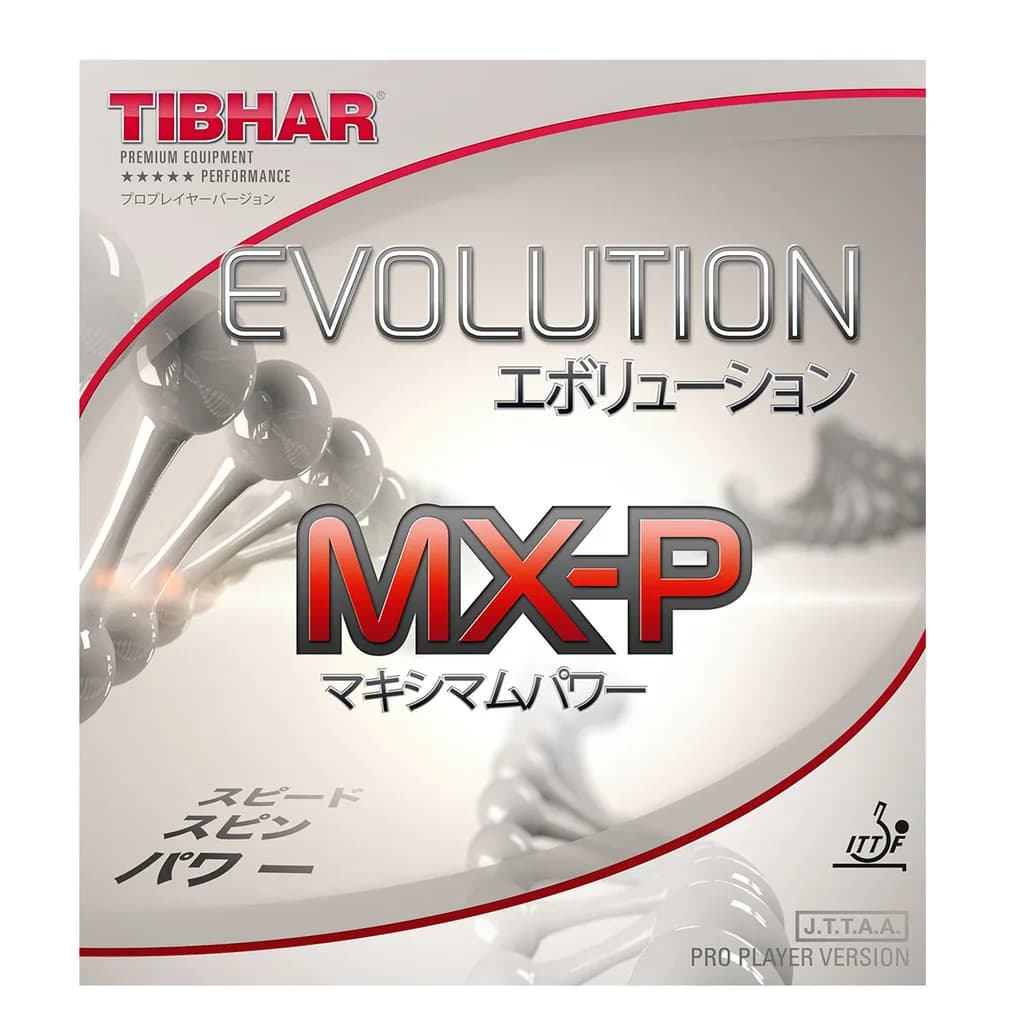
Evolution MX-P.
The European tensor that earned a permanent place in every conversation: very high speed, a low penetrating arc, and a performance-to-price ratio that shook the Japanese grip on the segment. It shows no mercy to a technique still under construction; it rewards whoever attacks with a long, committed stroke.
Gallery.
0 imagesFew rubbers have gathered as much praise, as many comparisons and as long a commercial life as the Tibhar Evolution MX-P. Launched within the German manufacturer's celebrated Evolution series, it soon became one of the benchmark European alternatives to the pricier Japanese tensor rubbers, and it still sits among the options any attacking player considers when building a bat. This review looks at what it actually delivers on the table, where it excels, where its limits show and which type of player it makes sense for.
Context: what it is and what it sets out to be
The product is worth placing before going into detail. The MX-P is an inverted rubber — a smooth contact surface with the small pimples turned inwards, glued to the sponge — of the kind known as a tensor rubber. That term deserves a note, because it is the key to everything else.
A tensor rubber pairs a topsheet and a sponge built so that the assembly sits pre-tensioned, like a loaded trampoline. When the ball lands, the rubber sends it back with extra speed and launch — the so-called catapult effect — without the player having to supply all the energy with the arm. Compared with classic untensioned rubbers, this kind of surface offers more speed and more potential spin, in exchange for demanding better technique to control it.
Within the Evolution family, Tibhar organises its rubbers by sponge hardness and orientation. The MX-P occupies the place of the fastest, most explosive member of the range with a medium-hard sponge, aimed squarely at modern topspin-based offensive play. Its purpose is plain: hit hard and spin heavily. It is not a rubber for beginners, and it does not pretend to be.
Specifications that matter to the player
Only a few figures on the spec sheet matter, but they are decisive.
Sponge hardness. It sits around 47° on the ESN scale (the usual reference for European rubbers of this type), which places it in medium-hard territory. That hardness is an important point: firm enough to transmit speed and hold up under powerful strokes, without reaching the extreme stiffness of the hardest rubbers on the market. That intermediate hardness explains much of its character.
Sponge thickness. It is usually sold in 1.9 mm, 2.1 mm and max. For the offensive game the rubber aims at, the thicker options (2.1 and max.) are the natural choice: they maximise the catapult effect and the spin potential. A thinner sponge trims speed and weight in exchange for a little more control, but it wastes part of the reason the MX-P exists.
Weight. This is a heavy rubber, in the order of 49 to 51 grams before being cut to the shape of the bat. That is worth keeping in mind, because mounted on an already heavy blade it can produce an overloaded assembly, awkward to handle close to the table and tiring over long matches. Balancing the total weight of the bat is a real consideration with this rubber.
Tack. The surface has very slight tack, barely noticeable. It is not a sticky rubber in the Chinese style: its spin does not come from the surface gripping the ball, but from friction and deformation at impact. That has practical consequences for the kind of strokes it performs best on.
On the table
This is where an offensive rubber really shows what it is, beyond the manufacturer's numbers.
The dominant trait of the MX-P is its combination of very high speed and heavy spin on the long stroke. It rewards a wide, committed swing: when the player accelerates and genuinely wraps the ball into a topspin, the answer is emphatic, with a fast launch and considerable spin. Many players describe the sensation that strokes which would be mere openings with other rubbers turn into winners here. That is its natural ground: mid- and far-distance attack, the counter, and the topspin rally.
The trajectory is a distinctive figure. The MX-P describes a fairly medium-low, direct arc, flatter than that of other benchmark rubbers. For the player who has the stroke under control, that translates into fast, penetrating balls, hard to read because of their taut flight. For anyone who has yet to master the contact point, that same low arc means less margin over the net and more balls sailing long or hitting the net: the rubber forgives few errors of arc.
On pure spin at low speed — short touches, the push, play over the table — the MX-P is more demanding. Being non-tacky and sitting on a fast sponge, it requires quality of contact to generate spin from soft strokes; it is not a rubber that "spins by itself". A player with good technique gets a perfectly competent serve and short game out of it, but the beginner or the player with an imprecise touch will find the ball tends to come off longer than expected.
Control is therefore its most debatable point, and it is worth saying so plainly. It is not an uncontrollable rubber — upper-intermediate players handle it without trouble — but its margin for error is narrow. The speed and the low arc call for technique that is already formed; on a solid base it is a superb tool, but on a technique still under construction it tends to amplify the flaws rather than hide them.
One aspect honesty requires flagging: durability and how performance evolves. The MX-P is at its best over the first few weeks and loses part of its explosiveness with use, a familiar trait in tensor rubbers with a porous sponge and a marked catapult. Many demanding players rotate it fairly often to keep it at its peak. It is not a flaw unique to this rubber, but it is a real cost over time and worth anticipating.
Who it is for
The Tibhar Evolution MX-P has a clear-cut audience: the upper-intermediate or advanced attacking player whose topspin technique is already formed, who builds their game around attack and wants speed and penetration. It is an excellent choice for the side of the bat given over to the power stroke — typically the forehand — in a player who attacks with a long, committed swing.
Conversely, it is not the rubber for the beginner or for the player still learning to topspin. That profile will be penalised by the low arc and the scant tolerance for error, and will progress faster with a softer, more forgiving tensor rubber — within the Evolution series itself, the softer-sponge versions fill that role. Nor is it the best option for anyone who puts control and placement ahead of power.
How it compares
The inevitable comparison is with the Butterfly Tenergy 05, the Japanese rubber that has set the standard for the segment for years. The MX-P was in fact born as a more affordable European alternative on that ground, and the comparison is revealing: the MX-P tends to be somewhat faster and more direct, with a lower arc, while the Tenergy 05 offers a higher trajectory, a little more spin on the touch and a feel generally considered more controllable and more comfortable. Choosing between them is largely a matter of style and budget: the Tibhar gives more for less money; the Butterfly offers that extra measure of control and consistency that many elite players still prefer.
Within the Evolution series itself, the MX-P is the fast, medium-hard sister. Anyone who finds it too demanding can look towards the softer-sponge versions of the range, which sacrifice some speed in exchange for more control and tolerance while keeping the family philosophy. That is one of the virtues of the series: it allows a player to climb in hardness and speed as they progress without changing language.
Against other European medium-hard, high-catapult alternatives, the MX-P stands out precisely for its combination of speed and low arc. A player after more spin and a curvier trajectory may be happier with grippier proposals; whoever puts direct, penetrating speed first will find in the MX-P one of the reference points of the segment.
Final assessment
The Tibhar Evolution MX-P earned its reputation on solid arguments and still holds them: a fast offensive rubber, with good spin on the full stroke, a penetrating trajectory and a performance-to-price ratio that, in its day, shook the dominance of the high-end Japanese rubbers. For the upper-intermediate attacker who has mastered the topspin, it remains a first-order recommendation.
Its limits are the coherent flip side of its virtues: demanding control, weight, less tolerance in the short game and performance that fades with use. None of them is a manufacturing defect; they are the logical price of a rubber designed to hit hard. In the right hands — a formed technique and an offensive style — the MX-P is a superb tool. In the wrong ones, it punishes without mercy. Knowing which of the two groups one belongs to is the best way to decide whether this rubber is the right one.
Pros
- Very high speed, outstanding in mid- and long-range attack
- Great spin potential on the topspin played with a long, full stroke
- Direct, penetrating trajectory, awkward for the opponent once mastered
- Excellent performance-to-price ratio against high-end Japanese tensor rubbers
- Very satisfying sound and impact feel on the full stroke, a shot of confidence for the attacker
Cons
- Demanding control: the low arc and the speed leave little margin for error
- High weight, which can unbalance blades that are already heavy
- Unforgiving in the short, soft game, being non-tacky and fast off the surface
- Performance fades with use, which pushes towards frequent rotation
- Not suited to a technique still forming: it tends to amplify the flaws
Which blade to pair it with
Being a fast, heavy, low-arc rubber, the MX-P asks for a base that adds feel and control without pushing the speed higher still. With offensive control blades (Off / Off−) the assembly gains predictability and helps tame its taut trajectory; with carbon blades the terminal speed goes up, at the cost of demanding even more precision and adding weight to an already loaded setup. Since it shines on the power stroke, many players reserve it for the forehand and mount something more tolerant on the backhand.
Set-ups that work
- Offensive control blade (Off−) + MX-P max. on the forehand — tames the low arc and exploits the penetration without losing margin.Allround-Off
- Carbon blade (Off) + MX-P max. — very high terminal speed for the hitter with a good physical engine; watch the total weight.Offensive
- MX-P on the forehand + a softer, grippier rubber on the backhand — splits demand and comfort between the two sides.Forehand
Rating by dimension
It hits hard and spins heavily — in the right hands.
The Tibhar Evolution MX-P earned its reputation on solid arguments and still holds them: a fast offensive rubber, with good spin on the full stroke, a penetrating trajectory and a performance-to-price ratio that, in its day, shook the dominance of the high-end Japanese rubbers. Its limits — demanding control, weight, less tolerance in the short game and performance that fades with use — are the coherent flip side of its virtues: the logical price of a rubber designed to hit hard. In the right hands it is a superb tool; in the wrong ones, it punishes without mercy.