
Stiga
Infinity VPS V.
The control blade that still makes sense in the carbon era. Five plies of limba and spruce, a polished feel and dwell that grips the spin: speed earned, not given away.
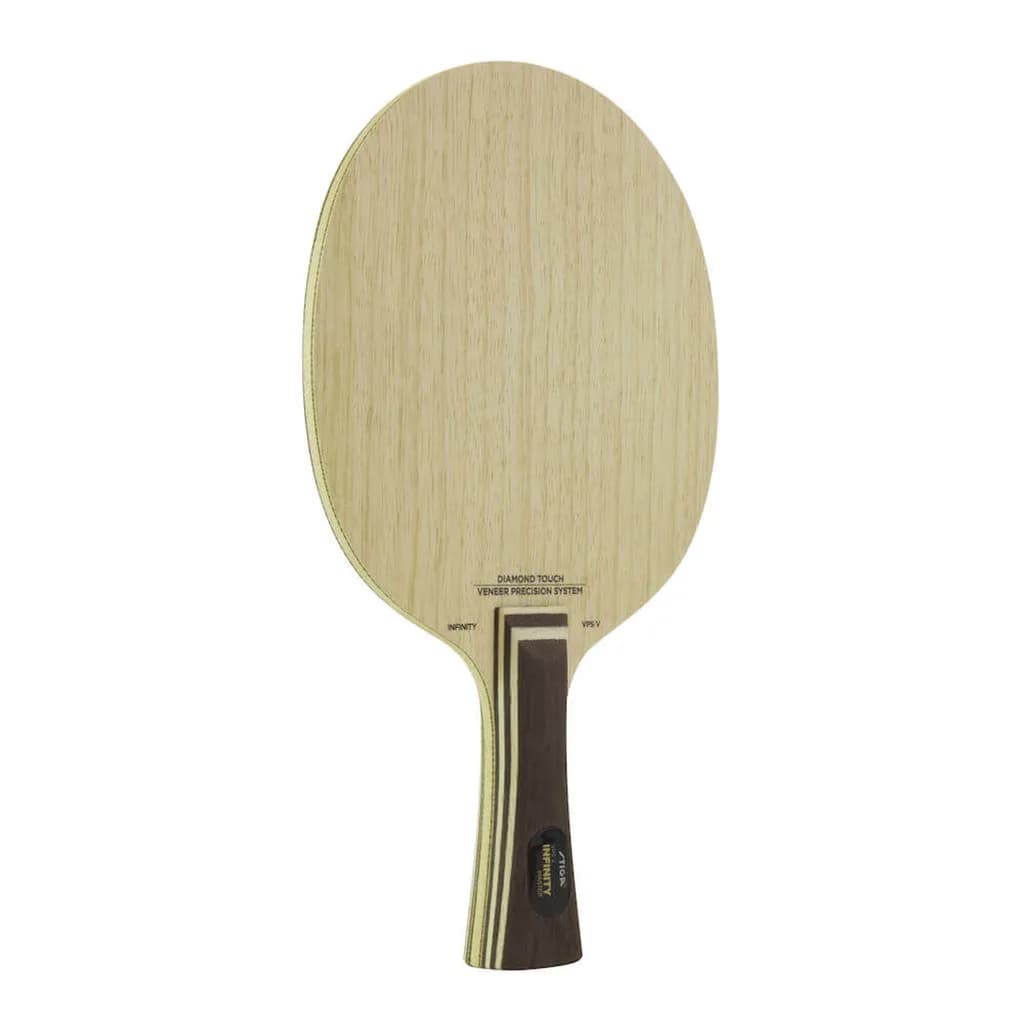
Gallery.
3 imagesThe Stiga Infinity VPS V is one of those blades that rarely head the new-release lists, yet have held their place on the shelves for over a decade for a simple reason: they do very well what they were designed to do. In a market increasingly given over to carbon structures, this five-ply all-wood laminate stands for a different philosophy — that of the player who puts feel, sensation and control ahead of raw speed.
This review looks at what the Infinity VPS V actually offers on the table, which type of player it suits and where it stands against its direct alternatives, both within Stiga's own range and outside it.
What it is and where it comes from
Stiga's Infinity family was born as a range of classic laminate blades aimed at modern topspin play, and the VPS V is its best-known member. The initials point to two of the manufacturer's technologies. VPS (Veneer Precision System) refers to a treatment of the inner plies through controlled heat and cold cycles, intended to stabilise and even out the behaviour of the wood. Diamond Touch is the treatment applied to the outer limba ply, meant to add a little surface hardness and a particularly smooth finish.
The marketing story is worth deflating: neither of these technologies turns the Infinity VPS V into anything radically different from a good five-ply limba-and-spruce blade. What they do provide, sensibly enough, is consistency between units and a polished feel. And that, without being revolutionary, is real value.
Structurally it is a textbook laminate: limba outer (the classic wood of European topspin, soft and responsive to spin), two spruce plies that add speed and stiffness without weight, and an ayous core. It is the recipe behind a whole school of offensive-control blades, and the Infinity executes it competently.
On-table behaviour
The Infinity VPS V is an offensive blade, but it is worth being clear about what kind of offence. It is not fast in the sense of carbon structures or of the harder, more direct blades on the market. Its speed is enough to attack from mid-distance and to finish points with a good topspin, but it asks the player to contribute: the arm, the acceleration and the technique. It sits squarely in OFF- / OFF territory, not among the more explosive blades. This is speed earned, not given away, and for many intermediate and advanced players that is precisely an advantage, because the margin for error on the table is greater. Where it does show its limits is in the flat smash and in pure power play from long distance: there the absence of fibre tells.
Control and feel are the ground on which the Infinity VPS V shines and earns its reputation. Medium flex combined with the limba ply produces a generous contact time (dwell): the ball stays an instant longer on the rubber, which translates into a very clear sense of the spin being "gripped". The practical result is excellent control in the spinny topspin, in the opening loop against backspin and, above all, in the short and touch game. Pushes, flips and control balls near the net come off with notable precision, because the blade sends a clear, readable vibration back to the hand. That direct feedback is, for a player with technical judgement, more useful than a lot of speed figures. The sweet spot, moreover, is wide for a five-ply all-wood, and it forgives slight imprecision in the contact without punishing either speed or direction too heavily.
As for weight, it usually falls in a moderate range (typically between 83 and 88 grams, varying from unit to unit). That lightness is one of its strengths: it allows modern rubbers — often heavy ones — to be mounted without ending up with an overloaded bat that is slow to handle. For a game of blocking, counter-attacking and linked topspins, manoeuvrability counts as much as speed, and here the Infinity gets it right.
Pros
- Outstanding control and feel for an offensive blade
- Generous contact time, ideal for spin and topspin play
- Wide sweet spot within its category
- Moderate weight and good manoeuvrability
- Excellent in the short, touch and opening game
- Reasonably good consistency between units
- Very competitive value for money against carbon blades
Cons
- Lacks punch in the flat smash and in pure power from long distance
- Thin, soft outer limba ply: sealing the blade before gluing is strongly advised
- Not the choice for anyone after "easy" speed without putting in the technique
- Against carbon, a smaller sweet spot and a less direct response when finishing
Rubber combinations
The Infinity VPS V calls for rubbers that supply the speed it does not give away, without losing its main virtue: control. On the forehand it works very well with medium-hard tensor rubbers — the likes of Yasaka Rakza 7, Xiom Vega Pro or, higher up the range, the benchmark European and Japanese tensors: the blade supplies the control and the rubber supplies the power. On the backhand, a slightly softer rubber makes blocking and fast play close to the table easier.
It is not the ideal blade for very hard, untreated Chinese rubbers in the hands of players who do not generate much acceleration of their own, because the combination can prove demanding and end up short on speed. With that caveat, it takes a wide range of set-ups.
Three set-ups that work
- Medium-hard tensor on the forehand (Rakza 7, Vega Pro or similar) — the blade supplies the control, the rubber the power. The Infinity's natural balance.Offensive
- A slightly softer backhand — a medium-hardness tensor makes blocking and fast play close to the table easier without losing the feel of the base.Block
- Hard Chinese only for those who generate acceleration — it pairs with a treated Chinese topsheet for a player with a full stroke; for short arms, it falls short on speed.Advanced
Who it is for
The Infinity VPS V is a particularly good fit for the offensive player with a technical base who builds the point through spinny topspin and values feeling the ball; for the intermediate-to-advanced player moving up to an offensive blade without giving up control, avoiding the sometimes excessive jump to a carbon structure; and for the classic European topspin player, for whom limba and all-wood laminates are natural territory.
It is not, on the other hand, the most logical choice for the pure power-and-smash player, nor for anyone after the speed and the wide sweet spot of a fibre blade from the very first stroke.
How it compares
Within Stiga's own range, the Infinity VPS V sits a step above classics such as the Allround Evolution in speed, and shares ground with offensive-control blades like the Clipper — the latter somewhat faster and more direct, with less dwell. Anyone looking to move up to fibre within the brand turns to the Carbonado family, clearly faster and with a larger sweet spot, but also less responsive and with a duller feel.
Outside Stiga, it holds its own against all-wood offensive-control blades from other European brands: five-ply limba-and-spruce structures of a similar profile. Its edge lies less in superior performance than in a very fine balance between control, feel and price.
Frequently asked questions
Is the Stiga Infinity VPS V suitable for beginners?
It is an offensive blade, so it is not the first choice for an absolute beginner. Its high control does make it friendlier than many OFF blades, though, so it can be a good option for a player who already has the fundamentals and wants a first clearly offensive blade.
Does the blade need sealing before use?
It is strongly advised. The outer limba ply is thin and soft, and sealing protects it from fibres tearing away when the rubber is peeled off, extending its working life.
How does it differ from a carbon blade such as the Carbonado?
The Carbonado and carbon structures in general are faster, have a larger sweet spot and a more direct response, but offer less feel and less contact time. The Infinity VPS V puts control and sensation first; carbon puts speed and forgiveness first.
Which rubbers go well with this blade?
It works especially well with medium-hard tensors that supply the speed the blade holds back. On the backhand, a slightly softer rubber can be comfortable, making blocking and fast play easier.
Does it work at mid and long distance?
It performs very well at mid-distance in linked topspin. At long distance and in pure power it shows its limits, owing to the absence of fibre.
Rating by dimension
Honest control in the carbon era.
The Stiga Infinity VPS V is not a spectacular blade on paper, and that is precisely its merit: it is honest. It delivers exactly what a good five-ply offensive-control laminate promises — feel, dwell, precision and consistency — at a very reasonable price, and it does so with the reliability of a long-standing, well-proven model. It is a highly recommendable buy for the offensive topspin player who values control and feel over raw speed, and a sensible alternative for anyone who does not want — or does not yet need — to make the jump to carbon. Whoever is after immediate power and a devastating smash should look elsewhere; whoever wants a precise tool for building the point will find in the Infinity VPS V a durable and coherent partner.