
Stiga
DNA Pro M.
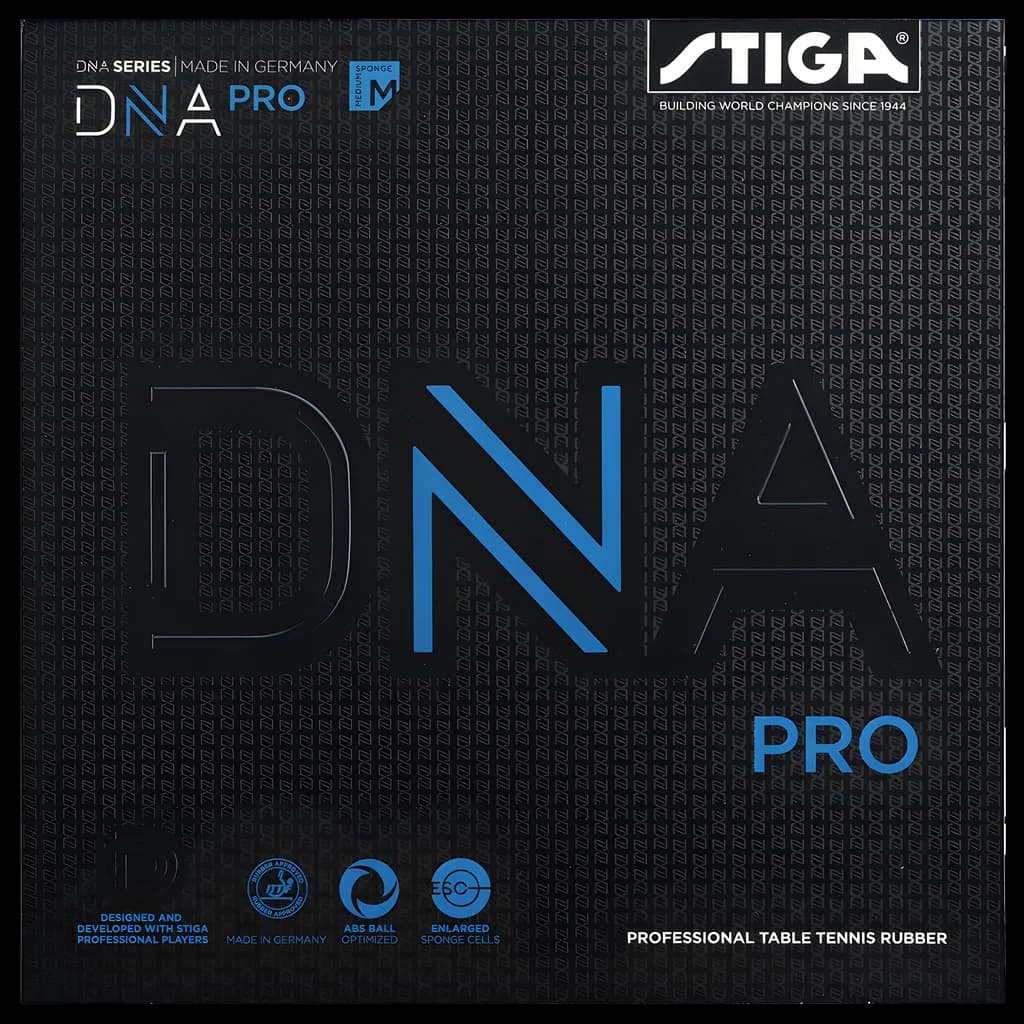
The medium variant of the DNA Pro range: control and safety ahead of power, with the high arc that characterises ESC technology. A backhand rubber for the intermediate-to-advanced player.
Gallery.
2 imagesThe medium variant of Stiga's DNA Pro range is, above all, a backhand rubber for the intermediate-to-advanced player who values safety as much as power. This review looks at what it offers, where it falls short, and which rivals it should be measured against.
What the DNA Pro M is and where it fits
Stiga builds its DNA Pro family around three sponge hardnesses, marked by a suffix worth understanding before buying: the S (Soft), at 42.5°, is the softest and most forgiving; the M (Medium), at 47.5°, is the middle ground and the subject of this review; and the H (Hard), at 50.0°, is the hardest, aimed at high-level offensive play.
The M deliberately sits at the centre of the range, and that is the key to understanding it. This is not the rubber Stiga uses to chase the player who wants maximum power — that job belongs to the H — but the one looking for a balance between speed, spin and, above all, safety over the table.
A tensor rubber is an inverted rubber whose sponge and topsheet leave the factory under an internal tension that raises elasticity and the so-called catapult effect — the sense that the ball "springs" off the surface — without the player adding anything to it. Sponge hardness, measured in degrees, shapes the feel and the point at which a rubber "wakes up": a softer sponge responds to gentle strokes and forgives more; a harder one demands more arm speed to perform, but gives back more power on the full stroke. At 47.5°, the M sits in a medium-hard band: neither the very forgiving softness of the S nor the demands of the H.
ESC technology: where the high arc comes from
The feature Stiga highlights across the whole DNA range is ESC (Enlarged Sponge Cells) technology, that is, sponges with larger cells. The manufacturer is after two effects: increasing the catapult effect and lifting the trajectory, so the ball describes a higher arc and crosses the net with more margin; and using a higher proportion of natural rubber to extend the life of the surface, no small matter given that modern tensor rubbers tend to lose performance fairly quickly.
The idea of the high arc is worth holding onto, because it explains this rubber's character better than anything else. Almost everything that defines it on the table follows from there.
Behaviour in play
Control is its signature. It is the trait that defines the M best and the most consistent thread through its behaviour. The high trajectory that ESC technology promises translates into a wide playing window and notable safety over the net: the ball tends to go in, and that margin is exactly what gives the player the confidence to attack without fear of going long. This is not a rubber that punishes a mistake; it forgives it.
Good spin, with a pronounced trajectory. The M generates rotation competently, and its high arc brings it close in character to a well-known benchmark in the segment, the Butterfly Tenergy 05. The resemblance should be taken for what it is: it does not mean the M performs like a Tenergy — these are different ranges and different prices — but that they share a nature, that of a rubber built on spin and a raised trajectory. For opening with topspin from mid distance, that arc is an ally.
Enough speed, not outstanding speed. This is a controlled-offensive rubber, not a pure power one. It has plenty for measured attacking play, but anyone chasing the more explosive hit will find a blunter answer in the H variant or in harder, faster rubbers on the market. Calling the M "slow" would be unfair; calling it the fastest in its class, inaccurate. It sits where it ought to sit: at the point where speed does not compromise control.
More backhand than forehand. That is its natural ground. Its character — control, high arc, predictability — fits more logically on the backhand of a player who values placement and the counter-attack ahead of raw power. Nothing stops it going on the forehand, and some do it with good results, but for a very aggressive forehand there are sharper options.
Feel and perceived hardness
One nuance deserves a mention: although the sponge is declared at 47.5°, in the hand the M feels rather friendlier than the figure suggests. That is not a contradiction but a useful reminder that perceived hardness also depends on the topsheet, on the blade it is mounted on and on the player's own touch. Taken as a whole, it should be understood as a medium-hard rubber with a pleasant feel, not a dry, demanding one. That balance between firmness and comfort is a good part of its appeal.
Pros
- Notable control and a wide playing window: its soundest trait
- Good spin with a high trajectory, useful for opening with topspin
- Overall balance: it does not shine in one area by sinking in another
- A very well-resolved backhand profile for the intermediate-to-advanced player
- Good expected working life (a higher proportion of natural rubber)
Cons
- Not the option for anyone after maximum power (that is the H)
- Perceived hardness may not match the official figure
- Fits the backhand better than a very aggressive forehand
- Worth confirming availability: the DNA family has evolved
Which player is it for?
The DNA Pro M is meant for the intermediate-to-advanced player who puts control and safety ahead of maximum power; who wants a reliable backhand rubber with good spin and a high arc; who plays a game of mid distance, placement and counter-attack rather than settling the point with one demolition hit; and who wants a balanced, predictable tensor rubber with no surprises.
It is not the most logical choice for the pure hitter who lives on speed. For that profile, Stiga's own range offers the H, harder and more offensive in character, or it is worth looking towards rubbers conceived explicitly for power.
How it stands against its rivals
Every comparison between rubbers carries a limitation worth stating up front: there is no universal standard of measurement. Each manufacturer scores speed, spin and control by its own yardstick, so the numbers are only reliable within a single brand. With that caveat, here is the picture against its most direct alternatives.
Against the Yasaka Rakza 7 the comparison is particularly interesting, because both aim at a similar audience. The Rakza 7 stands out for its durability — among the longest-lived in its category — and for delivering performance close to the top range with notable forgiveness. The DNA Pro M competes on control and adds the high arc that characterises ESC technology. For anyone who values lifespan and economy, the Rakza 7 is a serious rival; for anyone after a touch more spin and trajectory, the Stiga has its arguments.
Against the Tibhar Evolution MX-P there is no real contest of profile: the MX-P is a clearly faster, more demanding rubber with low control, meant for the advanced offensive player, and it comes boosted from the factory, with the consequence that it loses performance appreciably within weeks as the booster evaporates. The DNA Pro M plays in another league of forgiveness and predictability. Whoever puts control first will choose the Stiga; whoever puts pure speed first and accepts the demands that come with it, the Tibhar.
Against the Andro Rasanter R47, that one stands as a fast rubber with plenty of spin, an alternative leaning more towards power. The DNA Pro M answers with more control and a higher trajectory: two different philosophies for the same side of the bat.
Against Butterfly (Tenergy, Dignics), the relationship is what one would expect between an upper-mid-range rubber and the premium benchmarks of the market. The Stiga shares the character of the Tenergy 05 — spin and a high arc — but it is a family resemblance, not equal performance, and still less an equal price.
Frequently asked questions
Is it better on the forehand or the backhand? Its natural ground is the backhand, thanks to its control and its high arc. It works on the forehand, but it fits a game of placement and counter-attack better than a very aggressive forehand.
What is the difference between the M and the H? Essentially the sponge hardness: the M is 47.5° and the H is 50.0°. The H is harder, more offensive and demands more arm speed; the M offers more control and forgiveness. The S, at 42.5°, is the softest of the three.
Is it a rubber for beginners? It is aimed at the intermediate-to-advanced player. A beginner can handle it thanks to its control, but will get more out of a rubber designed specifically for learning.
Is it like the Butterfly Tenergy 05? It shares its character — spin and a high trajectory — but it is a family resemblance, not equivalent performance: these are rubbers from different ranges and at different prices.
Rating by dimension
Control ahead of everything else: honest about what it promises.
The Stiga DNA Pro M is an honest rubber: control ahead of everything else, good spin, a high arc and a balanced, predictable behaviour that feels particularly comfortable on the backhand of the intermediate-to-advanced player. It is not the fastest or the most powerful rubber in its segment — nor does it set out to be — and anyone after that side of the game should look towards the H variant or towards harder rubbers. Its main virtue is also the reason to choose it with some judgement: by betting on control and safety, it rewards the player who knows what they are after — reliability, placement, counter-attack — and may leave the one chasing the demolition hit a little cold. Within that band of use it is a solid, recommendable option, with the one practical caveat of checking current availability, given how the Stiga DNA family has evolved of late.