
Stiga
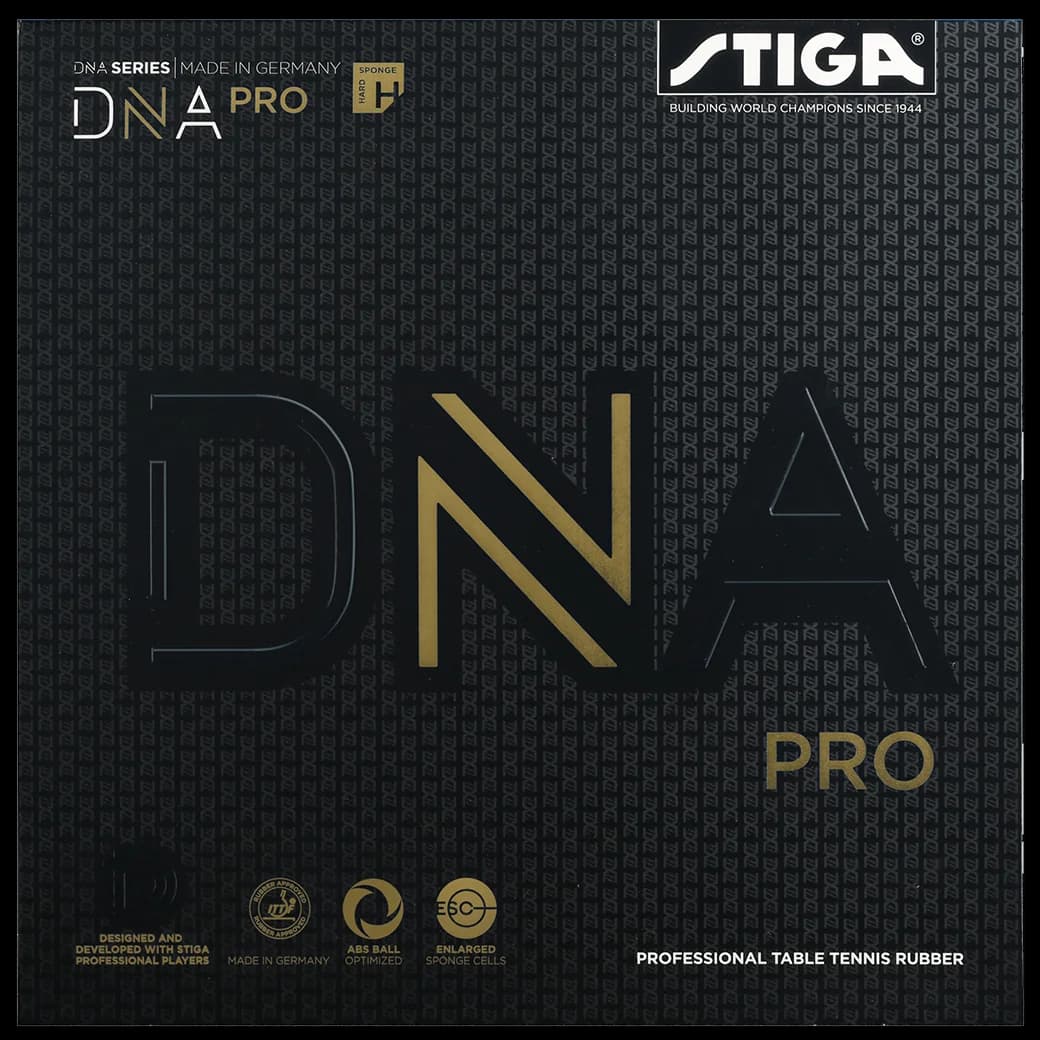
DNA Pro H.
The hard variant of the DNA Pro range: top-tier speed and spin ahead of tolerance, with the arc of the ESC technology conditional on a firm stroke. A forehand rubber for the advanced offensive player.
Gallery.
2 imagesThe hard variant of Stiga's DNA Pro range gives up part of the tolerance of its sisters to deliver top-tier speed and spin. This review looks at what this forehand rubber offers, where it makes demands, and which rivals it should be measured against.
What the DNA Pro H is and where it fits
Stiga builds its DNA Pro family around three sponge hardnesses, marked by a suffix worth understanding before buying: the S (Soft), at 42.5°, is the softest and most forgiving; the M (Medium), at 47.5°, is the middle ground, aimed at control; and the H (Hard), at 50.0°, the hardest of the three and the subject of this review.
The H is the offensive spearhead of the range. Where the M deliberately seeks balance and finds its natural ground on the backhand, the H sits at the opposite end of the philosophy: this is the rubber with which Stiga goes after the player who wants speed and spin ahead of tolerance, normally on the forehand. The manufacturer itself describes it as a hard rubber for a big-hitting offensive style, and its official figures — 76 for control, 160 for speed, 134 for spin — confirm that character: speed is in charge.
A tensor rubber is an inverted rubber whose sponge and topsheet leave the factory under an internal tension that increases elasticity and the so-called catapult effect — the sense that the ball "springs" off the surface — with no booster added by the player. Sponge hardness, measured in degrees, shapes the feel and the point at which the rubber "wakes up": a soft sponge responds to gentle strokes and forgives more; a hard one, like these 50.0°, demands more arm speed to perform, but gives back more power on a full stroke. This is the thing to hold on to about the H: it is not a rubber that switches itself on, but one that rewards the player who hits it with intent.
ESC technology: where the arc comes from
The feature Stiga highlights across the whole DNA range is ESC (Enlarged Sponge Cells) technology, that is, sponges with larger cells. The manufacturer is after two effects: increasing the catapult effect and lifting the trajectory, so the ball describes a higher arc and clears the net with more margin; and including a higher proportion of natural rubber to extend the working life of the sheet, no small matter in modern tensor rubbers, which tend to lose performance fairly quickly.
On the H, though, that arc sits alongside a hard sponge. The result is not a rubber as indulgent as the M, but a medium-high trajectory the player has to know how to govern: the catapult help is there, but it arrives conditional on a firm stroke. Much of what the rubber demands comes from exactly that.
Behaviour in play
Top-tier speed and spin. This is its calling card and the whole point of the variant. The H generates spin capably thanks to a very grippy topsheet that bites the ball well, and its speed on a full stroke puts it at the upper end of its segment. For opening with topspin, smashing from mid-distance or finishing the point with a single heavy stroke, it answers with the punch the M deliberately does not look for.
Notable grip, but not a Chinese rubber. The kind of spin deserves a qualification. The H has a light tack, not the sticky tack of Chinese forehand rubbers of the Hurricane type. It builds its spin through friction and speed, not through pure adhesion, so anyone coming from a Chinese rubber will find less direct "bite" on the ball and a faster, more linear game. That is not a fault: it is a different philosophy of spin.
Reasonable control for how hard it is. Here comes a point in its favour that surprises. Despite the 50.0° sponge, the H keeps acceptable control, above all in the short game — drop shots and pushes — and in the block. Several users single out its ability to block and hit flat with precision, and a manageable short response. It is not a rubber that forgives the way the M does, but neither is it dry and ungovernable: within its hardness bracket, it behaves with a certain nobility.
More a forehand than a backhand rubber. That is its natural ground and where the community places it clearly. Its character — hardness, power, grip — fits the forehand of the player who resolves points with speed and spin. Mounting it on the backhand is possible, but it asks for a technique and an arm speed not every backhand has; for that side, the M is the more logical choice within the range itself.
Feel and perceived hardness
The H transmits a firm feel in the hand, consistent with its official figure. That is a nuance which sets it apart from the M, whose perceived hardness tended to come across a little friendlier than the number suggested. There is no such effect here: the rubber feels hard, and that firmness is precisely what channels the power on a full stroke. It is worth keeping in mind, because perceived hardness also depends on the blade it is mounted on: over an already stiff, fast blade, the H can turn out to be too demanding for an arm that does not keep up with it.
One practical note: this is a medium-to-heavy rubber. It is not the heaviest on the market, but anyone watching the balance of their bat should take it into account, especially in combination with a carbon blade that is heavy in its own right.
Pros
- Top-tier speed and spin: its most solid trait and the reason to choose it
- Very grippy topsheet that bites the ball well and makes opening with topspin easy
- Better control than a 50.0° sponge would suggest, above all in the short game and the block
- A very well resolved offensive forehand profile for the advanced player
- Good expected working life (a higher proportion of natural rubber)
Cons
- Demands arm speed and a full stroke: it does not switch itself on, nor forgive passive play
- Not the option for whoever wants the "biting" spin of a Chinese rubber; its tack is light
- Medium-to-heavy, something to weigh in the balance of the bat
- Fits the forehand better than a backhand short on power
- Version and availability are worth confirming (it is not the DNA Hybrid H)
Who it is for
The DNA Pro H is meant for the advanced player who puts speed and spin ahead of maximum tolerance; who wants an offensive forehand rubber able to finish the point with real punch; who has enough arm speed to switch on a hard 50.0° sponge; and who plays a full attacking game — topspin, smash, fast counter — rather than one of patient placement.
It is not the logical choice for the player who puts control and safety first, nor for whoever wants a rubber that forgives a mistake or performs on soft strokes. For that profile, the Stiga range itself offers the M (backhand, control) or the S (the softest and most forgiving). Nor is it the rubber of the Chinese-style player who lives off sticky tack: that ground belongs to tacky rubbers of the Hurricane type.
How it stands against its rivals
Every comparison between rubbers carries a limitation worth stating up front: there is no universal standard of measurement. Each manufacturer scores speed, spin and control by its own yardstick, so the numbers are only reliable within a single brand. With that caution, this is the picture against its most direct alternatives.
Against the Andro Rasanter R53, the comparison is the most direct of all: two hard German forehand tensors with an offensive profile. The R53 is harder still (53°) and, in many hands, rather more explosive and demanding; the DNA Pro H offers a point more tolerance and slightly more accessible control within the same family of sensations. For whoever wants maximum hardness and power, the R53 is a serious rival; for whoever wants power without quite crossing into extreme demands, the Stiga has its arguments.
Against the Tibhar Evolution MX-P, this is a rubber with a somewhat softer sponge but a great deal of speed, with the particularity of arriving boosted from the factory, which makes it explosive out of the packet but costs it noticeable performance over weeks as the booster evaporates. The DNA Pro H offers a performance more stable over time and slightly more forgiving control. Whoever accepts the upkeep and the decline of the MX-P will find an initial spark; whoever prefers consistency, the Stiga.
Against the DHS Hurricane 3 Neo, there is no real dispute of profile, but of philosophy. The Hurricane is a tacky Chinese-style rubber, with a very high arc and a "biting" spin the H does not chase. Whoever comes from the Chinese game and wants that tack will not find the same feel in the Stiga; whoever prefers a faster, more linear European tensor will find the H is the option.
Against Butterfly (Dignics, Tenergy), the relationship is the expected one between a mid-to-high range rubber and the premium references of the market. The Stiga competes capably in its price bracket, but the high-end Butterflies operate at another level of refinement — and of cost.
Frequently asked questions
Is it better for forehand or backhand? Its natural ground is the forehand, for its hardness, power and grip. It works on the backhand, but it asks for an arm speed not every backhand has; for that side, the M variant is the more logical choice within the range.
What is the difference between the H, the M and the S? Fundamentally sponge hardness: the S is 42.5° (the softest and most forgiving), the M 47.5° (balance and control, aimed at the backhand) and the H 50.0° (the hardest and most offensive, aimed at the forehand). The harder the sponge, the more power on a full stroke but the more technique it demands.
Is it a rubber for beginners? It is not the most advisable one. It is aimed at the advanced player with arm speed. A beginner will handle the S or the M better, or rubbers designed specifically for learning.
Is it similar to a Chinese rubber of the Hurricane type? No. The H is a European tensor with light grip, not a tacky rubber. It generates spin through friction and speed, not through sticky tack, so it offers a faster, more linear game, without the "biting" effect characteristic of Chinese rubbers.
Rating by dimension
Honest power: speed and spin ahead of everything else.
The Stiga DNA Pro H is honest about what it promises: speed and spin ahead of everything else, notable grip and better control than its hardness would lead anyone to fear. It is the variant that gives the range's "Pro" label meaning for the offensive player, and its natural ground is the forehand of someone with the arm to switch it on. Its main virtue — power — is also the reason to choose it with care: by committing to a hard 50.0° sponge, it rewards the player who brings racket speed and can leave the player who works with soft touches, or who wants maximum tolerance, cold or plainly uncomfortable. Within that band of use it is a solid, competitive option for its price bracket, with the double practical caution of confirming the version — it is not the DNA Hybrid H — and checking current availability, given how the Stiga DNA family has moved of late.