
Stiga
Clipper Wood.
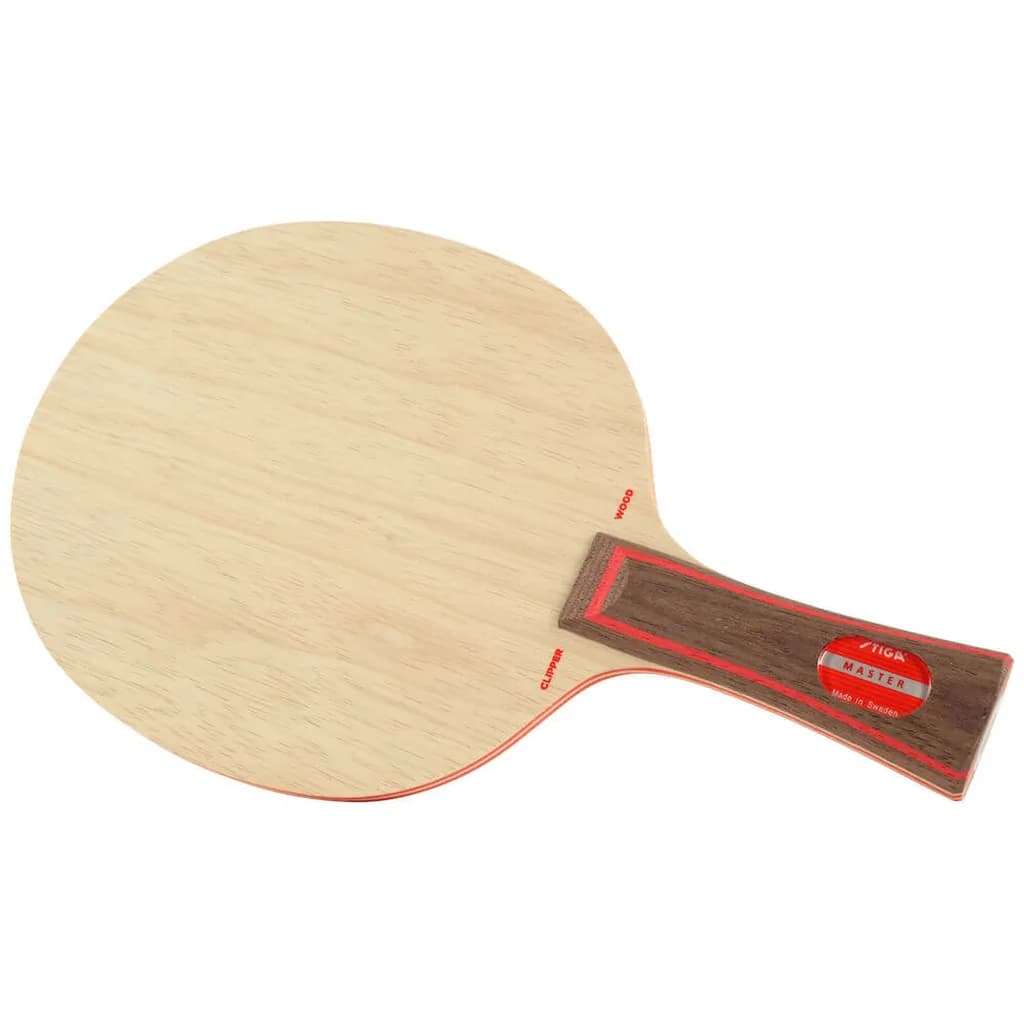
Seven plies of natural wood, no carbon, with a speed that catches players out. Four decades and more than a million units back a formula that still has plenty to say against fibre.
Gallery.
3 imagesSome products outlast the years through sheer inertia, and others do it because they simply do their job well. The Stiga Clipper Wood clearly belongs to the second group. Launched in the early 1980s, it has sold more than a million units and still appears in the catalogue of any specialist shop, as well as turning up, in its various versions, in the hands of players of very different standards, numerous Asian professionals among them.
The question worth asking is not so much why it has lasted, but what it offers on the table today. In a market dominated by blades with layers of carbon and synthetic fibre, the Clipper Wood argues for something else: seven plies of natural wood, with no reinforcement, and a speed that surprises for an entirely wooden build. This review sets out what that balance consists of, what the player who chooses it gains and loses, and which profile it still makes sense for.
What it is and what it was designed for
The Clipper Wood sits in a very specific category: offensive blades built entirely from wood, with no carbon layers or fibre. Against allround blades of restrained speed, the aim here is to supply power; against modern carbon blades, the proposal is to keep the feel and the progressive response of natural wood. It is, in a sense, a middle road with a character of its own.
The build runs to seven plies. The outer layers are limba, a medium-hardness wood with a pleasant feel that favours spin generation; the core and the intermediate layers are ayous, light and elastic. By adding two plies to a classic five-ply build, the blade gains stiffness and speed without resorting to synthetic materials. The result is a fast base — Stiga classifies it as offensive (OFF) — that still relays the impact with the clarity characteristic of wood.
That is its defining trait and the reason for its longevity: it offers a speed close to that of many carbon blades, but with a more linear, predictable response, free of the sometimes unpredictable rebound that some players hold against fibre.
How it behaves in play
The first thing that stands out about the Clipper Wood is that it is fast while still feeling like wood. In the power stroke it answers with energy, and it smashes and attacks from mid distance with authority. That speed does not arrive abruptly, though: the blade flexes progressively and relays the sensation of contact well, so the player keeps a reference for what they are doing. It is "controllable" speed, which is exactly what many look for and do not always find in the fastest bases.
In the spin game, the limba plies favour good grip on the topspin. The arc of the ball comes out naturally and the player can impart rotation comfortably, both in the opening loop and in the follow-up strokes. It is not a blade that hands out spin for free — the stroke has to be accompanied — but it repays good technique generously.
Control, within its category, is notable. Precision of language matters here: the Clipper Wood is not a control blade in the sense that an allround is, because its speed is appreciably higher. What it offers is high control for an offensive blade, thanks to its linear response and its stiffness, which steady the block and the game close to the table. Many players point out that, for all its power, it allows blocking and controlling with a security unusual in bases of its speed.
Its real limits are worth stating. The main one is weight. The Clipper Wood is a dense blade, and fitted with modern tensor rubbers — which tend to be heavy — it can produce a bat with serious punch behind it. For a player with sound mechanics and arm strength, that weight brings stability and inertia to the stroke; for a player with less physical range, or one who leans too heavily on the wrist, it can prove tiring and slow the transitions. It is perhaps the factor most worth weighing before deciding. Its second limit follows from its nature: fast as it is, it does not reach the extreme speed or the explosive rebound of high-end carbon blades in play from long distance. That is not a fault but the logical price of having given up carbon to keep the feel.
Pros
- Offensive speed to spare without resorting to carbon
- Linear, predictable response: none of the unpredictable rebound of fibre
- Good grip on the topspin thanks to the outer limba
- High control for a blade of its speed
- Excellent performance for the price, and available everywhere
- A proven blade, four decades in the catalogue
Cons
- Heavy: fitted with modern tensors, the whole bat carries real weight
- Demanding for the physically limited player or one very dependent on the wrist
- Falls short of the top speed and rebound of carbon from long distance
- Weight and thickness figures vary from unit to unit
Pairing it with rubbers
Being a fast base with good grip, the Clipper Wood takes a wide range of rubbers, but the choice deserves thought, above all because of the weight question.
With modern tensor rubbers of medium or medium-high hardness, the blade unfolds all its power and spin capacity, forming a clearly offensive set-up suited to an aggressive game close to and at mid distance from the table. It is a natural combination for the attacker who wants speed without wholly giving up the feel of wood. For anyone who puts control first, or who struggles with the weight, moderating the choice makes sense: a somewhat lighter or medium-hardness rubber on the backhand helps keep the bat manageable without sacrificing much performance. Hard Chinese rubbers, very heavy, push the total weight higher still and are only advisable for players with the strength and technique to govern them on this base.
Three set-ups that work
- Medium-high hardness tensor on both sides — unfolds all the power of the base for aggressive attack close to and at mid distance.Offensive
- Medium-high tensor on the forehand and a lighter rubber on the backhand — keeps the bat manageable without giving up the punch, ideal where weight is a concern.Balance
- Hard Chinese on the forehand, medium tensor on the backhand — for the Asian hitting player with the strength and technique to govern the extra weight.Punch
Who it is for
The Clipper Wood has a fairly well-defined audience. It is a very suitable choice for the offensive player who values the feel of wood and distrusts the behaviour of carbon layers. In their hands it finds speed to spare for attacking, but with a more honest and predictable response.
It is equally interesting for the intermediate or advanced player who wants to make the jump to a fast base without giving up control. The Clipper Wood allows decisive attacking and, at the same time, secure blocking and placement, which makes for a less brutal transition than jumping straight to a nervous carbon blade. It is also appreciated by the classic Asian-style or hitting player, after a solid base with punch and good grip for a direct attacking game close to the table.
By contrast, it is not the best blade for the absolute beginner, who will benefit more from the extra control and lower weight of an allround; nor for the physically limited player or one very dependent on wrist play, for whom the weight can become a serious drawback. Nor is it the choice of the attacker after maximum speed and rebound from long distance: that profile points towards carbon blades.
Compared with the alternatives
Within Stiga's own range, the Clipper lives alongside variants that share its spirit but introduce shades of difference. The Clipper CR WRB adds a treatment of the plies (Crystal) that hardens the surface slightly, bringing a little more speed and a somewhat firmer feel, along with the hollow WRB handle that lightens the whole and shifts the balance towards the head. For anyone who struggles with the weight of the Wood version, the WRB is a logical alternative to consider. The difference in sensation is noticeable, though both share the same underlying character.
Against other seven-ply all-wood blades from the competition — such as some classic offerings from Yasaka or Nittaku in this same category — the Clipper Wood stands out for its balance of speed and grip and, above all, for its availability and its price, more modest than that of most of its direct rivals. It remains one of the obligatory references whenever fast natural-wood blades come up.
Against mid-range carbon blades, the comparison is more a matter of philosophy than of raw performance: carbon offers more speed and a wider, more forgiving sweet spot, while the Clipper Wood answers with a richer feel and a more linear response. The choice depends on what each player values more.
Frequently asked questions
Is the Stiga Clipper Wood a fast blade?
Yes. Stiga classifies it as offensive (OFF) and in play it behaves as a clearly fast base, especially in the power stroke. What is particular about it is that it delivers that speed while still relaying the impact like natural wood, with a more linear response than many carbon bases.
Is it suitable for beginners?
It is not the most advisable option for anyone starting out. Its speed and its weight make it more demanding than an allround control blade. A beginner will progress better with a slower, lighter base, and can consider the Clipper Wood later, once their technique has settled.
Why is it said to be so heavy?
It is a blade of seven dense plies, and fitted with modern tensor rubbers — which are heavy too — the whole bat can end up carrying serious weight. For a player with sound mechanics that weight brings stability; for one with less arm strength it can prove tiring. Choosing a light unit or the WRB variant helps mitigate it.
Which rubbers pair well with the Clipper Wood?
It goes well with modern tensor rubbers of medium or medium-high hardness, which make use of its speed and its grip for an offensive game. Where the aim is to keep the total weight in check, it is worth moderating the backhand choice with a somewhat lighter or less hard rubber.
What is the difference between the Clipper Wood and the Clipper CR WRB?
The CR incorporates a treatment of the plies that hardens the surface and brings a little more speed and firmness, while the hollow WRB handle lightens the whole and carries the balance towards the head. In practice the WRB is more manageable in weight; both share the same underlying offensive character.
Rating by dimension
Four decades of speed with feel.
The Stiga Clipper Wood has survived forty years because it solves one concrete problem well: delivering offensive speed without giving up the feel and the predictability of natural wood. It is not the fastest blade on the market, nor the lightest, nor the most forgiving, but it rarely disappoints anyone who fits its profile. Its balance of power, grip and control keeps it among the benchmark all-wood blades, and its modest price reinforces the argument. The main reservation is the weight, worth assessing honestly before buying, and enough to tip the decision towards the WRB variant for players sensitive to that point. Past that, it is a solid recommendation for the attacker who wants a fast but communicative base.