
Stiga
Allround Classic.
The best-selling blade in history. Five plies, no carbon: half a century teaching players to play and giving back exactly what is put into the stroke.
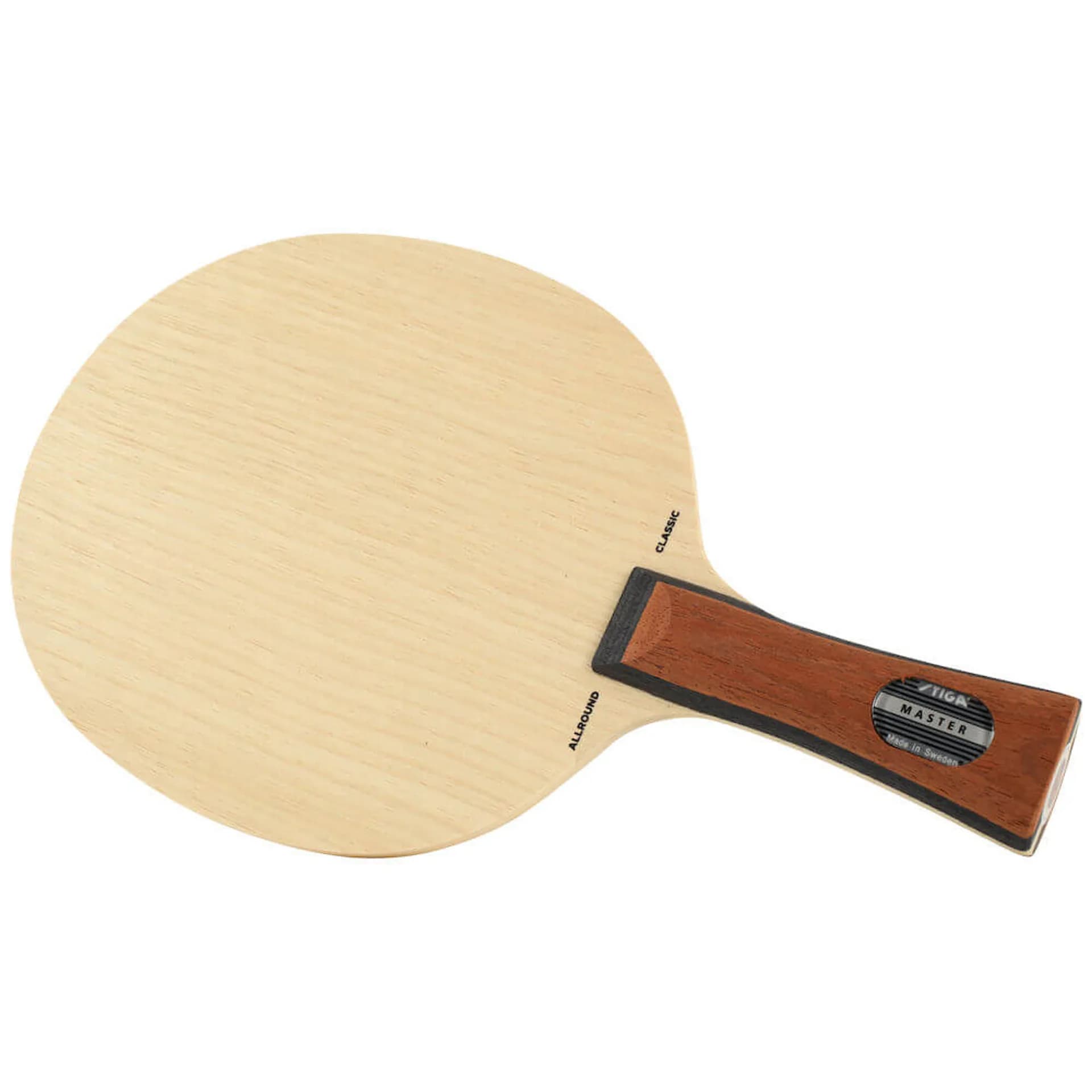
Gallery.
3 imagesThe Stiga Allround Classic needs no introduction in table tennis clubs, and yet it deserves to be explained calmly. Since it appeared in 1967 it has accompanied several generations of players, has passed a million units sold, and still turns up, decades later, on the shelves of any specialist shop. Few sporting products can claim such continuity.
It is worth asking why. In a market saturated with blades built from carbon plies, synthetic fibres and promises of extreme speed, what keeps a simple five-ply blade relevant? This review tries to answer without slipping into nostalgia or easy enthusiasm: what the Allround Classic really offers on the table, which kind of player it makes sense for today, and in which cases it is worth looking elsewhere.
What it is and what it was conceived for
The allround category — or "all-terrain" — refers to blades of restrained speed designed for a versatile game, one in which control takes priority over power. They are not built to win the point in a single stroke, but to allow every kind of resource: measured attack, block, changes of pace and a comfortable, predictable close-to-the-table game.
The Allround Classic is, most likely, the archetype of this category. Its construction is deliberately simple: five plies of natural wood, with no carbon reinforcement or synthetic materials. The outer plies are limba, a wood of medium hardness and pleasant feel; the core and the intermediate plies are ayous, light and elastic. It is better to take this composition as the usual recipe for this kind of blade rather than as a fixed fact: the figures for weight (around 85 g) and thickness (5.1–5.2 mm) vary from one unit to another — normal in any natural-ply blade — and the official spec sheet is not always easy to verify. That combination, in any case, explains much of its behaviour: neither too rigid nor too soft, it flexes progressively and reports clearly what happens at impact.
Behaviour in play
The first thing the Allround Classic conveys is feel. The flex of the plies and the absence of rigid layers let the player sense the contact of the ball clearly, both in touch strokes and in the close game. It is a blade that "talks", and that communication is especially valuable while technique is still being built.
On speed, one has to be honest: the Allround Classic is not fast on its own. Against modern offensive blades it clearly gives ground on the powerful stroke and on the attack from mid-distance. But that apparent limitation is in fact its reason for being. By not supplying "free" speed, it forces the player to generate the energy with their own stroke, and that makes it a notable teaching tool: whoever learns to hit with this blade develops a cleaner mechanic, because the material does not forgive shortcuts. Its construction is also flexible: hit with commitment, the blade bends, stores energy and gives it back with more drive than its speed rating would suggest. Anyone who knows how to load the stroke will find more speed here than the figures on paper would lead them to expect.
Control is its great virtue, and here user opinions agree with striking unanimity. On the block, the drop shot and the touch game near the table, the blade offers a predictability that inspires confidence. The opening topspin comes off naturally, with a comfortable arc, as long as the player follows through with the stroke: being a flexible blade, it performs better with lifted strokes than with flat, dry impacts.
It is also worth pointing out its real limits. The optimal hitting zone — the so-called sweet spot — is not especially wide, so off-centre impacts lose a fair amount of performance and can feel a little "dead". And at distance, when the rally moves away from the table and demands power, the blade falls short. This is not a manufacturing flaw but the logical consequence of its philosophy: the Allround Classic is built for close control, not for the offensive long-distance rally.
Pros
- Benchmark control, among the best in its class
- Noble feel and clear feedback: it teaches the player to feel the ball
- Flex that hides more speed than it appears to
- Tolerant with rubbers: takes a medium tensor or a hard Chinese
- Excellent performance-to-price ratio and total availability
- A proven blade, half a century in the catalogue
Cons
- Restrained sweet spot: it punishes off-centre strokes
- Falls short for the offensive game at mid and long distance
- Performs better with lifted strokes than with flat impacts
- Weight and thickness figures vary by unit and by source
Pairing with rubbers
The final behaviour of any blade depends largely on the rubbers it is paired with, and in the case of the Allround Classic the choice is decisive. Being a base of restrained speed, it takes modern tensor rubbers very well, which supply the speed and spin the blade does not offer on its own, without giving up its excellent control.
For a developing player, a balanced combination — a medium-hardness rubber on the drive and a slightly more controlled backhand — draws the best out of the blade and makes learning the fundamental strokes easier. More offensive players who want to keep the feel of this base tend to turn to high-end tensor rubbers, accepting that the setup will still be slower than one built on a carbon blade.
Three set-ups that work
- Medium-hardness tensor on both sides — a balanced drive and an offensive allround game with no surprises, making the most of the blade's control.Allround
- High-end tensor for the offensive player — adds speed and spin while keeping the feel of the base, at the cost of still sitting below a carbon setup.Offensive
- Controlled medium-hardness rubber on both faces — the noblest platform for building technique from scratch without speed sabotaging the learning.Beginner
Which player it is for
The Allround Classic has very clear addressees. It is an excellent choice for the beginner or developing player who wants to build their technique on an honest, controlled base. It will let them progress for a long time, upgrading their setup simply by changing the rubbers, with no need to replace the blade.
It is equally suited to the allround or active-defensive player who prioritises safety, placement and the touch game over raw power. In their hands, the blade becomes a reliable and consistent tool. It is also appreciated by the experienced player who is after feel, the one who, after years with fast blades, rediscovers the pleasure of a material that reports every contact and rewards technique over strength.
On the other hand, it is not the blade for the modern attacker who bases their game on the powerful topspin from mid and long distance. That player will find its lack of speed frustrating and will miss the extra drive of a faster base or one reinforced with carbon.
Comparison with alternatives
Within Stiga's own range, the Allround Classic coexists with the WRB version, which adds a hollow handle (Weight Reduction Balance) that lightens the setup and shifts the balance slightly towards the head. The difference in play is subtle but perceptible: the WRB feels a touch more manageable in fast wrist play. It is a matter of personal preference more than of objective performance.
Against allround blades from other brands, such as the classic Yasaka Sweden Extra or various mid-range offerings from Butterfly, the Stiga stands out for its flexible feel and its enormous availability: it is hard to find a shop that does not stock it. Anyone after the same spirit but with a little more speed can look to the Stiga Allround Evolution, slightly faster and of somewhat more modern construction, though at the cost of some of that feel so characteristic of the classic version.
A practical note for anyone buying it. In recent years Stiga has launched products that share the name — versions with carbon or with a differently shaped head, of the Cybershape type — that are not this blade: they are different blades, with other behaviour and other figures, and should not be confused with the traditional five-ply Allround Classic.
Frequently asked questions
Is the Stiga Allround Classic a good blade to start with?
Yes, it is one of the most recommended options for getting started. Its high control and communicative feel make it easier to learn correct technique, and it allows years of progress by changing only the rubbers.
Which rubbers go well with this blade?
It pairs very well with modern, medium-hardness tensor rubbers, which supply the speed and spin the blade does not offer on its own while keeping its excellent control. It is a very versatile base.
Is it suitable for an offensive player?
For a measured attack close to the table, yes. For a modern offensive game based on the powerful topspin from mid and long distance, it falls short on speed; in that case it is worth looking to faster blades or ones reinforced with carbon.
What is the difference between the Allround Classic and the WRB version?
The WRB adds a hollow handle that lightens the setup and shifts the balance towards the head, making it a little more manageable. The difference is subtle and comes down to personal preference more than to an objective gain in performance.
Why is it so flexible and what does that imply?
Its construction of five plies of natural wood, with no rigid reinforcement, gives it a progressive flex. This translates into more control and better feel, but it also means it performs better with lifted strokes than with flat impacts.
Rating by dimension
Half a century teaching players to feel the ball.
The Allround Classic is not a spectacular blade, and that is precisely where its worth lies: it is coherent, honest and instructive, it does exactly what it promises and it does not hide its limitations behind marketing rhetoric. Its control is outstanding, its feel is hard to match in its price range, and its capacity to teach good technique keeps it relevant almost sixty years on. It is not the blade for everyone or forever: anyone aiming for a powerful attack from mid and long distance will end up needing something faster or reinforced with carbon. But as a base for learning, as a companion for a control game, or as a reunion with the sensations lost in modern blades, it remains a sensible recommendation. Passing a million units is no accident.