
JOOLA
Dynaryz AGR.
The fast, demanding sibling of the Dynaryz range: speed and a tense launch for the attacker who wants to hit hard and finish the point close to the table without asking permission. Power with no concessions, and in exchange very little margin for error.
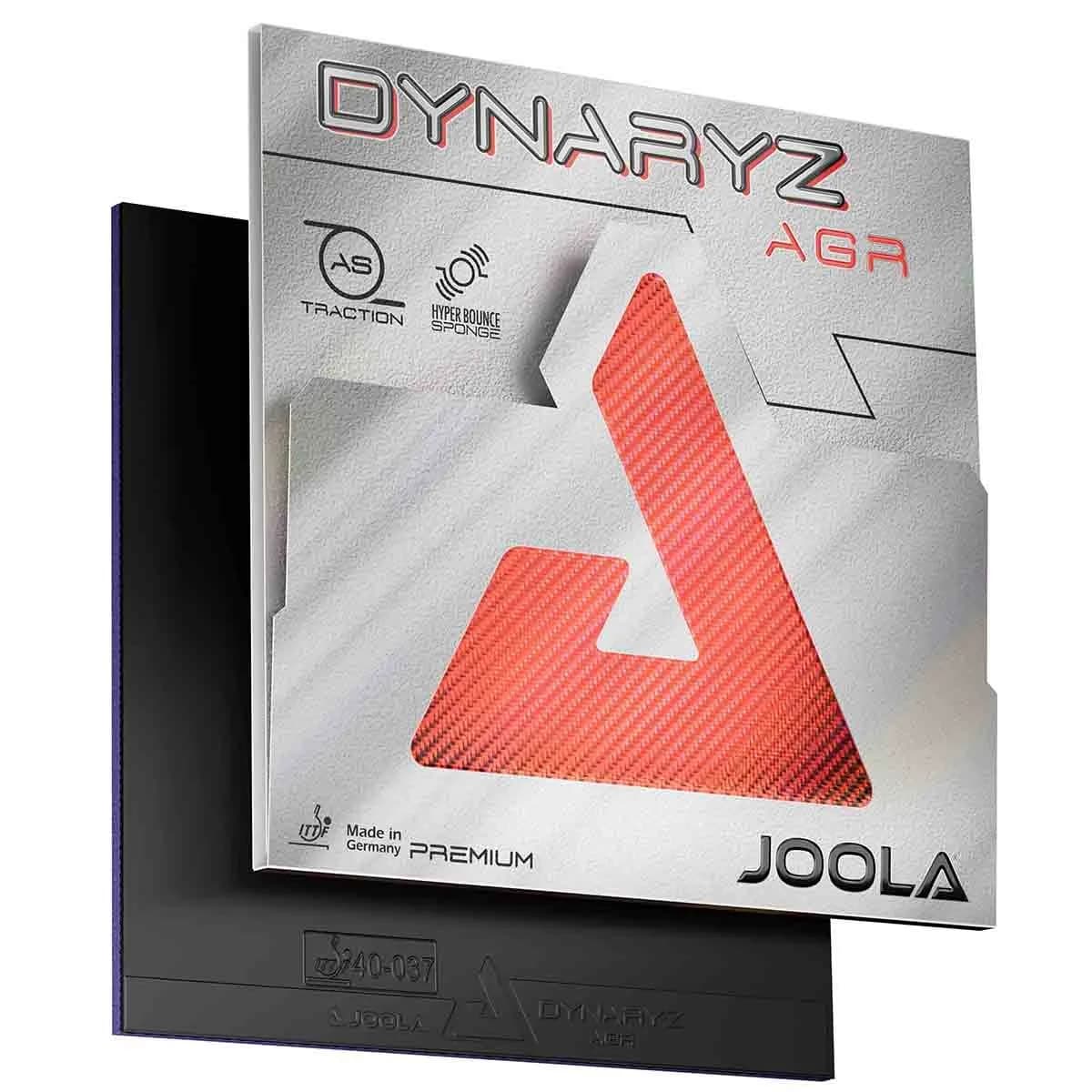
Gallery.
4 imagesWhen JOOLA launched the Dynaryz range, it placed its most ambitious bet in the field of high-performance tensor rubbers, the premium segment where Butterfly's Dignics and an ever larger pack of European and Chinese tensors have dominated for years. Within that family, the Dynaryz AGR takes the role of the fast, demanding sibling: the rubber made for the attacker who wants to hit hard, set the pace and finish the point close to the table without asking permission.
It is also the rubber that gave JOOLA a serious calling card in the conversation about the best offensive rubbers on the market. But "fast" and "powerful" are adjectives that marketing hands out far too freely. What really matters is something else: what it demands in exchange for that power, who it makes sense for, and where its limits lie. That is the subject here.
Context: what it is and where it fits
It helps to place the AGR within its own family to understand it. JOOLA's Dynaryz range is built around several rubbers that share a philosophy — a new-generation sponge and a high-grip topsheet — but differ in hardness and character. The AGR is the hard, speed-oriented variant; its sibling the ACC carries a softer sponge, with a rounder, more controllable feel; and above them sits the ZGR, harder and more direct still, at the most professional end of the range. Understanding that hierarchy is key, because much of the AGR's character is explained precisely by its position: it is hard, but not the hardest; fast, but with a degree of grip that makes it more than a plain hitting rubber.
The Dynaryz AGR is an inverted rubber — pimples-in or inverted: a smooth contact surface with the small projections, the pimples, facing inwards, against the sponge — of the type known as a tensor rubber. This type of rubber pairs an upper sheet (the topsheet) and a sponge built so that the assembly sits under tension, like a loaded trampoline. On impact, the rubber returns the ball with extra speed and launch without the player having to supply all the energy with the arm. It is not a tacky rubber in the Chinese style: its spin does not come from a sticky surface but from friction and deformation at impact.
Two elements define its technical identity. The first is the HyperBounce sponge, hard — of the order of 50° on the ESN scale common in Europe — with a large, visible pore, designed to maximise the catapult effect and the speed of launch. The second is the Advanced Traction topsheet, a high-grip surface meant to stop that fast sponge from eating the rotation. The combination chases the hardest thing to achieve in a hard rubber: extreme speed without giving up spin.
Specifications that matter to the player
Only a few figures on the spec sheet matter, but they are decisive.
Sponge hardness. This is the trait that conditions everything else. With a sponge around 50° ESN, the AGR is clearly a hard rubber. That hardness is the source of its power and its tense launch, but also of its demands: a hard sponge returns any imprecise contact to the player bluntly, offers less margin for error and absorbs heavily spun incoming balls less well. It is no small detail: it defines from the outset the kind of player who can get something out of it.
HyperBounce sponge and tense character. The large pore of the sponge and its bounce-oriented design produce a very marked catapult effect, noticeable from the first stroke. The rubber "jumps", and it does so with a naturally lower, tenser trajectory than softer or spinnier rubbers. That direct launch is its greatest offensive virtue and, at the same time, the reason it demands technique that is already settled.
Advanced Traction topsheet and grip. Despite its hardness, the AGR grips the ball well. The high-friction topsheet lets it generate rotation soundly on a stroke with travel, something hard, speed-oriented rubbers do not always manage, as they tend to sacrifice spin. It is one of the successes of the design: it holds a high level of rotation for how hard and fast it is.
Sponge thickness. It is usually offered in 1.9 mm and in maximum thickness (MAX). For the offensive game the rubber aims at, maximum thickness is the natural choice, since it makes the most of the catapult effect. The 1.9 mm trims some speed and weight in exchange for a little more control, and can make sense on the backhand of a player who prioritises placement.
Weight. This is a heavy rubber, of the order of 49 to 50 grams once cut, consistent with its hard, dense sponge. It is worth keeping in mind when assembling the bat: two sheets of this rubber on a heavy blade produce a set-up that is demanding to handle, especially in close play and in long matches.
A practical warning on assembly. Several sources agree that the large-pore sponge is somewhat fragile when removing the glue used in rubber changes: extra care is needed to avoid damaging it. It is a minor detail, but a real one, and worth knowing before the first installation.
Behaviour in play
This is where an offensive rubber is really defined, beyond the numbers.
The trait that best defines the Dynaryz AGR is its direct power and tense launch. From the first strokes it transmits a sense of immediate energy: the ball leaves fast, with a lower, more penetrating trajectory than high-arc rubbers, and the catapult effect makes itself clearly felt on the flat hit and on the finishing topspin. It is a rubber that invites attack, rewards the committed stroke and punishes hesitation.
In offensive topspin close to the table it is on its natural ground. The combination of a hard sponge and a high-grip topsheet generates a fast, loaded topspin with a tense trajectory that arrives early on the far side and kicks hard off the bounce. The grip of the topsheet makes it possible to close the arc inside the table despite how direct the launch is, and the player with clean technique finds here a devastating tool for finishing strokes.
In the block and the counter close to the table, its low trajectory works in its favour: it allows a short, fast block, with a tense ball that unsettles the opponent. This is in fact one of the areas where the hardness and the contained arc are an advantage over livelier, bouncier rubbers. That said, it demands precision in the bat angle against heavily spun balls, because the hard sponge forgives little.
It is in distant and passive play that the AGR shows its limits. At mid and long distance, the rubber loses part of its shine: its character is so oriented towards the close, direct hit that the longer-travelling game, with a high arc and a ball worked from far back, is not its speciality. And in passive and defensive play — soft blocks, drop shots, balls with no intent — the lack of margin becomes obvious. This is not a rubber that supports the hesitant player: it is a rubber that demands purpose in every contact.
The short game and touch play is, as with almost every hard, non-tacky tensor, the most delicate chapter. The combination of hardness, bounce and absence of tackiness means an imprecise contact on the short ball easily turns into a return that is too long or too high. A player with good touch and a sensitive wrist can keep the ball short and low, but it takes craft; the intermediate player usually finds their greatest difficulty of control here. It is the usual toll of rubbers in this segment, and the AGR, by virtue of its hardness, collects it with some severity.
Taken as a whole, the AGR is a rubber of marked and somewhat one-dimensional character: brilliant at what it was designed for — fast, powerful attack close to the table — and less versatile outside that ground. This is not a flaw but a design decision; it is, however, a decision the buyer needs to know about.
Pros
- Top-tier power and speed, with a catapult effect noticeable from the first stroke
- Tense launch and low trajectory, ideal for penetrating attack and the short, fast block
- Good grip for how hard it is, thanks to the Advanced Traction topsheet, with a high level of rotation
- Excellent on finishing strokes close to the table
- A direct, solid feel that conveys what happens at impact well to the player with refined technique
Cons
- Very demanding: it forgives little, punishes imprecise contact and is not suitable below a good intermediate-advanced level
- Limited control in passive play and on balls with no intent
- Delicate short game, as with every hard non-tacky tensor, aggravated by its hardness
- Less brilliant at mid and long distance: its character is one-dimensional, very focused on close play
- High weight, which can make the bat tiring to handle
- Sponge somewhat fragile when removing glue, which calls for care during assembly
- High price, in line with the premium segment
Which player is it for?
The JOOLA Dynaryz AGR has a very clearly defined addressee: the advanced offensive player, with topspin technique already settled, who bases their game on fast, powerful attack close to the table and who values speed and a direct launch above versatility and margin for error. It is a rubber for whoever strikes with quality and decision, knows how to finish the point with power and does not need the rubber to forgive hesitation.
It works especially well on the forehand of a hard-hitting attacker, where its power and tense trajectory are exploited to the full. On the backhand it is also a solid option for the active block and the counter, though a player who prioritises control on that side may prefer its sibling the ACC, softer and more forgiving.
It is not, on the other hand, a rubber for the intermediate player still refining their topspin technique, nor for whoever values control, mid-distance play or safety above raw power. As user assessments note again and again, below a certain level of play the AGR is frankly hard to master, and its demands can become an obstacle rather than an advantage. Whoever is not going to wring out its power will find more enjoyment — and better results — in more balanced rubbers.
Comparison with alternatives
The most useful internal comparison is with the range itself. Against the Dynaryz ACC, the AGR is harder, faster and more demanding, with a lower trajectory; the ACC offers a rounder feel, a better sense of the ball and more control, at the cost of some power. It is the natural choice for whoever finds the AGR too severe. Above it, the Dynaryz ZGR takes the hardness and the direct character further still, into the territory of the professional player chasing maximum speed. The AGR thus occupies an upper-middle point: very powerful, but not as uncompromising as the ZGR.
Against the obligatory benchmark of the segment, the Butterfly Dignics 09C, the contrast is one of philosophy. The Dignics 09C combines a hard sponge with a slightly tacky topsheet that gives it extra rotation and a more "gripped" feel, particularly valued in spin play and on opening balls. The AGR, non-tacky, goes for a cleaner, more direct launch and a feel closer to a pure tensor. Whoever wants rotation and ball control with a degree of grip may prefer the 09C; whoever prioritises speed and the direct hit will be more comfortable with the AGR. The Dignics 05, for its part, draws a somewhat higher, spinnier arc, against the tenser, more penetrating profile of the JOOLA.
Within JOOLA's own catalogue, the AGR sits a step above the JOOLA Rhyzer Pro 50 in speed and raw power, with a more explosive and demanding character. And in the wide field of high-end European tensors — ESN families such as Andro's Rasanter or Tibhar's Evolution — the AGR competes with the hardest and fastest options in each catalogue; the specific choice will depend as much on budget as on the feel being sought, a field where personal preference weighs as much as the specifications.
Frequently asked questions
Is the Dynaryz AGR a rubber for beginners?
No. It is a hard, fast, demanding rubber, made for the advanced offensive player with topspin technique already settled. Below a good intermediate-advanced level it is hard to control and its demands can weigh the game down rather than improve it.
What is the difference between the Dynaryz AGR and the ACC?
The AGR is harder, faster and more demanding, with a lower, more direct trajectory. The ACC carries a softer sponge, with a rounder feel, a better sense of the ball and more control, in exchange for some power. The ACC is the option for whoever finds the AGR too severe.
How does it compare with the Butterfly Dignics?
The AGR goes for the clean, direct launch of a non-tacky tensor. The Dignics 09C adds a slight grip that favours rotation and spin play, while the Dignics 05 draws a somewhat higher, spinnier arc. The AGR stands out in speed and the penetrating hit; the Dignics, in ball control and nuanced rotation.
Which thickness should be chosen?
To make the most of the rubber's offensive character, maximum thickness (MAX) is the natural choice, since it wrings out the catapult effect. The 1.9 mm brings a little more control at the cost of speed and weight, and can make sense on the backhand of a player who prioritises placement.
Is it true that the sponge is fragile?
The HyperBounce sponge, with its large pore, is somewhat delicate when removing the glue used in rubber changes. It is not a durability problem in play, but a warning about assembly: extra care is needed when cleaning the sponge so as not to damage it.
Is it any good for mid and long distance play?
It is not its speciality. Its character is very much oriented towards fast, powerful attack close to the table; in the longer-travelling game, with a high arc and a ball worked from far back, it loses part of its shine. A player who moves well away from the table will find more suitable rubbers.
Rating by dimension
A rubber that is honest with itself: it knows what it wants to be.
The JOOLA Dynaryz AGR is fast, powerful and direct, with notable grip for its hardness, and it gives the advanced attacker a top-tier tool for imposing their game close to the table. On its own ground — the hard hit, the finishing topspin, the short, tense block — few rubbers beat it for immediate sense of power. The trade-off is the one to expect from a rubber of this character: it demands a great deal and forgives little. It is not versatile, it does not support passive or long-distance play, and its control in the short game calls for craft. This is not a rubber for everyone, nor does it claim to be. But for the offensive player with the right technique and level, who wants speed and power with no concessions and knows what they are buying, it is a fully competitive choice, able to stand on equal terms with the best of the segment. The question is not whether the rubber is good — it is — but whether the player is up to it.