Donic
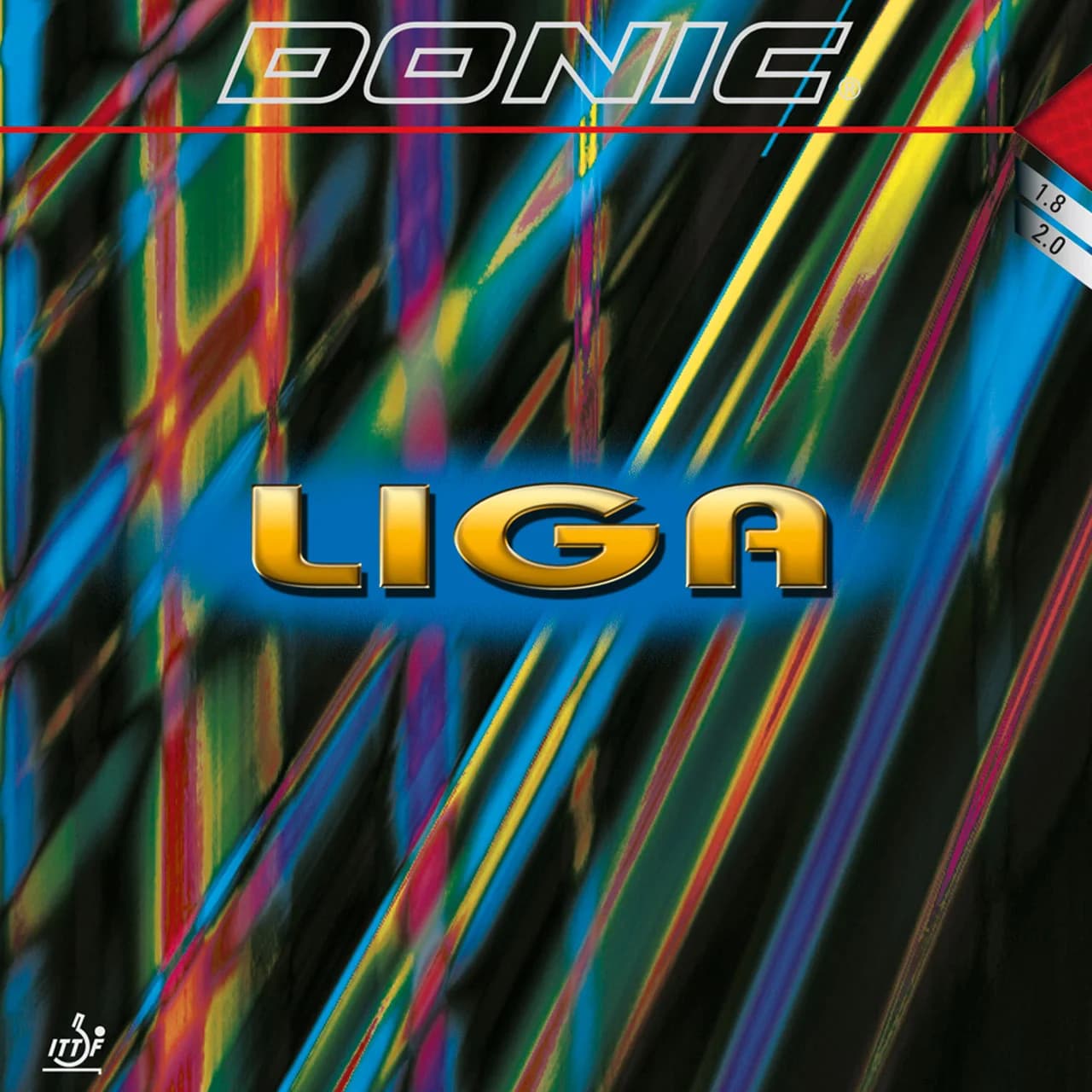
Liga.
The honest beginner rubber: it controls, it forgives, it lasts and it costs little. It never promises what it cannot deliver, and that is its greatest merit.
Gallery.
0 imagesThe Donic Liga is one of those rubbers that rarely turn up in the most-watched equipment videos or in the bags of elite players, yet it has kept a great many amateurs company through their first months with a bat. It belongs to the entry-level range of the German maker Donic and is aimed, without any ambiguity, at the beginner. This review looks at what it actually delivers on the table, who it makes sense for, and when the time comes to leave it behind.
What it is and what it sets out to be
It is worth starting with the terms, because a reader looking for a first rubber has no reason to know the jargon. An inverted rubber is the most common kind: the surface that meets the ball is smooth and the small projections (the pimples) point inwards, against the sponge. It is the standard choice for learning to play the modern attacking game, with topspin.
The Liga is exactly that: an inverted rubber built for the first steps. Donic classifies it as a defensive or all-round (ALL) rubber, that is, aimed at controlling the ball rather than at putting speed on it. It is not a product that aspires to compete with modern tensor rubbers, nor does it pretend to; its purpose is to let the beginner sustain rallies, feel the ball and build a technique without the equipment working against them.
That positioning matters, so as not to set up the wrong expectations. Judging the Liga by its lack of speed would be like blaming a driving-school car for being slow round a circuit: that is not what it is for.
The specifications that matter to the player
Only a few things on the spec sheet are of any interest, but those few say a lot.
Sponge thickness. It comes in 1.8 and 2.0 mm. For an absolute beginner, 1.8 mm is a very sensible option: it adds a little more control and makes for a slightly more manageable bat, which helps in mastering the stroke. The 2.0 mm gives a touch more dwell and speed, suitable for a player already making progress or looking to move towards a slightly more aggressive game. Neither comes in a max version, which is consistent with what the rubber is for.
Hardness. The sponge is medium, leaning towards medium-soft in the perception of most users. That favours the so-called catapult effect at low speed: the ball stays on the rubber for an instant and becomes easier to place. The sensation is pleasant and forgiving, exactly what someone who does not yet control the contact point needs.
Tack. The topsheet has a light tack. It is not a sticky rubber in the manner of the Chinese classics, but it grips enough for the beginner to start noticing what spin is and how it is produced.
Behaviour in play
This is where a beginner rubber really shows its hand, beyond the manufacturer's numbers.
The dominant trait of the Liga is control. It is a forgiving rubber. The ball leaves at a contained and fairly predictable speed, which lets the novice string together long rallies without the ball flying off the table every other stroke. That predictability is probably its greatest teaching virtue: it speeds up learning because it cuts down the mistakes that have nothing to do with technique.
In the spin game, the Liga is enough to learn on. It makes the fundamental strokes — topspin, push, block — understandable and executable, with a coherent response. The spin it generates is moderate: enough for the beginner to feel that the rubber answers the wrist, but a long way from the bite of a modern tensor rubber. The logical consequence is that it does not shine at reading and neutralising the spin coming from the other side either; once the opponent starts loading the ball, the Liga proves less able to absorb and return that spin comfortably.
Speed is its most obvious limit, and it deserves to be said plainly. The rubber has few "gears": it responds well in the slower, building game, but a genuinely fast stroke is hard to draw out of it, and getting one takes a big, committed swing. A player progressing quickly will hit that ceiling soon enough. It is not a manufacturing flaw but the flip side of its enormous control: in rubbers of this type the two are inseparable.
One point very much in its favour: durability. The topsheet stands up well to use, and the rubber holds its performance for a good while. For someone starting out — who may not yet know whether table tennis will become a serious hobby — spending little on equipment that also lasts is a weighty argument.
Pros
- Exceptional and very predictable control, ideal for building technique from scratch
- Forgiving behaviour: it cuts down non-technical errors and makes long rallies easier
- Good durability, uncommon in the entry-level range
- Low price and excellent value for money
- Contained weight, which helps in handling the bat during the first weeks
Cons
- Low speed ceiling: it falls short as soon as the player wants to attack in earnest
- Limited range of "gears": accelerating the ball demands big swings
- Mediocre handling of incoming spin: it struggles against heavily loaded balls
- Outgrown quickly by anyone progressing at a good rate
Which player is it for?
The Donic Liga has a very clear addressee: the absolute beginner, or the occasional player who values control and simplicity above performance. It is a sound choice for putting together a first club bat, for a beginners' course, or for someone returning to the sport after years away who wants to find the feel again without complications.
It is not, on the other hand, the right rubber for a player with attacking ambition who already has the basic strokes and is after speed and spin. That profile will feel held back and would do well to look towards mid-level beginner tensor rubbers.
Compared with the alternatives
In the beginner segment, the Liga competes with several well-known options. Against the classic Yasaka Mark V — perhaps the most celebrated learning rubber in the history of the sport — the Liga offers even more pronounced control and a lower price, at the cost of slightly less versatility and of spin that becomes harder to exploit as the player improves; the Mark V stays useful for longer through that progression.
Compared with entry-level tensor rubbers such as the Donic Bluefire M3 and its like, the difference is one of philosophy: those offer more speed and spin, and therefore more room for a player who is advancing, but they are considerably less forgiving and can overwhelm a pure beginner. The Liga wins in the earliest phase; tensor rubbers win from intermediate level onwards.
Within Donic's own catalogue there is also the Donic Liga Plus, an evolution with a little more grip and performance. Where the budget allows and the player looks likely to progress, that version can be a natural transition.
Frequently asked questions
Is the Donic Liga good enough for competition? For the first competitions at beginner level it can do the job, but its speed ceiling and its limited handling of incoming spin make it uncompetitive as soon as the standard rises. It is a rubber for learning, not for competing with ambition.
Which thickness to choose, 1.8 or 2.0 mm? For an absolute beginner, 1.8 mm gives more control and a more manageable bat. The 2.0 mm gives a little more speed and dwell, suitable for a player already progressing or looking for a slightly more attacking game.
Is it a tacky rubber? Not especially. It has a light tack, enough to start generating and noticing spin, but a long way from the stickiness of the Chinese classics.
When is it time to change rubber? When the stroke accelerates and the ball no longer responds with the speed the player is after, or when heavily spun balls start causing trouble. That is the sign that the equipment has been outgrown and the moment for an intermediate-level tensor rubber has arrived.
Is it worth it against more expensive rubbers? For starting out, yes. Its balance of control, durability and price is hard to match. Spending more on a rubber only pays off once the technical level is there to exploit its performance.
Rating by dimension
Honest about what it is: hard to beat as a first rubber.
The Donic Liga does well what it promises and never promises what it cannot deliver, and that honesty is its greatest merit. As a beginner rubber it is a solid recommendation: it controls, it forgives, it lasts and it costs little. It makes an excellent companion for the first weeks and months, the time when a player above all needs to repeat strokes without the equipment adding obstacles. Its ceiling is also the reason it eventually gets replaced: as soon as the technique matures and the urge to impose speed and spin appears, the Liga falls short. Far from being a criticism, that is the proof that it has done its job.