
DHS
Power G7.
The seven-ply blade that made the step up to attack affordable: all-wood, controllable and with a long contact time, at a price few can match.
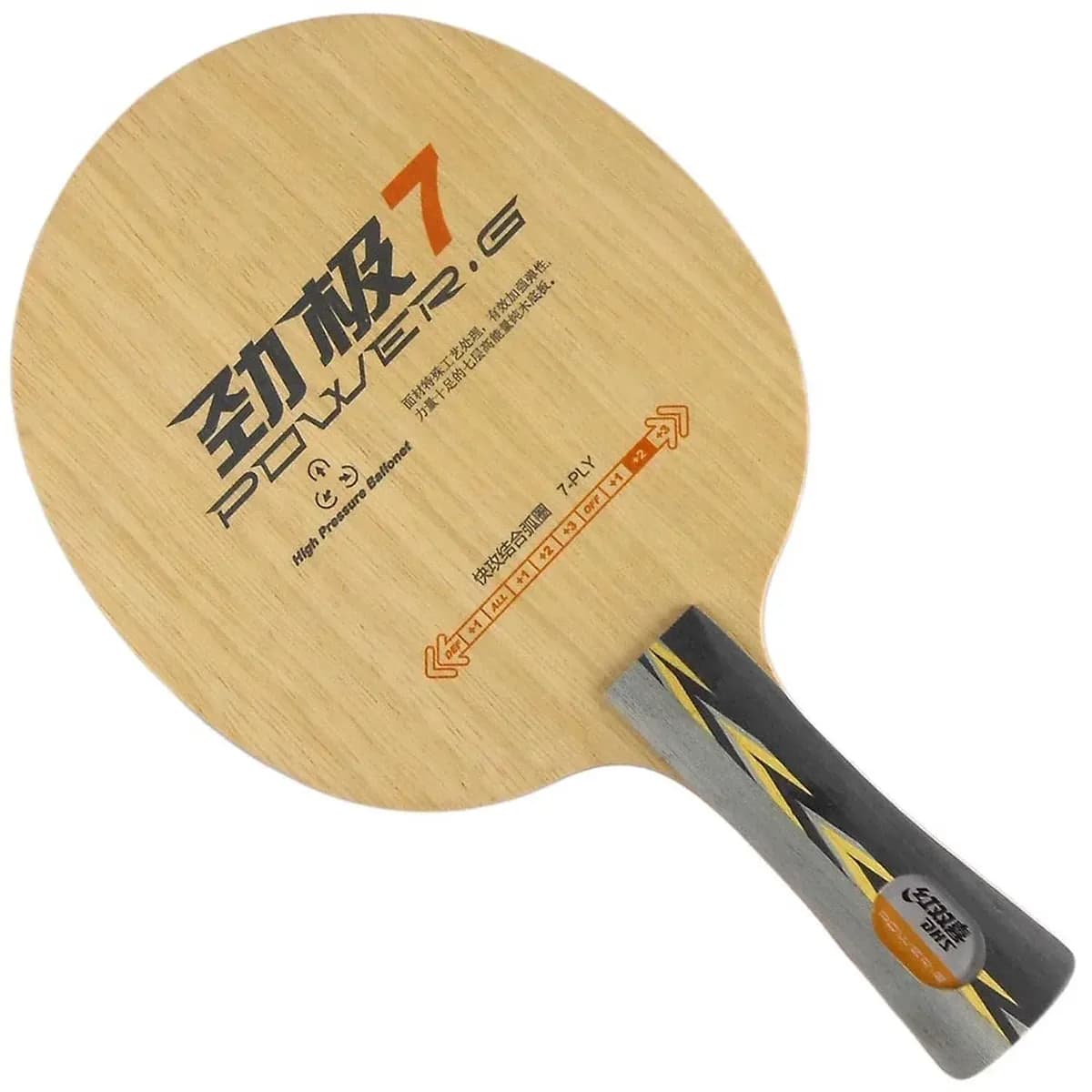
Gallery.
2 imagesFew blades have found a niche as clearly defined as the DHS Power G7. In a catalogue where the Chinese manufacturer is known above all for its rubbers — the ubiquitous Hurricanes — and for high-end blades tied to elite players, the Power G7 occupies a different place: that of the player who wants to step up from a five-ply blade to a seven-ply one, somewhat faster and more structured, without spending top-of-the-range money or giving up the control they already had.
It is a blade that comes up again and again in conversations about a "first serious blade" and in value-for-money lists. This review looks at what it actually puts on the table, which type of player it makes sense for, how it behaves against alternatives of similar construction and where its limits lie. The aim is not to repeat the manufacturer's sales pitch, but to help the reader decide whether this blade fits their game.
What DHS is offering with the Power G7
The Power G7 is a blade made of seven plies of pure wood, with no carbon or arylate fibre. That starting point already defines its character: against composite blades — stiffer, faster, with a wider and more forgiving sweet spot — a seven-ply all-wood blade offers a more progressive launch, more feel on contact and, as a rule, better control in the short game, in exchange for slightly less raw speed and stability on off-centre strokes.
The construction combines two woods that are very common in offensive blades: limba in the outer plies and ayous in the five inner layers, core included. Limba is a relatively soft wood with good grip, which favours contact time (dwell time, the time the ball stays "hooked" on the surface before it is launched) and makes it easier to load spin. Ayous, being light, keeps the weight in check and adds an elastic response. On top of that, DHS applies an outer surface treatment — a treated medium-hard veneer — intended to add a little power and speed without turning the whole thing into a hard board.
The intended result is recognisable: an affordable attacking blade that feels like wood, geared towards topspin and the game close to the table. One point of classification is worth making: DHS labels it OFF+ in parts of its commercial documentation, but the behaviour described consistently by reference laboratories and by accumulated user experience places it rather in the OFF- / OFF range. It should be taken as an offensive blade of moderate speed, not as an explosive board.
Behaviour in play
Honesty about the starting point matters here: what follows rests on the manufacturer's specifications, on the tests published by specialist laboratories and on the consistent assessment of a very large number of players and reviewers, not on weeks of personal use with this particular blade. That said, in the case of the Power G7 the volume of opinion is so high and so consistent that it allows a reliable portrait of its behaviour to be drawn.
On speed, the Power G7 is clearly an offensive blade, but a moderate one within its category. It shares its seven-ply construction with faster blades, yet sits a step below them in pure speed: it is more flexible and less direct than, for example, the Tibhar Samsonov Force Pro, which follows a very similar layout. That contained speed is not a defect but its whole reason for being: it does not fire the ball off at the slightest touch, which makes it manageable for someone coming from a slower blade and still refining their stroke. When the player really accelerates, there is enough power to attack close to the table; what it does not offer is the penetration of a stiff blade at mid to long distance.
In feel and contact time lies one of its strongest arguments. Being an all-wood blade with an outer limba ply, it generates a long contact time and a clear sensation at impact. For the topspin player this translates into two concrete advantages: more capacity to load the ball with spin, and a more progressive, more predictable launch. Users agree in describing good dwell, particularly helpful when opening against backspin and on heavily rotated topspin. The flip side of that feel is a slightly more marked vibration on contact than with many fibre blades: not unpleasant, but present, and part of its woody character.
The trajectory is medium or slightly high, which helps clear the net with margin and makes spin easier to impart. It is a blade that rewards the player who works with arc and looks for rotation over flat speed. On serve it performs soundly: it allows both short, heavily rotated serves and long, fast ones, thanks to that combination of feel and control.
In control and the short game, not being an explosive blade and offering good feel, the Power G7 is comfortable to handle: drop shots, flicks, touches and low pushes are easier than with stiff, bouncy blades. That is precisely one of the reasons it is so often recommended as a first "serious" blade: it keeps much of the control of a five-ply blade while adding some speed and structure.
Its most debatable point is the sweet spot and stability. Having no fibre, the Power G7 has a more contained sweet spot than a blade with carbon or arylate: off-centre strokes lose more speed and feel less solid. For a player with a clean stroke this is no problem; for someone who does not yet strike the ball with consistent precision, it is a factor to bear in mind. Some users also note a certain tendency to send balls very deep when playing away from the table, which fits its character as a blade designed for the close game.
Pros
- Exceptional value for money: serious offensive blade performance well below high-end prices
- An ideal transition from five plies, with no loss of the control already in hand
- Good contact time and woody feel: makes it easier to load spin
- Excellent in the short and control game: drop shots, pushes and touches
- Very sound on serve, whether short and rotated or long and fast
Cons
- Contained sweet spot: with no fibre, it forgives off-centre strokes less
- Limited speed at mid to long distance; designed for the game close to the table
- Somewhat marked vibration, consistent with its all-wood construction
- Needs sealing before gluing the rubbers on, so that fibres are not torn out when removing them
- Bulky handle: it feels large for small hands
Which player it is for
The Power G7 fits particularly well with the spin attacker who plays close to or at mid-distance from the table and is looking for a blade with good value for money. It is a good choice for the advanced allround player who wants to step up to a seven-ply blade, somewhat faster, without losing the control already available; for the topspin attacker who appreciates a long contact time and puts rotation ahead of flat speed; and for whoever is putting together their first "serious" offensive bat on a tight budget and does not want to overspend on the blade.
On the other hand, a game defined by power from distance, smashes at maximum speed and an immediate launch off the blade, or a search for the wide, forgiving sweet spot of a carbon blade, will be better served by a fibre blade or by a stiffer, more direct all-wood one.
Compared with the direct alternatives
Against the Tibhar Samsonov Force Pro. This is the most frequently cited comparison, because both share the seven-ply limba-ayous construction. The Samsonov Force Pro is somewhat faster, stiffer and more direct; the Power G7 is more flexible, with more contact time and more vibration, and therefore more oriented towards control and spin. In practice: the Tibhar for whoever wants a little more speed and penetration, the DHS for whoever puts feel, control and, above all, price first.
Against a classic five-ply blade (a Stiga Allround or similar), the Power G7 is the next step: more speed, more structure and a slightly more offensive launch, in exchange for a rather less generous sweet spot on soft contact. That is exactly the journey it was designed for.
Against a mid-range carbon blade, the difference is one of philosophy. A fibre blade will offer more speed, more stiffness and a wider, more forgiving sweet spot; the Power G7 answers with more woody feel, better control in the short game and a far lower price. It is not that one is better: they answer to different priorities.
How to set it up
Given its character — offensive but controllable, geared towards spin and the close game — the Power G7 takes well to an affordable set-up in keeping with its philosophy. It is worth remembering that the blade requires sealing before the rubbers go on, a step that is not optional on this particular blade if the surface is to survive having them removed.
One set-up that works
- DHS Skyline 3 on the forehand — a tacky Chinese rubber that adds stiffness and spin on the opening, squeezing the most out of the blade's rotational character.Forehand
- Yasaka Rakza 7 on the backhand — a versatile European tensor that adds speed and easy blocking without demanding a faster blade.Backhand
- A set-up geared towards attack on a contained budget, in line with what the blade itself offers: serious performance without a high-end price.Budget
Frequently asked questions
Does the DHS Power G7 contain carbon?
No. It is a seven-ply blade made entirely of wood (limba on the outside, ayous inside), with no carbon or arylate fibre. That is the source of its woody feel and its good control in the short game.
Is it a good first blade for moving from five plies to seven?
Yes, that is one of its most recommendable uses. It adds speed and structure over a five-ply blade while keeping much of the control, and its price makes it especially attractive for that step.
Why does it need sealing?
The outer surface needs lacquering or sealing so that wood fibres are not torn out when the rubbers are removed. It is advisable care on this particular blade, and it should be done before the rubbers go on for the first time.
Is it any use for playing away from the table?
That is not its ideal ground. It is designed above all for the close and mid-distance game; away from the table it falls a little short on speed and penetration, and some players notice a certain tendency to send balls too deep.
Which rubbers does it combine well with?
It takes well to both tacky Chinese rubbers (a DHS Skyline 3 or Hurricane) on the forehand, to squeeze out the spin, and versatile European tensors (a Yasaka Rakza 7) on the backhand. Not being an extremely fast blade, it does not demand very hard rubbers to perform.
Rating by dimension
The seven-ply blade that made the step up to attack affordable.
The DHS Power G7 is a coherent attacking blade, very well resolved for what it costs. It does not try to compete with top-of-the-range blades on speed or sweet spot, and that renunciation is precisely what makes it valuable: it offers a progressive launch, a good contact time and notable control at a price few can match. Its limits are clear and easy to accept for a player who knows their own game: a contained sweet spot, speed geared towards the close game, and the need to seal it before assembling a bat. With those cards on the table, it is one of the most recommendable options for stepping up from a five-ply blade to a seven-ply offensive base without overspending or losing the control already in hand.