
DHS
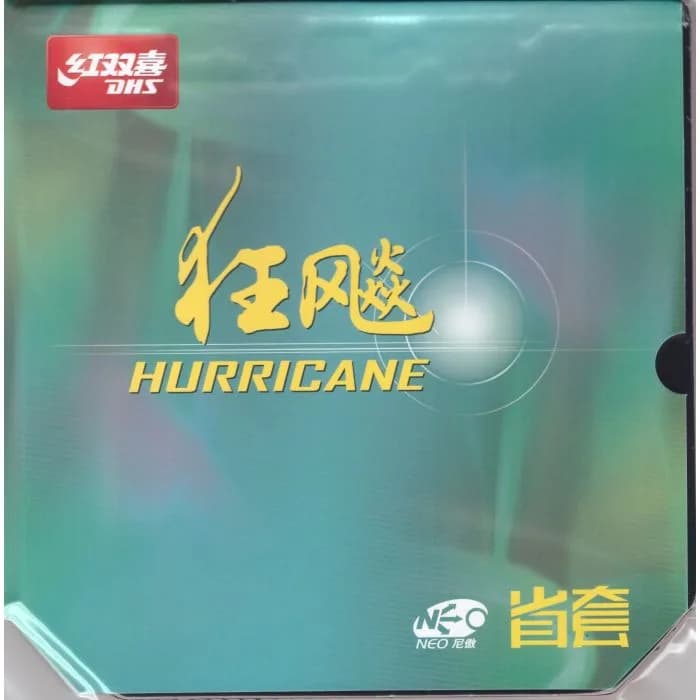
Hurricane 3 Neo.
For two decades the forehand weapon of the Chinese elite: enormous spin, a low penetrating arc, and a level of demand that never forgives average technique.
Gallery.
1 imagesFew rubbers carry as much historical and symbolic weight as the DHS Hurricane 3. For two decades it has been the forehand weapon of much of the Chinese elite — from Ma Long to a long list of Olympic and world champions — and it has become the emblem of one way of understanding table tennis: brutal spin, a short arc, and a full, committed stroke. The Neo version is the evolution that put that philosophy within reach of the club player without resorting to artificial treatments. This review looks at what it actually offers on the table, why it divides those who try it so sharply, and which kind of player it makes sense for — which is not just anyone.
What it is and what it sets out to be
The Hurricane 3 Neo makes no sense without first explaining which family it belongs to, because it is the exact opposite of a modern European tensor. It is a tacky Chinese rubber: an inverted rubber whose topsheet is genuinely sticky to the touch. Rest a ball on it, turn the bat over, and the ball stays stuck for a moment. That tack is not decoration but the physical principle on which its whole behaviour is built.
Where a European tensor generates spin mainly through friction and elastic deformation at impact, a tacky rubber adds the sticky grip of the topsheet, which "traps" the ball for a fraction of a second longer and makes an exceptional amount of rotation possible. In exchange, rubbers of this type tend to offer less speed of their own and a far more modest catapult: the energy does not come from the rubber, it has to come from the player's arm. Hence the maxim that follows the whole Chinese school around: these rubbers do not play by themselves, they demand technique and physical condition.
The Neo suffix is the key to why this particular version deserves a review of its own. The classic Hurricane 3 was sold with a "dry" sponge that many players treated with oils or boosters to expand it, tension it and wake up its performance — a practice that was widespread in the Chinese world for years. Neo technology uses a sponge that already comes pre-tensioned from the factory, with part of that effect built in from the start and a much longer useful life for that charge. In practice the Neo offers a slightly livelier speed and a touch more dynamism out of the packet than the traditional Hurricane 3, with no treatments needed, which made it the natural entry point to the Chinese experience for the club player.
There is one last factor that has to be understood before buying, because it causes enormous confusion: the Hurricane 3 Neo exists in several grades. The commercial version — identifiable by its bluish sponge — is the one sold in volume and the most affordable. Above it sit the provincial and national versions, in theory selected under stricter quality control, with specific sponges and higher performance, at a markedly higher price. These are not identical products with a different stamp: consistency between units and actual performance really do vary between grades, and a good part of the contradictory opinions circulating about this rubber come from comparing different versions as if they were the same one.
Specifications that matter to the player
Only a handful of figures on the spec sheet are of interest, but they are decisive and need careful reading.
Tack. This is the defining trait. The topsheet of the Hurricane 3 Neo is markedly sticky, among the tackiest on the widely distributed market. That quality is responsible for its enormous spin, but also for its demands: the ball "stays" on the rubber and has to be torn away with a fast, complete stroke for it to leave with any speed. On passive strokes that same tack slows the ball down and adds a margin of safety against the opponent's incoming spin.
Sponge hardness. The sponge is hard, in the order of 39° to 41° on the DHS scale. This is worth pausing on: those numbers are not equivalent to the ones on a European rubber. A Chinese 40° is noticeably harder to the touch than a 40° ESN, so anyone coming from a "medium-hard" European tensor should expect a clearly greater firmness. The commonest variants are 39°, somewhat more forgiving, and 40°/41°, firmer and more demanding. It is this hardness that forces a full stroke to sink the ball into the sponge and activate its response.
Sponge thickness. It is offered mainly in 2.15 mm and 2.20 mm (Max). Unlike European tensors, the range of thicknesses here is narrow, and the maximum is the logical choice for the offensive game the rubber is built for. Thinner sponge versions exist for specific profiles, but they are a minority.
Weight. This is a heavy rubber. The combination of a dense tacky topsheet and a hard sponge produces one of the heaviest rubbers on the market once it has been cut to the shape of the bat. That detail is not trivial: mounted on the forehand over a blade that is already heavy in itself, it can result in a bat that is physically demanding, something to weigh up before committing.
Behaviour in play
This is where the Hurricane 3 Neo reveals why it is both revered and feared.
The trait that defines it best is its spin, quite simply outstanding. On a topspin with real length of stroke, the combination of tacky topsheet and hard sponge generates an amount of rotation that very few rubbers reach. The ball leaves with a low, short, very flat arc and drops sharply onto the far side of the table under its own spin load, producing that bounce that "jumps forward and down" so characteristic of Chinese topspin and so awkward for the opponent to block. This is not a rubber of high, safe trajectories: it is direct, penetrating and dangerous.
That performance comes with one non-negotiable condition, though: the full stroke. The Hurricane 3 Neo is heavily dependent on technique and arm acceleration. When the player executes a complete topspin, with a fine contact and genuine acceleration, the response is magnificent: brutal spin, placement and an extraordinarily heavy ball. But when the stroke is reduced to a shove, a passive block or a short swing with no intent, the rubber gives very little: the ball stays on the face and comes off slow and lifeless. It forgives neither laziness nor average technique.
On speed the usual perception needs qualifying. The Hurricane 3 Neo is not a fast rubber in the European catapult sense: its speed on soft strokes is contained, even slow. Its speed is explosive but conditional: it appears on the full stroke, when the player compresses the hard sponge all the way down. It is a speed that has to be earned, very different from the easy, constant launch of a tensor. That is why the cliché that "it is slow" is misleading: it is not slow on the complete stroke; it is slow on everything else.
Where the rubber shines in its own right is in opening against backspin and in the first-ball topspin over a low push. Its tack makes it notably easy to lift heavily chopped balls, "gripping" the ball from underneath and loading it with rotation over the net. That forehand opening, safe and heavily loaded with spin, is one of the hallmarks of the Chinese school and one of the great reasons why the Hurricane 3 is still mounted on so many elite forehands.
In passive and control play the tack also brings advantages: the block is very safe because the rubber absorbs the opponent's spin well, and the short game over the table — pushes, touches — is fine and controllable, with the ball well held. The trade-off is that holding the opponent's spin passively demands an adjusted angle: a rubber this sensitive to spin punishes blocks played with a badly oriented bat.
The point where it shows its limits is twofold. First, continuous counter-attacking away from the table: at distance and with no time for full strokes, the lack of catapult of its own demands considerable physical effort to keep the power up, which is tiring and penalises anyone without solid technique and conditioning. Second, the backhand: although some players use it on both sides, the Hurricane 3 Neo is not the natural choice for the modern fast-topspin backhand, where its hardness and its lack of easy speed make it uncomfortable for most. Its territory is the forehand.
One aspect worth mentioning without drama is the variability between units of the commercial version. As a mass-produced product, it is not unusual to find differences in hardness or tack between two rubbers of the same model. It is not a flaw that invalidates the product — its performance-to-price ratio remains remarkable — but it explains why the provincial and national versions, with better quality control, exist and are in demand.
Pros
- Outstanding spin, among the highest on the market, thanks to the tacky topsheet and the hard sponge
- Exceptional opening topspin against backspin, with great safety and a heavy spin load
- Low, flat arc that produces an awkward, penetrating bounce for the opponent
- Very safe block and short game, with good absorption of the opponent’s spin
- Unbeatable performance-to-price ratio in its commercial version
- Neo technology delivers lively performance out of the packet with no treatments needed
Cons
- Heavily dependent on technique and physical condition: it gives little without a full, accelerated stroke
- Little speed of its own and scarce catapult; the energy comes from the player
- High weight, which can make the bat as a whole demanding
- Demanding away from the table, where it tires anyone without good conditioning
- Poorly suited to the modern fast-topspin backhand
- Variability between units in the commercial version
- Long adaptation curve for anyone coming from European or Japanese rubbers
Which player is it for?
The DHS Hurricane 3 Neo has a clear and demanding target: the offensive forehand player, at intermediate-to-advanced level or above, with solid topspin technique and good physical condition, looking for maximum spin and active control play close to the table in the Asian style. It is the natural choice for anyone wanting to develop a forehand heavily loaded with rotation, with a safe opening topspin and full, committed strokes.
It is especially coherent for the player who has already settled on the Chinese school of play — heavy bat, big swing, priority on spin and on the first forehand ball — and who has the physical condition to sustain it over a match. Mounted on the forehand over a fast blade with some stiffness, it makes up a combination whose power and spin load are hard to match on the full stroke.
Conversely, it is not a rubber for beginners, nor for the player still building their technique: its demand for a complete stroke and its lack of help mean it punishes half-hit strokes rather than forgiving them. Nor is it the sensible option for anyone after an "easy" rubber with fast, constant speed, or for the European-style player whose game is built on catapult and counter-attacking from distance. And barring exceptions, it is not the rubber for the backhand.
Compared with the alternatives
The most natural comparison is with high-end European and Japanese tensors such as the Butterfly Tenergy 05 or the Dignics 09C. The difference is one of philosophy. Tensors offer speed and spin with far fewer physical demands: the rubber "helps", it has catapult and it forgives incomplete strokes, at the cost of a higher arc and a spin that, high as it is, comes from a different principle. The Hurricane 3 Neo asks more of the player but returns, on the full stroke, a spin and a sense of a "heavy ball" that pure tensors rarely match. It is telling that Butterfly itself developed the Dignics 09C precisely to bring the Chinese tacky feel closer to the comfort of a modern tensor: a hybrid that offers part of the tack with more speed and fewer demands, albeit at a far higher price.
Against other Chinese-European hybrid rubbers — the so-called tacky tensors, such as some of the Rasant and Rakza proposals or the European brands' own hybrid ranges — the Hurricane 3 Neo is the more "purist" and authentic option: more real tack, more demands and fewer concessions, but also more reward for the player who has the technique. The hybrids are a reasonable bridge for anyone who wants the Chinese character without giving up easy speed altogether.
Within the DHS ecosystem itself, the most important decision is the version. For most club players the commercial Neo offers value for money that is hard to beat and is the logical starting point. The jump to the provincial or national versions makes sense for the advanced player who already knows the rubber, extracts its full potential and values the greater consistency and the extra margin of performance, accepting a much larger outlay. Buying the national version outright without mastering the commercial one first is rarely a profitable decision.
How to set it up
- The Hurricane 3 Neo in 2.20 mm (Max) on the forehand, over a fast blade with some stiffness: maximum spin and the full Chinese-style stroke.Forehand
- The logical starting point is the commercial version (bluish sponge): unbeatable performance for the price, and the sensible step before jumping to Provincial or National.Version
- Only with topspin technique and physical condition in place: it forgives neither laziness nor a half-finished stroke, and it tires the player away from the table.Physique
Final assessment
The DHS Hurricane 3 Neo is not just another rubber: it is the purest and most accessible representative of an entire school of play. Its proposition is coherent and radical: it gives up easy speed and catapult in exchange for enormous spin, a low penetrating arc and an active control that only unlock with technique and physical condition. On the forehand of a player who knows how to hit, it is a top-level weapon; in underdeveloped hands it is a frustrating rubber that gives little and asks a great deal.
Its limits are the coherent flip side of its virtues: it demands a full stroke, it tires the player away from the table, it is heavy and it is not the choice for a modern backhand. But for the Asian-style forehand attacker, with the technique already built and the legs to sustain it, the Hurricane 3 Neo remains, decades after it was born and at an unbeatable price in its commercial version, one of the best doors into — and for many, a final destination in — the world of tacky Chinese rubbers.
Frequently asked questions
Is the Hurricane 3 Neo suitable for a beginner?
No. It is a rubber that depends heavily on technique and physical condition: it punishes incomplete strokes rather than forgiving them, it has little speed of its own and it demands a full stroke to perform. A beginner will progress far better with a softer, more tolerant tensor rubber.
What does "Neo" mean?
It refers to the factory pre-tensioned sponge this version uses. The classic Hurricane 3 was usually treated with oils or boosters to wake up its performance; Neo technology builds part of that effect in from the start and holds it for longer, giving a livelier speed with no treatments needed.
What is the difference between the commercial, provincial and national versions?
They are different grades of the same model. The commercial one (bluish sponge) is the widely distributed and most affordable version. The provincial and national ones are selected under stricter controls, offer greater consistency and slightly higher performance, at a markedly higher price. For most club players, the commercial version is the logical starting point.
Can it be used on the backhand?
It can, and some players use it on both sides, but that is not its natural ground. Its hardness and its lack of easy speed make it uncomfortable for the modern fast-topspin backhand. Its territory is the forehand.
Why do some units seem different from others?
The commercial version is a mass-produced product and shows a degree of variability in hardness and tack between units. It does not invalidate its excellent performance-to-price ratio, but it is one of the reasons the provincial and national versions, with better quality control, exist.
Does it need to be treated with booster?
Not necessarily. Neo technology already delivers lively performance out of the packet. The use of boosters is very widespread in the Chinese environment to squeeze even more out of the rubber, but it is worth remembering that these treatments may be restricted by competition regulations and alter the rubber in ways that are not always reversible.
Rating by dimension
A top-level weapon on the forehand of someone who knows how to hit.
The Hurricane 3 Neo is not just another rubber: it is the purest and most accessible representative of an entire school of play. It gives up easy speed and catapult in exchange for enormous spin, a low penetrating arc and an active control that only unlock with technique and physical condition. Its limits — it demands a full stroke, it tires the player away from the table, it is heavy and it is not the choice for a modern backhand — are the coherent flip side of its virtues. For the Asian-style forehand attacker with the technique already built, decades on and at an unbeatable price in its commercial version, it remains one of the best doors into the world of tacky Chinese rubbers.