
Butterfly
Dignics 80.
The all-rounder of the series: between the spin of the 05 and outright speed, a more linear launch, a stony block and the gentlest learning curve of the three Dignics.
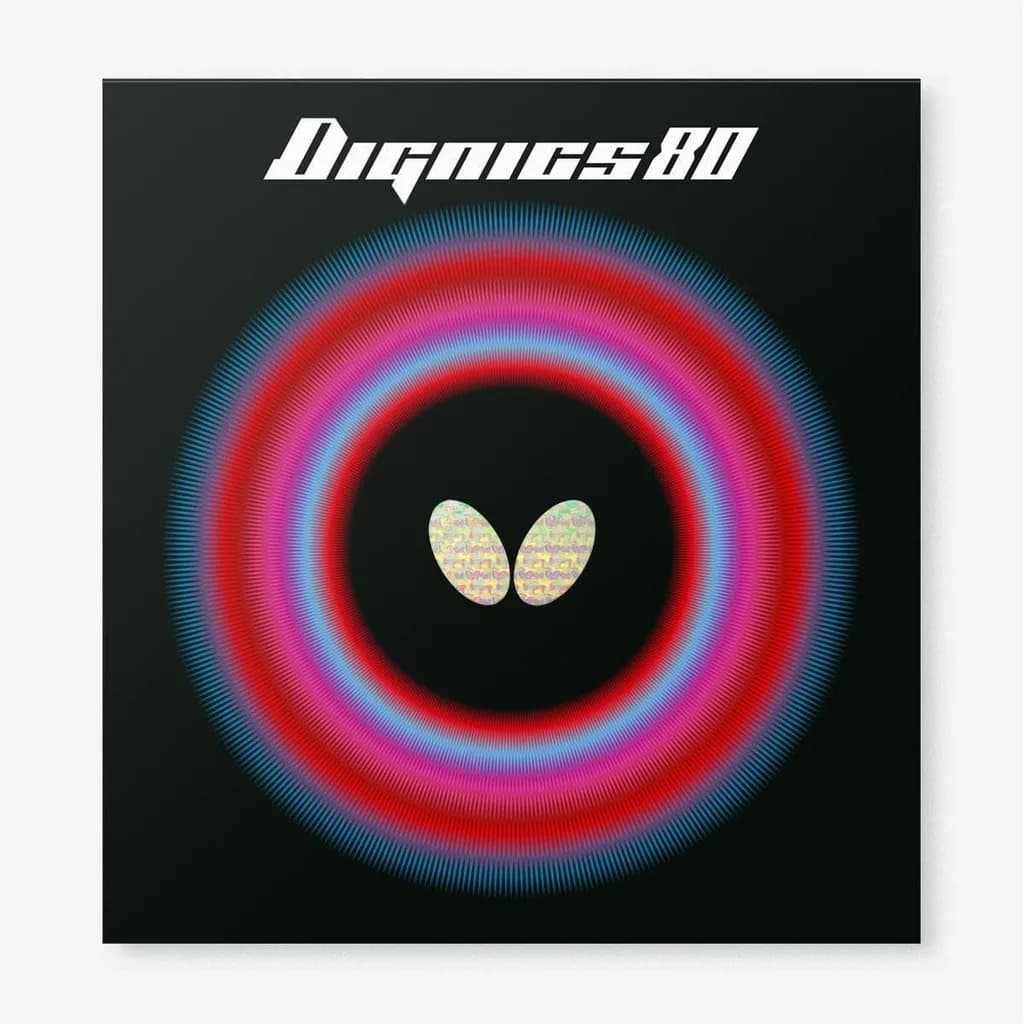
Gallery.
4 imagesIn practice, Butterfly's Dignics series is built around three clearly distinct characters. The Dignics 05 is the heir to the spin lineage of the Tenergy, with its taut arc and top-level spin. The 09C looks towards Chinese rubber, with a tacky topsheet and a dense ball. And in between, occupying ground of its own, sits the Dignics 80: the most direct, the most balanced and — it is worth saying from the outset — the easiest of the three, although "easy" is always a relative term where high-end rubbers are concerned.
The Dignics 80 inherits the pimple geometry of the Tenergy 80, the topsheet that sits midway between the 05 (wide, widely spaced pimples, aimed at spin) and the 64 (finer, denser pimples, aimed at speed). On that base Butterfly fitted the new Spring Sponge X, the same elastic, firm sponge that defines the whole series. The result aims at a compromise between speed and spin, with a more linear and predictable launch than its sisters. The question this review will try to answer is not whether the Dignics 80 is "better" than the 05, but what it actually proposes on the table, how it differs from its sisters in the series, and which player this particular rubber pays off for within a premium range that is expensive to begin with.
Where the 80 sits within the series
Understanding the Dignics 80 means placing it against its two sisters, because its identity is defined precisely by contrast.
The key lies in the topsheet geometry, which is what Butterfly inherits from the Tenergy catalogue. The Tenergy 05 — and by extension the Dignics 05 — carries wide, widely spaced pimples that favour tangential contact and, with it, wide-arc spin. The Tenergy 64, at the other extreme, carries finer, denser pimples that favour a faster, flatter launch. The 80 sits halfway between them: an intermediate topsheet that shares speed and spin out more evenly, without leaning decisively towards either.
On top of that topsheet, the Dignics 80 carries the Spring Sponge X, the more elastic and slightly harder sponge Butterfly developed to adapt the series to the 40+ mm plastic ball. It is the same one fitted to the 05 and — in a harder version — to the 09C. That combination is where the character of the 80 comes from: a rubber that draws a more direct and predictable trajectory than the 05, with a slightly lower arc and a more linear response, without the taut, deceptive parabola of its sister but also without the demand to commit fully to every stroke in order to "pull" the ball out of the sponge.
Put simply: the 05 is the spin specialist, the 09C the specialist in the dense Chinese-style ball, and the 80 is the all-rounder of the series, the one with the most balanced behaviour and a somewhat gentler learning curve.
How it behaves in play
Topspin and the spin game
On the topspin, the Dignics 80 gives a fast, direct response, with notable spin but less of the top-level bite of the 05. Where the 05 asks for a committed stroke to unfold its full dynamic range and rewards the complete gesture with enormous spin, the 80 delivers its performance more linearly: the ball comes off with purpose even on medium-intensity strokes, on a flatter and more penetrating trajectory. That makes it more predictable and, for many players, more comfortable in the mid-distance topspin exchange.
The important nuance is that this linearity cuts both ways. On one side: the 80 forgives a little more and does not demand as much to give good results. On the other: it never reaches the spin peak of the 05, nor that sense of "infinite gears" the sponge shows when it is really squeezed. The 80 is more consistent, but less spectacular at its ceiling.
Speed and the flat game
This is where the 80 shines naturally. Its intermediate geometry and direct launch make it especially solid in the fast, somewhat flatter game, in the tense exchanges close to and at mid-distance where the speed of the ball matters more than the spin load. It is a penetrating rubber that responds well when the aim is to impose rhythm rather than maximum spin. For the player who builds a game on pressure and speed rather than on wide-arc topspin, the 80 fits better than the 05.
Block and the close game
The block is a strong point, as it is across the whole Dignics series. The medium-high hardness of the Spring Sponge X brings stability against the opponent's spun ball: it absorbs incoming spin well and returns a firm ball, without the tendency to jump found in softer rubbers. The direct trajectory of the 80 also makes an active, quick block easier, which is very useful in containment play close to the table. It is a dependable rubber here, with predictable behaviour that inspires confidence.
Counter-topspin and play away from the table
On the counter-attack, the 80 holds its own thanks to the stability of its sponge and its direct launch, which makes it possible to answer the opponent's topspin with a fast, low ball. Away from the table it keeps its speed competently, although, like any rubber of this profile built around a direct launch, it loses some of the safety margin the high arc of a spinnier rubber provides. It is not its favourite ground, but it does the job.
Short game and touch
Like its sisters in the series, the Dignics 80 is a non-tacky tensor rubber with a medium-high hardness sponge and plenty of bounce, so it is not the most comfortable choice for fine short-game manipulation. With good technique, pushes and receives are controlled without trouble, but it does not forgive a lack of touch: an imprecise contact on the short ball tends to go long or high. That is the usual toll of high-end tensor rubbers, and the 80 does not escape it, though its predictable trajectory does help a little in taming the ball.
Pros
- Speed-spin balance: the most versatile of the series, without leaning too far towards either extreme
- Direct, predictable trajectory, with a gentler learning curve than the 05
- Very solid in the fast, flat game, where speed matters more than maximum spin load
- Stable, dependable block thanks to the hardness of the Spring Sponge X
- Excellent durability, typical of the Dignics series and far above that of the Tenergy
Cons
- Very high price, typical of Butterfly's premium range: it shapes the recommendation entirely
- Less top-level spin than the 05: whoever is after maximum spin will find more in its sister
- Less defined character: it does not stand out outstandingly in any single area
- Considerable weight, worth bearing in mind on bats that are already heavy
- Less friendly short game, as its bounce and hardness imply
Recommended set-ups
- On the backhand of an attacker, where its direct launch and easy block pay off most. It combines well with offensive fibre blades of the ALC type (Viscaria, Timo Boll ALC) for a fast, stable backhand.Backhand · fast attack
- On the forehand of a player after a penetrating game rather than a purely spinny one. On a balanced ALC blade it offers speed and rhythm with very readable control.Forehand · pressure
- As an entry into the Dignics range without the technical demands of the 05 or the 09C. On a control-attack blade (all+/off−) it softens the learning curve and becomes easier to exploit.Step up to the high end
Comparison with the alternatives
The obvious comparison is within the Dignics series itself. Against the 05, the 80 offers a more direct and predictable launch and a smoother learning curve, in exchange for less top-level spin and a slightly lower dynamic ceiling. Against the 09C, the gap is wider still: the 09C is a tacky rubber, specialised in dense Chinese-style spin and physically very demanding, whereas the 80 is a non-tacky tensor, fast and balanced. If the 05 is the spin option and the 09C the Chinese specialist, the 80 is the balanced and accessible one of the three, the natural choice for anyone who wants high-end performance without the specialised character of its sisters.
Against its direct predecessor, the Tenergy 80, the Dignics 80 improves on maximum power, on block stability and, very clearly, on durability, thanks to the Spring Sponge X and the High Tension topsheet. In exchange it is more expensive and slightly firmer, which makes it ask for a little more commitment in the stroke. For the player who already knew and valued the Tenergy 80, the Dignics 80 is a coherent and tangible evolution.
Against the high-end European tensors (from the ESN family, such as Tibhar's Evolution or Andro's Rasanter), the Dignics 80 stands out for its far greater durability and for the quality of its topsheet, even though several of those rivals offer close performance for considerably less money. Once again, it is a comparison in which price weighs heavily: the Dignics 80 wins on refinement and service life, but pays for that advantage on the label.
Who it is for
The Dignics 80 is aimed at the advanced or competitive offensive player who wants a balance between speed and spin and prefers a direct, predictable response to maximum specialisation. It suits the fast-attack, pressure style particularly well, the one built more on speed and rhythm than on wide-arc topspin. It fits naturally on the backhand of many attackers — where its direct launch and easy block are very valuable — and it works just as well on the forehand of a player after a penetrating game rather than a purely spinny one.
It is also the most recommendable option in the series for anyone who wants to step up to Butterfly's high end without the technical demands of the 05 or the 09C: it forgives a little more, it is understood sooner and it behaves more consistently. Within the limits of what a premium rubber can be, it is the most "democratic" of the Dignics.
What it is not is a rubber for the intermediate player in transition, however accessible it may be within its range: its price makes it a poor investment for someone still building the stroke, who will get better results — and spend far less — with a Rozena or a mid-range European tensor. Nor is it the choice for the pure spin player who lives off maximum-spin topspin, who will find a more natural partner in the 05.
Frequently asked questions
What is the difference between the Dignics 05, the 80 and the 09C?
The 05 is the spinniest, with a taut arc and top-level spin. The 09C is tacky, specialised in the dense Chinese-style ball and very demanding. The 80 is the balanced one: a direct, predictable launch, a good split between speed and spin, and a gentler learning curve.
Is the Dignics 80 easier to play than the 05?
Yes, within the limits of what a high-end rubber can be. Its linear response and direct trajectory make it more predictable and less demanding in stroke commitment. It is not a beginner's rubber, but it is the most accessible of the series.
Which side is it better on, forehand or backhand?
It fits very well on the backhand of an attacker, where its direct launch and easy block are especially valuable. On the forehand it works just as well for a player after a fast, penetrating game rather than maximum spin.
How does it relate to the Tenergy 80?
The Dignics 80 inherits the pimple geometry of the Tenergy 80, but carries the new Spring Sponge X and a High Tension topsheet. It improves on maximum power, block stability and, above all, durability, in exchange for a higher price and slightly greater firmness.
Which thickness is best, 1.9 or 2.1 mm?
The 2.1 mm is the usual choice for offensive play, since it makes the most of the sponge. The 1.9 mm brings a little more control and lightens the assembly slightly, an option worth considering on the backhand or on bats that are already heavy.
Is it worth the price?
Only for the advanced player who is going to make the most of it. Its durability, far above that of the Tenergy, puts the cost per hour of play in some perspective, but it remains a premium rubber beyond the reasonable reach of anyone who is not going to wring out its performance.
Rating by dimension
The piece that balances the series.
The Dignics 80 is not the most spectacular of the three — that role belongs to the 05 with its top-level spin, or to the 09C with its dense ball — but it is probably the most versatile and the easiest to make the most of. It offers a direct, predictable launch, penetrating speed, a stony block and the excellent durability that characterises the whole range, with a noticeably gentler learning curve than its sisters. Its limit is the flip side of its virtue: by not specialising, it never reaches the peaks the 05 or the 09C hit on their own ground, and it still carries the price penalty that puts it beyond the reasonable reach of anyone who is not going to wring it out. But for the player it is aimed at — the advanced attacker with a fast, balanced game, or whoever wants to enter the Dignics range through the most accessible door — it is a sound and coherent choice. It does not set out to dazzle; it sets out to work well in more situations than any other rubber in the series, and at that it succeeds completely.