Andro
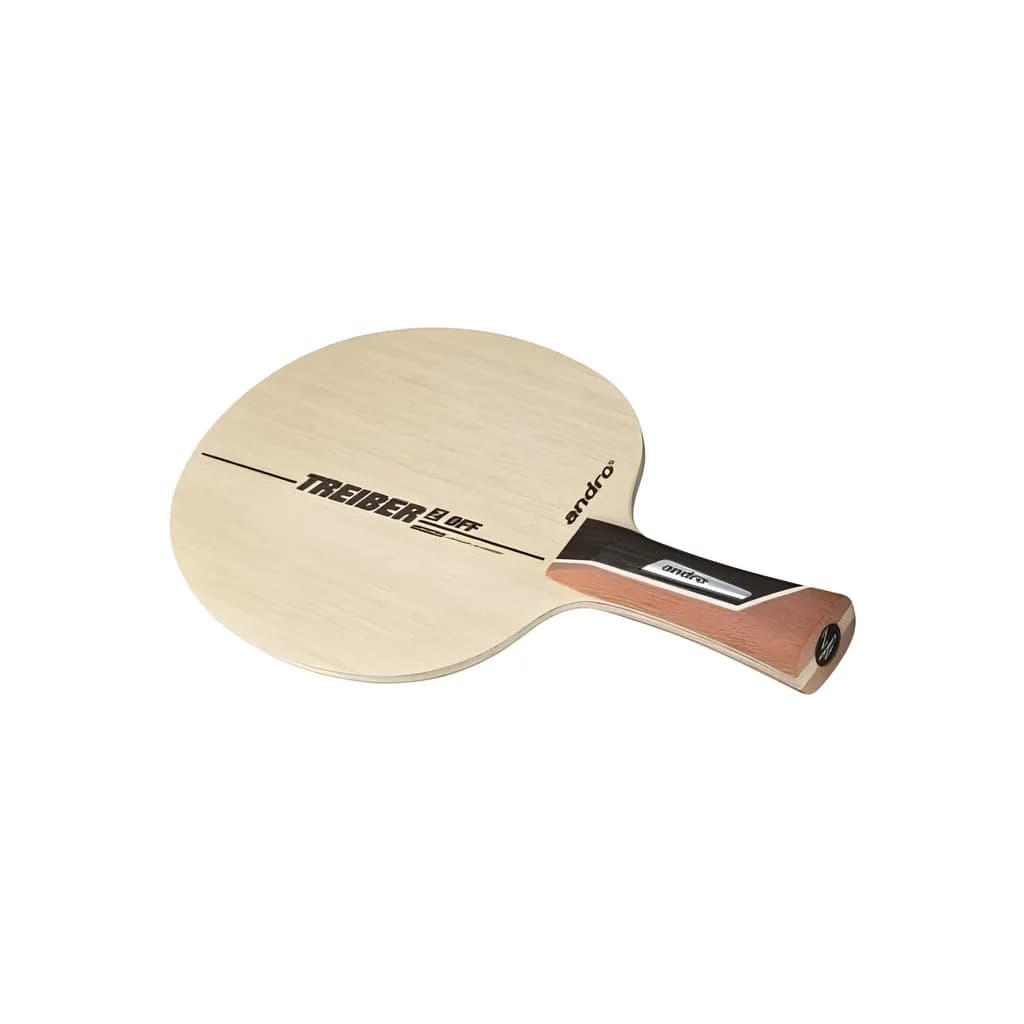
Treiber Z.
The most offensive composite blade in the Treiber series turns its generous thickness into control: OFF-level speed with a sweet spot that forgives.
Gallery.
0 imagesSome blades aim to stand out through an eye-catching speed figure, and others chase something far harder to sell on a spec sheet: the feeling that the ball always goes where it was sent. The Andro Treiber Z clearly belongs to the second group. It is the most offensive proposition in Andro's Treiber series, a seven-ply composite blade that has built a solid reputation among players on one specific and uncommon virtue: delivering OFF-level speed without giving up extraordinary control and predictability.
This review looks at what the Treiber Z actually offers on the table, where its distinctive character comes from, which kind of player it suits and where its limits lie. The aim is not to repeat Andro's sales pitch but to help decide whether this blade fits a given game.
What it is and where it fits
It is worth placing the product before going into detail, because the name "Treiber Z" often causes a confusion that deserves clearing up. The Treiber Z is a blade (the part of the bat the rubbers are glued to), not a rubber. The Treiber series is precisely Andro's family of offensive blades, and it should not be confused with the Rasanter series, which is the brand's range of tensor rubbers. Several blades live within the Treiber family — the Treiber H, the Treiber K, the fibre models Treiber FI and FO — and the Treiber Z occupies the most offensive and refined position, the one Andro conceived as the culmination of the series.
Its defining feature is the construction. The Treiber Z is a seven-ply composite blade: five wood plies reinforced with two layers of synthetic fibre that Andro calls "Z Fibre". The brand has not publicly detailed the exact nature of that material; some point to zylon, but in behaviour and feel it sits closer to an aramid-carbon (ALC) type fibre, or even to fibreglass, than to the stiffer, more explosive carbon fibres. This ambiguity is not a marketing whim: what matters to the player is not the label on the material but how it translates on the table, and there the Treiber Z has a very recognisable character.
The outer ply is kiso hinoki, a Japanese wood prized for its soft touch and its good energy return, used here as a thin layer. It is a choice consistent with the blade's philosophy: seeking feel and contact ahead of raw stiffness.
Thickness as a signature
One figure on the spec sheet is far from an anecdote and explains much of how the Treiber Z behaves: its thickness. At around 6.8 mm, it is one of the thickest seven-ply composite blades on the market. And that thickness, contrary to what might be assumed, does not serve extreme speed but control and stability.
A thick, well-built blade brings stiffness and consistency at impact. The bat "sinks" less and gives back a more uniform, predictable response, with a very wide sweet spot: the area of the blade where the ball comes off with good feel and a stable trajectory is larger than usual, which forgives slightly off-centre contacts. Add to that a very low vibration, another consequence of the construction, which transmits a clean, solid sensation on the stroke.
The result is a fast blade — it is clearly in OFF territory — that never feels twitchy or hard to govern. The speed is there when the player calls for it with a full stroke, but the blade does not impose it on every contact. That is the key to its reputation: an uncommon speed-control balance, in which offensive performance coexists with a docility that is rare in blades with this ceiling.
How it plays
This is where a blade really defines itself, beyond the manufacturer's numbers. The trait that best describes the Treiber Z is consistency. It is an offensive blade that does not try to dazzle through sheer speed but to offer a solid, predictable, well-communicated response across every kind of stroke. Close to the table it moves with particular ease: the block is firm and stable thanks to its stiffness and its wide sweet spot, and flicks and counters over the table come off with precision. That firmness means even the more passive strokes put the opponent under pressure, because the ball leaves with contained speed and trajectory.
On the topspin — forehand and backhand alike — the Treiber Z responds with a fast launch and a low, direct arc. That taut trajectory is one of its signatures: it produces penetrating, fast balls, at the cost of demanding good control of the contact point, since a low arc leaves slightly less margin over the net than a blade with a curvier trajectory. The thin hinoki layer and the fibre help to "bite" the ball on a contact with dwell, so the blade accompanies spin generation well without taking the leading role itself: the spin comes from the rubber, and the Treiber Z simply stays out of the way and provides a stable base.
At mid distance it keeps its composure. Counter-topspin and loop exchanges benefit from its predictability: the response is proportional to the stroke, with no surprises, which inspires real confidence in committing to the ball. Far from the table, however, is where it shows its clearest limit. The Treiber Z is fast, but it does not belong to the most explosive, catapult-heavy category of blades: away from the table and without a full, accelerated stroke, winners are hard to extract from it. Anyone whose game is built on maximum-power topspin from mid-to-long distance will notice it lacks that last degree of speed and "push" that the stiffer carbon blades offer. That is not a flaw but the logical consequence of its approach: the Treiber Z trades part of its maximum power for control, feel and consistency.
One aspect that deserves explicit praise is its behaviour in the short game and touch play. Many fast blades become awkward on the push and in play over the table, with a launch that is hard to meter. The Treiber Z, despite its offensive character, offers feel and control in the short game above much of its competition at similar speed, which makes it more complete and less one-dimensional.
Pros
- An outstanding speed-control balance, uncommon in a blade with an OFF ceiling
- A very wide sweet spot that forgives off-centre contacts and brings great reliability
- Very low vibration and a clean feel, with a solid, well-communicated response
- Excellent close to the table: firm block, precise flicks and counters
- Good behaviour in the short game, rare in a fast blade
- Versatility: it performs soundly at every distance and across every kind of stroke
Cons
- Less maximum power than the most explosive carbon blades, especially far from the table
- A low, direct arc, which leaves little margin unless the contact point is controlled
- Weight and thickness that make it feel robust; anyone after a very light, nimble bat should bear that in mind
- Not the choice for the pure hitter whose game is built on power from a distance
- The fibre composition is not detailed by the manufacturer, which makes it harder to compare on paper
Which player is it for?
The Andro Treiber Z has a broad but well-defined audience: the intermediate-advanced or advanced offensive player looking for a fast blade who, above all, values control, consistency and reliability. It is an especially sound choice for those who develop their game close to and at mid distance from the table, for the attacker who combines active blocking, counter-attack and topspin with dwell, and for anyone who wants a carbon (or fibre) blade without the twitchiness and harshness that sometimes come with that kind of construction.
It works well on both forehand and backhand, and its versatility makes it suitable for varied playing styles. It is a blade that accompanies rather than demands constant correction, and that docility makes it a very sensible option for the player wanting to step up to a high-end offensive base without losing the control already mastered. By contrast, it is not the right blade for the pure hitter whose game is built on maximum-power topspin from a distance: that profile will find more room in stiffer, more explosive carbon blades. Nor is it the best choice for anyone after a particularly light, nimble bat, since its thickness and weight give it a robust, solid feel rather than a lively one.
How to set it up by playing style
- An offensive tensor of medium-high hardness on the forehand — the blade transmits the spin and speed the rubber provides with real reliability; this is where the bite comes from.Attack
- A slightly more balanced tensor on the backhand — it makes the most of the wide sweet spot and the firmness in the block, this base's greatest virtue.Control
- Rubbers from Andro's own range (Rasanter) or any high-end tensor — they pair naturally with the direct, stable character of the Treiber Z.Rule of thumb
Compared with the alternatives
The most natural comparison is with the classic ALC-type carbon blades, with the Butterfly Viscaria as the universal benchmark of the segment. Against a high-end ALC blade, the Treiber Z tends to feel slightly less explosive and catapult-like far from the table, but more controllable and with better feel in the short game and at mid distance. The Viscaria and its derivatives seduce through their power and their slightly more generous arc; the Treiber Z answers with a more direct trajectory, a larger sweet spot and a predictability many players prefer. The choice comes down to whether the priority is the power ceiling or control and versatility.
Within the Treiber series itself, the Z is the most offensive and refined option. The Treiber FI and FO, also with fibre, offer different shades of hardness and speed, while the all-wood versions of the range sit a step below in offensive performance. The Z is the culmination of the series: the one that brings the highest speed ceiling together with the control that characterises the whole family. More broadly, the Treiber Z competes in the crowded field of high-end offensive composite blades, a segment where the differences are often a matter of nuance. Its argument for standing out in that pack is precisely its speed-control balance and its wide sweet spot: it is neither the fastest nor the most powerful, but it is among the most reliable and complete.
Frequently asked questions
Is the Treiber Z a blade or a rubber?
It is a blade. The Treiber series is Andro's family of offensive blades, and the Z is its most offensive version. It should not be confused with the Rasanter series, which is the brand's range of tensor rubbers.
What is the "Z Fibre" it uses?
It is the synthetic fibre that reinforces the blade's two composite layers. Andro has not publicly detailed its exact nature; in behaviour and feel it sits closer to an ALC-type or glass fibre than to the stiffer, more explosive carbon fibres.
Is it a blade for beginners?
Not quite. Although it stands out for its control, it is still a blade with an OFF ceiling that gives its best to a technique already under way. A developing player will progress better with a slower, more forgiving blade, even though the Treiber Z is more controllable than many in its category.
Why is it so thick, and how does that affect play?
At around 6.8 mm it is one of the thickest seven-ply composite blades on the market. That thickness brings stiffness, stability, a very wide sweet spot and very low vibration, which translates into more control and consistency rather than more raw speed.
How does it compare with a Butterfly Viscaria?
The Viscaria and the high-end ALC blades tend to be somewhat more explosive far from the table, while the Treiber Z offers more control, a larger sweet spot and better feel in the short game and at mid distance. The choice comes down to whether power or versatility and control take priority.
Which rubbers pair well with it?
Being a versatile, controllable blade, it takes high-end offensive tensors well. It pairs naturally with rubbers from the same brand, such as the Rasanter line, and generally with any medium-high hardness tensor that supplies the spin and speed the blade transmits so reliably.
Rating by dimension
Half an arsenal in the service of reliability.
The Andro Treiber Z is an offensive blade that does not need a spectacular speed figure to justify itself: it makes its case on the table, with a consistency and a control that place it among the most reliable options in its category. Its generous thickness, far from making it a twitchy bat, is the key to its stability, its wide sweet spot and its clean, solid feel. It is a fast blade that lets itself be governed, and that is a harder virtue to achieve than it looks. Its limits are the coherent flip side of its virtues: anyone after maximum power from mid-to-long distance will find more emphatic blades, and anyone who wants a very light, nimble bat should bear its robust character in mind. But for the intermediate-advanced offensive player who values control, versatility and feel as much as speed, the Treiber Z is hard to improve on within its segment, and one of the best ways into the world of high-end composite blades.